How to study for the SAT in one month: a 30-day plan


Table of contents
- Your 30-day SAT study plan, day by day
- Which skills give the fastest points
- Reading and Writing
- Math
- How to review your mistakes
- What’s realistic to gain in a month
- How to use Achievable’s SAT course alongside Bluebook
- Frequently asked questions
- How do I study for the SAT in one month?
- Can I improve my SAT score in a month?
- How many hours a day should I study for the SAT with a month left?
- What should I do the day before the SAT?
- Key takeaways
To study for the SAT in one month, triage. Take a timed diagnostic on day 1, spend 60 to 90 minutes a day on the highest-weight skills you’re missing, and take a full timed practice test every week on a day off, finishing with light review and a good night’s sleep in the last days. Achievable’s free SAT practice exam is a quick first diagnostic, and Achievable SAT gives you the lessons, 610+ practice questions and three full-length practice SATs to run the rest of the month, for $99 for 12 months of access, paid once rather than as a subscription.
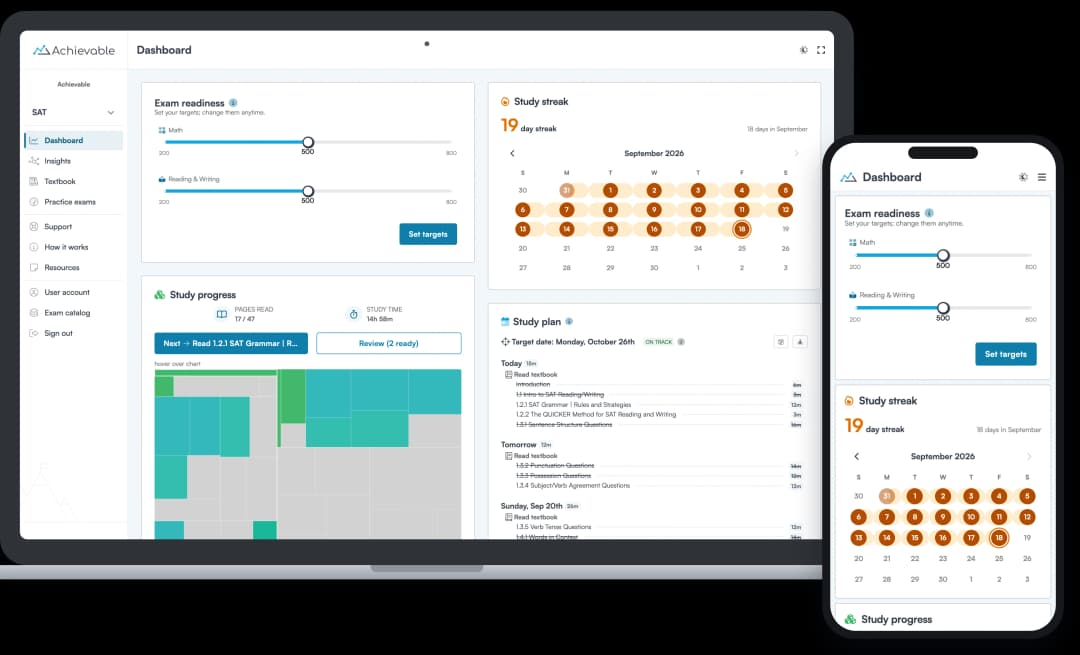
The plan below adds up to about 40 hours over 30 days, with your test on day 30. It is built from the chapters of Achievable’s SAT course and puts the rules-based skills that pay off fastest first. After the day-by-day table come the skills that give the quickest points, how to review mistakes, what a month can realistically add, and how to fit Achievable’s course together with College Board’s official Bluebook tests.
With more time, follow our 3-month SAT study plan: 12 weeks at five study days a week, with the fundamentals first, then timed sets, then full practice tests two weeks apart.
Studying mostly on your phone around a full-time job? How to study for the SAT on your phone lays out a 12-week plan of 20- to 30-minute weekday sessions.
Your 30-day SAT study plan, day by day
Days 7, 14, 21 and 26 are full practice tests: about two and a half hours with the break, plus a first look at your misses. Put them on days off, and shift the rest of the table around them. Each other day is one focused session; when a day’s lessons run short, spend the rest of the time on its practice questions and your error log (see “How to review your mistakes” below).
Day | What to do | Time |
|---|---|---|
1 | Diagnostic: take Achievable’s free SAT practice exam under its timer, then list every miss by section and skill | 1.5 hours |
2 | Set up: the course introduction, the Reading and Writing strategies (grammar rules, the QUICKER method) and the Math tools (the UnCLES method, the formula sheet). Enter your test date in the study planner | 1 hour |
3 | Standard English Conventions: sentence structure and punctuation (the “boundaries” questions) | 60–90 min |
4 | Algebra: solving and manipulating equations, linear equations | 60–90 min |
5 | Standard English Conventions: possession, subject-verb agreement, verb tense | 60–90 min |
6 | Algebra: linear inequalities, systems of equations and inequalities; graph a system in Desmos | 60–90 min |
7 | Practice SAT 1, timed, all four modules; start your error log | 3 hours |
8 | Review every miss and every guess from Practice SAT 1 | 60–90 min |
9 | Expression of Ideas: transitions, rhetorical synthesis | 60–90 min |
10 | Algebra: exponents, rates and proportions; a timed Math module of Endless Math practice | 60–90 min |
11 | Advanced Math: evaluating functions, quadratics and other polynomials | 60–90 min |
12 | Craft and Structure: words in context, function and purpose, passage structure, cross-text connections | 60–90 min |
13 | Advanced Math: exponential functions, modeling, translating functions | 60–90 min |
14 | Practice SAT 2, timed; update the error log | 3 hours |
15 | Review Practice SAT 2, then redo last week’s error-log questions without looking | 60–90 min |
16 | Information and Ideas: main idea, inferences, strengthen and weaken | 60–90 min |
17 | Problem Solving and Data: percents, mean, median and standard deviation, table data and probability | 60–90 min |
18 | Information and Ideas: details, illustrating a claim, using data from tables and graphs | 60–90 min |
19 | Problem Solving and Data: scatterplots and other graphs, statistical methods and inferences | 60–90 min |
20 | Geometry: angles, triangles, right triangle trigonometry | 60–90 min |
21 | Practice SAT 3, timed; update the error log | 3 hours |
22 | Review Practice SAT 3; Geometry: circles, quadrilaterals and polygons, 3D figures | 60–90 min |
23 | Your weakest Reading and Writing domain from the three practice SATs: reread its lessons, redo its practice questions | 60–90 min |
24 | Your weakest Math domain: reread its lessons, then a timed Endless Math practice module | 60–90 min |
25 | Redo every open error-log question; download and update Bluebook on the device you’ll test with | 60 min |
26 | Dress rehearsal: an official full-length practice test in Bluebook, at the time of day you’ll test | 3 hours |
27 | Review the Bluebook test in My Practice; one last pass on the patterns it shows | 60–90 min |
28 | Light review: grammar rules, the formula sheet, the error log. No new material | 45 min |
29 | Rest. Check what College Board asks you to bring, charge your device, and sleep early | 15 min |
30 | Test day: a normal breakfast, arrive early, and keep a steady pace through each module | The test |
That is about 24 hours across the 19 study sessions, 12 hours across the four practice tests and their first review, and about 6 hours in the setup days and the lighter days at the end. If you have more time on a day, add a timed module (Endless Math practice or a section you’re weak in) rather than new lessons: the last two weeks are for practice under the clock.
Which skills give the fastest points
The digital SAT has two sections, each split into two modules: Reading and Writing (54 questions in 64 minutes) and Math (44 questions in 70 minutes), 2 hours and 14 minutes in all with a 10-minute break between them, according to College Board’s test structure page. The second module of each section adapts to how you did on the first (our SAT exam guide covers the rest of the format). Spend your month where the questions are, and where a few hours change the most answers.
Reading and Writing
College Board’s Reading and Writing specifications give each domain’s share of the questions:
- Standard English Conventions (about 26%): boundaries (where a sentence ends, and when to use a period, semicolon, colon, comma or dash) and form, structure and sense (subject-verb agreement, verb tense, possessives). These are rules, not judgment calls, so a few days of study fixes most of them for good. That’s why they come first in the plan.
- Expression of Ideas (about 20%): transitions and rhetorical synthesis. For a transition, read the sentences before and after the blank and decide the relationship (contrast, cause, addition, example) before you look at the choices. For rhetorical synthesis, read the goal in the question first: the answer is the choice that meets that goal from the notes, not the one with the most detail.
- Craft and Structure (about 28%): words in context, text structure and purpose, and cross-text connections. Predict a word for the blank before reading the choices.
- Information and Ideas (about 26%): central ideas and details, command of evidence (from text and from tables and graphs), and inferences. Answers stay inside the passage; a choice that needs outside knowledge is wrong.
Our Reading and Writing strategies guide goes deeper on each question type.
Math
College Board’s Math specifications put about 35% of questions on Algebra, about 35% on Advanced Math, about 15% on Problem-Solving and Data Analysis and about 15% on Geometry and Trigonometry. That’s why the plan starts with algebra:
- Linear equations, functions, systems and inequalities are the core of Algebra, and they come back inside word problems across the section. Getting fast and accurate here is the quickest Math gain for most students.
- Use the Desmos calculator on purpose. Bluebook has a Desmos graphing and scientific calculator built in, and College Board’s calculator policy also allows your own approved handheld calculator. Graphing both sides of an equation and reading where they meet solves many systems, quadratics and “how many solutions” questions in seconds. Practice it in the weeks before the test, not on the day; our guide to the Desmos SAT calculator shows how.
- Advanced Math (quadratics, exponential functions, function notation and transformations) is the other big block; give it the same attention as Algebra.
- Some Math questions ask you to enter the answer rather than choose it, so practice writing answers without choices to lean on.
Our SAT Math tips and topic breakdown lists the topics within each domain.
How to review your mistakes
In a one-month plan, reviewing a practice test is worth as much as taking it. For every question you missed or guessed on:
- Rework it before reading the explanation. If you get it right the second time, the problem was time or care, not knowledge.
- Then read the explanation. Every answer in Achievable’s practice questions and practice SATs comes with one, and Bluebook shows correct answers and rationales in My Practice.
- Log it. Write the question’s section and skill, why you missed it (didn’t know the rule, misread, ran out of time, careless slip, lucky guess) and the fix in one line.
- Redo the log. Two or three days later, answer the logged questions again without looking (days 15, 25 and 28 in the plan). A question you miss twice goes back on the list.
- Look for patterns, not single misses. Five misses on punctuation or three on systems of equations is a lesson to reread. Misses clustered at the end of a module mean pacing: College Board’s timing works out to about 1 minute 11 seconds a question in Reading and Writing and about 1 minute 35 seconds in Math.
What’s realistic to gain in a month
It depends on where you start and how many of your misses come from fixable gaps. College Board’s own data on free Official SAT Practice (on Khan Academy) gives a sense of scale, though all of it comes from the paper SAT before the 2024 switch to digital:
- In 2017, College Board reported that 6 to 8 hours of practice was associated with an average 90-point gain from the PSAT/NMSQT to the SAT, and 20 hours with 115 points. College Board called that nearly double the average gain of students who didn’t use it, so part of it is the growth students make between the two tests anyway.
- Its 2020 SAT Suite results summary, which controls for PSAT/NMSQT scores and background, found six hours of practice associated with 21 additional points on the SAT.
So for most students, a focused month adds tens of points, not hundreds. The biggest jumps come when misses cluster in something learnable in days: the punctuation rules, a type of algebra problem, the Desmos calculator, or a pacing problem that a few timed tests fix. A 200-point jump usually takes more time than a month at an hour a day: our guide to how many hours it takes to raise your SAT score 200 points puts it at 80 to 150 hours.
Before test day, aim for 100% readiness: practice-test results comfortably above the score you’re aiming for, consistently, across several full-length tests, so your result doesn’t depend on the luck of the draw. If your last two practice tests are still below your target, a later test date may be worth more than another week of cramming. Use our SAT score calculator to see what your practice results add up to.
How to use Achievable’s SAT course alongside Bluebook
Use one resource to learn and practice, and the official app to rehearse:
- Achievable SAT is the backbone of the plan. Its lessons cover every Reading and Writing and Math domain in plain English, and it has 610+ practice questions with explanations and 3 full-length practice SATs, each with two Reading and Writing modules and two Math modules at the digital SAT’s question counts and time limits. Endless Math practice serves new versions of a Math module, with new numbers every time, so you can keep drilling after the three practice SATs. The study planner lays out a day-by-day plan to your test date, and the AI tutor answers questions as you go. It’s $99 for 12 months of access, paid once rather than as a subscription, and the first lessons are free, no credit card needed. It comes with a score improvement guarantee: +120 points for a starting score below 1000, +90 points for a starting score of at least 1000 and below 1200, and +60 points for a starting score of at least 1200 and below 1400, or your money back. The guarantee covers students with an official SAT score below 1400 from the last 5 years: you send that score report within 7 days of buying and take the SAT again while your year of access is active.
- Achievable’s free SAT practice exam is one module of each section, 27 Reading and Writing questions and 22 Math questions, under a single 67-minute timer. Every question is scored instantly with the correct answer and an explanation, which makes it a fast day-1 diagnostic.
- College Board’s Bluebook is the app you’ll test in, and its official full-length practice tests are adaptive and timed like the real test, with scores, correct answers and rationales afterwards. Take at least one there before test day. It doesn’t teach: after a test, it points you to tailored question sets, College Board’s Student Question Bank and Khan Academy for practice. Each official test gives a fresh read only the first time you take it, so save one for your final week.
- Khan Academy’s free Official SAT Prep has lessons and practice by skill: its SAT Math course alone runs to 14 units and 127 skills, ordered from foundations to advanced. It has no full-length timed practice SAT of its own (it sends you to Bluebook for those), and 127 Math skills is more than a month allows, so use it to drill one skill your error log keeps flagging.
Weighing a paid SAT app instead? Dolphin SAT alternatives: is Dolphin worth it? compares Achievable with Dolphin and the other SAT prep apps and courses.
Frequently asked questions
How do I study for the SAT in one month?
Take a timed diagnostic on day 1, such as Achievable’s free SAT practice exam, and list your misses by skill. Then study 60 to 90 minutes a day, starting with the highest-weight skills you miss (punctuation and grammar rules, linear equations and systems), and take a full timed practice test every week, reviewing every miss and guess in an error log. Do one final official test in Bluebook about four days out, and keep the last two days light.
Can I improve my SAT score in a month?
Yes, if you practice the right things. College Board’s 2020 data associated six hours of Official SAT Practice with 21 additional points, and this plan is several times that much practice. For most students the gain is tens of points; larger jumps come when your misses cluster in learnable rules, a few Math skills or pacing. A 200-point gain usually takes 80 to 150 hours.
How many hours a day should I study for the SAT with a month left?
About 60 to 90 minutes a day, plus about three hours once a week for a full practice test and its first review. That comes to about 40 hours over the month in this plan. More time helps most when it goes to timed practice and reviewing mistakes, not to rereading lessons.
What should I do the day before the SAT?
Nothing new. Skim your error log and the formula sheet for 15 minutes, check what College Board asks you to bring, update Bluebook and charge your device, and go to bed early.
Key takeaways
- In one month, triage: diagnose on day 1, then spend your time on the highest-weight skills you’re missing.
- Study 60 to 90 minutes a day and take a full timed practice test each week, about 40 hours in all.
- Start with the rules-based skills (Standard English Conventions) and Algebra, which pay off fastest.
- Review every miss and guess in an error log, and redo the log a few days later.
- A focused month usually adds tens of points; aim for practice results comfortably above your target, consistently, before test day.
- Use Achievable SAT to learn and practice, and take at least one official test in Bluebook as a dress rehearsal.