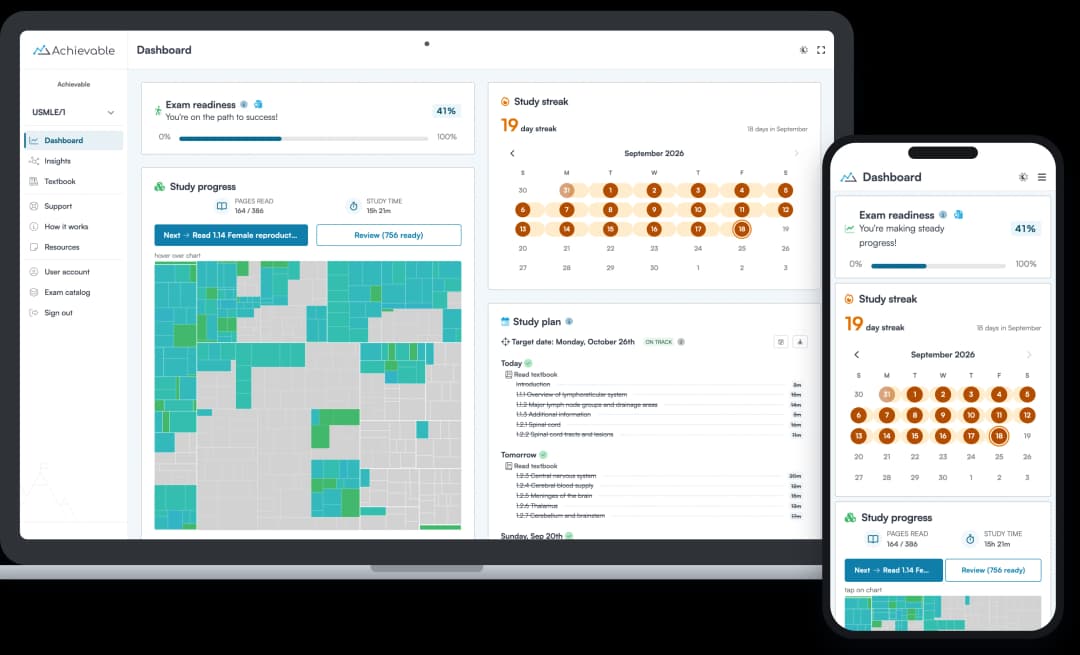
Ace USMLE Step 1 with our 12-Month study plan


Table of contents
- Months 1-3: Laying the foundation (3-6 hours/day)
- Months 4-6: Start active learning (4-6 hours/day)
- Months 7-9: Systematic mastery (6-8 hours/day)
- Months 10-11: Dedicated prep (full-time, ~8-10 hours/day)
- Month 12: Final review + rest before exam
- Sample weekly schedule (during dedicated period)
- Maybe you’re not looking for a full 12-month plan. That’s okay too!
- 1. Figure out your timeline
- 2. Stick to core, high-yield resources
- 3. Plan by system, not by subject
- 4. Review daily using Anki or other flashcard resources
- 5. Practice early and strategically
- 6. Track progress weekly
- Final tips for success
The USMLE Step 1 is one of the most important milestones in a medical student’s journey. Although this exam is scored pass/fail, developing a strong Step 1 study schedule remains crucial for sharpening clinical reasoning and laying a solid foundation for success in Step 2. Crafting an effective, comprehensive study plan that uses reputable USMLE questions in a structured way will help you master the vast volume of material and reduce the risk of burnout.
The good news is that, with the right intention, proven study strategies, and disciplined practice, you can confidently tackle this exam. Below is a comprehensive 12-month Step 1 study schedule designed to help you efficiently organize your preparation, master challenging topics, and minimize exhaustion throughout your USMLE journey.

Months 1-3: Laying the foundation (3-6 hours/day)
Goal: Develop a strong conceptual understanding of core systems
Focus areas:
- Watch foundational video content by organ system (start with cardio, renal, neuro)
- Skim through review books alongside videos to familiarize yourself with exam-style framing
- Begin spaced-repetition flashcards daily (1 hour/day)
- Start general pathology and integrate by organ system
Study tips:
- Track the systems you’ve covered with a simple checklist
- Start slow and steady: consistency beats intensity early on
- Focus on understanding, not memorizing
Months 4-6: Start active learning (4-6 hours/day)
Goal: Transition from passive review to active recall with a USMLE question bank
Focus areas:
- Start working through a USMLE question bank, organized by system or topic
- Reinforce your understanding using visual and interactive resources (such as animations and diagrams)
- Keep up with daily flashcard reviews to solidify knowledge gained from the question bank
- Annotate mistakes from the USMLE question bank and add them to your flashcards or a dedicated review document
Study tips:
- Begin with 20 practice questions per day from the USMLE question bank, then gradually increase your daily question count
- Use questions you missed in the question bank as prompts for new flashcards
- Schedule weekly reviews of challenging topics. Spaced repetition with question banks helps maximize retention.
Months 7-9: Systematic mastery (6-8 hours/day)
Goal: Strengthen recall, sharpen test-taking strategies
Focus areas:
- Increase question volume to ~40/day
- Take a full-length practice test to assess your baseline at month 8
- Use supplemental content (visuals, breakdowns) to review weak points
Study tips:
- Complete all organ-system blocks before moving to mixed review
- Flag weak areas and focus reviews around them
- Fine-tune your flashcard deck: remove cards you’ve mastered, add new ones from errors

Months 10-11: Dedicated prep (full-time, ~8-10 hours/day)
Goal: Simulate test conditions, sharpen exam strategy, and improve speed/accuracy
Focus areas:
- Practice in timed, mixed-question sets to build endurance
- Take 2-3 full-length practice tests to track progress
- Focus reviews around incorrect answers and weak systems
Study tips:
- Daily: 2 blocks of 40 questions + 3-4 hours of review
- Weekly: 1 full-length practice test
- Use a daily study schedule to stay on track
Month 12: Final review + rest before exam
Goal: Confidence and review, not panic or cramming.
Focus areas:
- Quick daily chapter reviews
- Light flashcard sessions
- Final practice test to confirm readiness
Study tips:
- Review weak areas in 1-2 days each
- Take 1-2 full days off to reset
- Light review leading up to test day
Sample weekly schedule (during dedicated period)
| Day | Morning (9-12) | Afternoon (1-4) | Evening (5-7) |
|---|---|---|---|
| Monday | practice questions + review | system review | flashcards + notes review |
| Tuesday | practice questions + review | visual learning session | light practice |
| Wednesday | full-length practice test | test review | light review or rest |
| Thursday | topic drills | practice questions + review | flashcards |
| Friday | practice questions + review | system review | flashcards |
| Saturday | practice test | review | break |
| Sunday | rest or catch-up | flashcards | plan the week ahead |
The intensity of the USMLE may require you to devote entire days and weeks to preparation alone, as long as your schedule permits. This Step 1 study schedule offers a balanced weekly approach for crunch time, ensuring comprehensive content coverage and consistent review. By following this weekly calendar, customizing it to your unique study pace, and making active review a daily habit, you’ll build a strong foundation for Step 1.

Maybe you’re not looking for a full 12-month plan. That’s okay too!
If you’re not ready to lock in a full 12-month USMLE Step 1 study plan, or if your long-term schedule remains uncertain, that’s perfectly fine. Whether you’re laying the groundwork for your exam strategy or preparing for a focused, intensive review period, you can still create a smart and effective Step 1 study schedule. Use this streamlined guide to develop a targeted program that incorporates numerous high-yield USMLE questions and is tailored to your time constraints.
1. Figure out your timeline
First, determine how much time you can realistically dedicate. Most students spend 6-12 weeks in full-time prep after classes.
Example Dedicated Period:
- 8 weeks
- 8-10 study hours/day
- 1 rest day/week
If you’re studying during school, go at a slower pace and be consistent over time.
2. Stick to core, high-yield resources
- Use video, flashcards, and question-based review in harmony.
3. Plan by system, not by subject
Sample Cardiovascular Week:
- Day 1: Watch content + take notes
- Days 3-4: Do practice questions + review
- Day 5: Flashcards + reinforce concepts
- Day 6: Practice block
- Day 7: Rest/light review
4. Review daily using Anki or other flashcard resources
- 1-2 hours/day of flashcards
- Focus on missed questions and weak concepts
- This builds retention and reduces the need to cram later
5. Practice early and strategically
- Start questions early and review answers in-depth
- Build stamina with full-length days as the test nears
6. Track progress weekly
Use a spreadsheet or app to track systems covered, percentage correct on practice questions, flashcard progress, and practice exam scores. You should adapt your plan weekly based on what’s working and what’s not.
If you’re not ready to commit to a 12-month schedule, start here. Build week by week, focus on understanding, and stay consistent. Trust the process, and you’ll get to where you need to be to pass the test.

Final tips for success
- Start early, practice daily, and avoid burnout. Think of this as a marathon rather than a sprint. Establish a realistic timetable early and stick to it.
- Track your USMLE Step 1 progress by maintaining a detailed Excel or Google Sheet, documenting completed topics, remaining objectives, and scores from practice tests.
- Prioritize physical and mental health while studying. “Physician, heal thyself.” Neglecting well-being can negatively impact your performance.
Preparing for the USMLE Step 1 exam can seem daunting given the sheer number of medical concepts to master. For international students seeking to practice medicine in the U.S., aligning your curriculum with the exam content can be even more challenging. However, the right planning can make it much more manageable. Whether you are on a full 12-month study schedule or adapting a flexible timeline, the keys to success are staying consistent and using active learning strategies.
As you practice, focus on developing a genuine understanding rather than relying on rote memorization. Implement spaced-repetition tools, such as Anki, and use practice tests and questions frequently. These steps help you strengthen recall, hone your test-taking abilities, and instill knowledge until it becomes second nature.
Above all, remember that your well-being is vital to your success in following your USMLE Step 1 study plan: consistent rest, regular movement, and community support go further than any single study resource. Stay focused on your goal, be patient with progress through each problem set, and continue to show up daily. You’re not just working toward acing Step 1; you’re laying a foundation for your future physician career, and the hard work here will truly pay off.