USMLE Step 1 for international medical graduates: what you need to prep


Table of contents
- Eligibility and registration
- Step 1 format at a glance
- The resources, by the job each one does
- Where Achievable fits
- A timeline: 3, 6 or 12 months
- 12 months: still in school, or working full-time
- 6 months: graduated, studying part-time
- 3 months: full-time, basic sciences still fresh
- Problems IMGs run into, and what to do about them
- Time since basic sciences
- Reading English vignettes at speed
- U.S. conventions
- Making the first attempt count
- More from IMGs who’ve done it
- Frequently asked questions
- Do I need ECFMG Certification before I take Step 1?
- Can I take Step 1 while I’m still in medical school?
- Can I take Step 1 in my home country?
- Is Step 1 still scored?
- Is Achievable enough on its own for Step 1?
- Which question bank should an IMG use?
- How do I know when I’m ready?
- Key takeaways
As an international medical graduate (IMG), you need three things for USMLE Step 1: confirmed eligibility, a registration with the right organization, and a prep plan built for an exam that reports only Pass or Fail. ECFMG confirms that your medical school and your enrollment or graduation qualify, and since January 12, 2026 you apply for the exam itself through the Federation of State Medical Boards (FSMB).
A typical prep stack has three parts: a review course to learn the material, such as Achievable USMLE Step 1 ($179 for a year, first lessons free), with First Aid and Pathoma as references; one clinical-vignette question bank, most often UWorld; and NBME’s self-assessments plus the free USMLE sample questions to check that you’re ready.
Below: eligibility and registration, the exam’s format, each resource by the job it does, 3-, 6- and 12-month timelines, the problems IMGs run into most, and answers to common questions. Every exam fact comes from usmle.org, ECFMG or NBME, and every price from the provider’s own site.
Eligibility and registration
Who can take Step 1 as an IMG: you must be officially enrolled in, or a graduate of, a medical school outside the U.S. that the World Directory of Medical Schools lists with an ECFMG Sponsor Note, both when you apply and on test day. A student must also have finished the basic medical sciences part of the curriculum by the start of the eligibility period. Graduates of Canadian medical schools count as IMGs if they graduated on or after July 1, 2025; earlier Canadian graduates don’t.
Where you apply: first open an ECFMG account, meet its identity checks and have your Application for ECFMG Certification accepted. Then apply for Step 1 through the FSMB, which took over USMLE registration, score reports and customer service for IMGs from ECFMG on January 12, 2026. ECFMG still decides whether you’re eligible and passes that to the FSMB.
What it costs: $695 for the exam, plus a $210 region fee when you test outside the U.S. and Canada (exams taken in India also carry an 18% tax). Before that, ECFMG charges $110 to open your MyIntealth account and $580 for the Application for ECFMG Certification, and verifying your final diploma and transcript costs $220 more on the way to Certification, with $945 for the ECFMG Pathway application plus the OET’s own fee. NBME’s fee assistance program is open only to U.S. citizens, permanent residents and DACA recipients enrolled at accredited U.S. or designated Caribbean schools, so most IMGs can’t use it; the exception is a U.S. citizen, permanent resident or DACA recipient at one of NBME’s designated Caribbean schools.
When you test: you choose a three-month eligibility period when you apply, then book a date inside it at a Prometric test center once your scheduling permit arrives. Step 1 is given worldwide, at about 100 Prometric centers outside the U.S. and Canada. A one-time three-month extension is available for a fee. From January 2029 the USMLE plans to move from year-round testing to set testing dates, so check the dates if you’re planning that far ahead.
What ECFMG Certification adds: you need ECFMG Certification to start residency in the U.S. It takes passes on Step 1 and Step 2 CK, an ECFMG Pathway that includes a satisfactory score on the Occupational English Test (OET) Medicine, and a verified final diploma and transcript. You don’t need Certification to take Step 1, only eligibility for it, but you need it before Step 3.
Start the paperwork early. Verification of your school and enrollment or graduation takes time, and you can’t pick a test date until your scheduling permit arrives. Our step-by-step USMLE registration guide covers the application screens.
Step 1 format at a glance
The USMLE changed Step 1’s test day for exams taken on or after May 14, 2026. The day is the same length and holds the same number of questions, cut into shorter blocks:
Item | Step 1 since May 14, 2026 |
|---|---|
Testing day | One day, up to 8 hours |
Blocks | 14 blocks of 30 minutes |
Questions per block | Up to 20 |
Questions in all | Up to 280 |
Break time | At least 55 minutes, plus a 5-minute optional tutorial |
Result | Pass or Fail only |
Passing standard | 196 on the three-digit scale |
The new test software that arrived the same day adds a settings menu, better keyboard navigation and contrast control for images; the content and the total length didn’t change. Results usually arrive two to four weeks after your test date, but the USMLE says to allow at least eight weeks when you plan around them.
The resources, by the job each one does
Each resource below is sold by the company named with it, at the list price on its own site; several run frequent sales.
Job | Resource | Price | What it gives you |
|---|---|---|---|
Learn the material | $179 for a year; first lessons free | 11 subjects, every page narrated, 25 videos, 1,400+ review questions on spaced repetition | |
Reference book | First Aid for the USMLE Step 1 (McGraw Hill) | $65 for the current edition; a new one each year | The high-yield book many students annotate; no questions |
Question bank | UWorld QBank | $349 for 30 days to $749 for 730 days | 3,600+ exam-style questions; videos are a $99 upgrade; self-assessments $50 each, or one to three included on plans of 90 days or longer |
Pathology | Pathoma | From $84.95 for 3 months | A 218-page paperback text with 35+ hours of video; pathology only; sales final |
Microbiology and pharmacology | Sketchy | From $349.99 for 6 months | Illustrated mnemonic video lessons, best known for microbiology and pharmacology, plus quizzes, a question bank and patient cases |
Flashcards | AnKing Step Deck | $6 a month through AnkiHub | Flashcards studied in Anki; reviews, doesn’t teach |
Check readiness | From $62 a form | Seven official forms of 200 questions, with an estimated probability of passing | |
Practice the real screens | Free | More than 100 official questions; answer key with no explanations |
Most IMGs need one resource for each job, not several: a review course to learn the material, one question bank, and NBME’s self-assessments, with a reference book and Pathoma or Sketchy as needed. Buying two question banks or three video series spreads your time thin; finishing one of each, and reviewing what you miss, is what moves your readiness.
Where Achievable fits
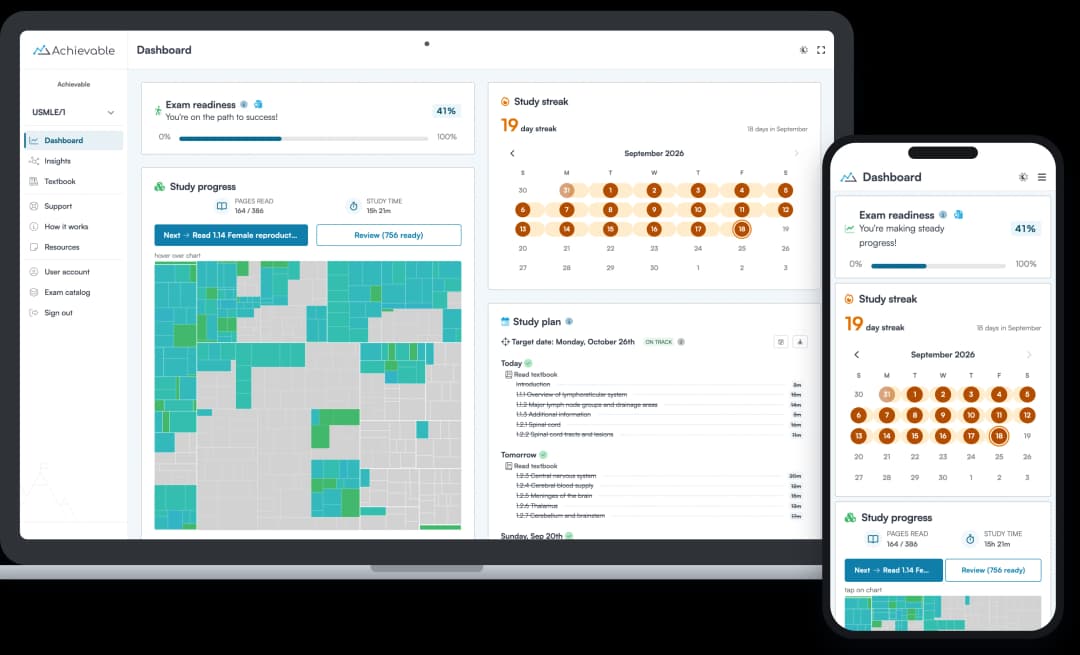
Achievable USMLE Step 1 is written for Step 1 alone, separate from Achievable’s MCAT course for medical school admission. It is a review course for learning the material before and alongside your question bank:
- 11 subjects in about 26 hours of reading, every page narrated, with 25 short videos.
- 1,400+ review questions that come back on a spaced-repetition schedule until the facts stick.
- An adaptive study planner.
- $179 for a full year of access, one payment, with the first lessons free and a full refund within 7 days of purchase, for any reason.
For an IMG, two things matter. A year of access covers a 6- or 12-month plan with one purchase, where UWorld’s shortest plan is $349 for 30 days. And because every page is narrated, you can listen through a subject as well as read it, which helps when your study hours come around clinical work. Its review questions are short recall questions, not clinical vignettes, so pair it with one question bank rather than using it instead of one. Nicholas Flint, co-founder of AnKing, put it this way: "Very efficient…gets right to the point without giving you extra details."
What the others leave out: First Aid is a book, with no questions to check what you remember. UWorld’s QBank has no video lessons unless you pay $99 more for QBank Plus, and its shortest plan, 30 days for $349, costs more than a year of Achievable. Pathoma covers pathology only, ships its book in paperback only (outside the U.S., local customs and duties may apply), and its sales are final. Sketchy teaches through illustrated mnemonics and is best known for microbiology and pharmacology; its plan includes a question bank too, so choose which bank is your one bank. Our Step 1 question banks compared weighs the banks in more detail.
A timeline: 3, 6 or 12 months
Pick the plan that fits how long ago you studied basic sciences and how many hours a week you have. Whichever you choose, aim for 100% readiness before you test: on self-assessments that report a three-digit score, such as UWorld’s, about 10 points above the 196 passing standard (about 206), repeatedly across several forms; on NBME’s forms, a consistently high estimated probability of passing, so a pass doesn’t depend on the luck of the draw.
12 months: still in school, or working full-time
- Months 1 to 7: work through Achievable’s 11 subjects alongside your classes or clinical work, answering its review questions as they come back. Add Pathoma and Sketchy as pathology, microbiology and pharmacology come up.
- Months 8 to 10: start your question bank in tutor mode, one system at a time, and read every explanation.
- Months 11 and 12: switch the bank to timed, random 20-question blocks, take NBME forms every week or two, and the free sample questions in the last week.
Our 12-month Step 1 plan maps each month to what to buy and when.
6 months: graduated, studying part-time
- Months 1 to 3: Achievable’s 11 subjects, with your bank in tutor mode on each system once you’ve reviewed it.
- Months 4 and 5: timed, random blocks of 20 questions in 30 minutes, with a log of every miss by system. Go back to Achievable’s matching subject for anything you miss twice.
- Month 6: an NBME form every week or two, closing the gaps each one shows, and the free sample questions in the last week.
3 months: full-time, basic sciences still fresh
- Weeks 1 to 4: a fast pass through Achievable’s 11 subjects, starting with your weakest, while your bank runs in tutor mode.
- Weeks 5 to 10: timed, random blocks every day, reviewing every explanation, with a first NBME form early to see where you stand.
- Weeks 11 and 12: more NBME forms, a review of your miss log, and the free sample questions in the interactive version to practice the real screens.
Three months is tight for anyone more than a few years past basic sciences. If your first NBME form is well short of the readiness bar above, move your test date rather than hoping the last weeks close the gap.
Problems IMGs run into, and what to do about them
Time since basic sciences
Many IMGs sit Step 1 years after their preclinical courses, and recall of biochemistry, microbiology and pharmacology fades fastest. Don’t lead with a question bank: rebuild each subject first, then do that system’s questions. A review course with spaced repetition brings each fact back on a schedule until it sticks, which matters more the longer ago you learned it.
Reading English vignettes at speed
Each block gives you 30 minutes for up to 20 questions, about 90 seconds a question, and many of them are clinical vignettes several sentences long. Reading them in a second language at that pace is a skill of its own, separate from knowing the medicine. Practice in timed blocks early, not only in the final month, and read every explanation in full: it builds the medical English the exam uses as much as the content. If English isn’t your first language, listening to narrated lessons while you read along helps with pronunciation and phrasing as well as the facts.
U.S. conventions
Step 1 is written for U.S. medical practice. Questions use U.S. generic drug names (acetaminophen rather than paracetamol, epinephrine rather than adrenaline) and describe patients and disease patterns as they present in the U.S. Learn the U.S. names as you meet them in your review, and note them in your miss log. A table of normal lab values is available on screen during the exam, so practice reading it quickly rather than memorizing every range.
Making the first attempt count
The USMLE allows at most four attempts at a Step, and no more than three in 12 months; a fourth attempt has to be at least 12 months after the first and six months after the most recent. In 2025, 75% of first-time Step 1 takers from medical schools outside the U.S. passed, against 93% of U.S. MD students (USMLE performance data). So test when your self-assessments say you’re ready, not when your eligibility period happens to end; the paid three-month extension exists for exactly that.
More from IMGs who’ve done it
Two physicians who took the USMLE as IMGs share their own approach on Achievable Insights:
- Approaching USMLE strategy as a non-U.S. IMG, by Yulius Haryadi, MD: early planning, fewer resources, and sequencing Step 1 and Step 2 CK.
- Early USMLE prep secrets for IMGs, by Dr. Abhiraj Yadav: high-yield focus, mentorship and a study schedule across the Steps.
Frequently asked questions
Do I need ECFMG Certification before I take Step 1?
No. You need to be eligible for ECFMG Certification, with an accepted Application for ECFMG Certification, before you apply for Step 1. Certification itself comes after you pass Step 1 and Step 2 CK and meet ECFMG’s English and credential requirements, and you need it for residency and for Step 3.
Can I take Step 1 while I’m still in medical school?
Yes. A student officially enrolled at an eligible medical school outside the U.S. can take Step 1, as long as they’ll have finished the basic medical sciences part of the curriculum by the start of their eligibility period and are still enrolled on test day.
Can I take Step 1 in my home country?
Usually, yes. Step 1 is given at Prometric test centers worldwide, about 100 of them outside the U.S. and Canada, with a $210 region fee for testing outside those two countries. Check Prometric’s center locator for a site near you before you choose your eligibility period.
Is Step 1 still scored?
No. Step 1 exams taken on or after January 26, 2022 report only Pass or Fail, with no numeric score. The passing standard is 196 on the USMLE’s three-digit scale.
Is Achievable enough on its own for Step 1?
No, and it isn’t meant to be. Achievable USMLE Step 1 teaches the material and keeps it fresh with spaced repetition, at $179 for a year. Pair it with one clinical-vignette question bank, such as UWorld, and check your readiness with NBME’s self-assessments and the free USMLE sample questions, which come with an answer key but no explanations.
Which question bank should an IMG use?
One, finished properly. Start with a review course such as Achievable to learn each system, then add UWorld, AMBOSS or a lower-cost bank such as TrueLearn for vignette practice. Our question banks comparison has each one’s price and size.
How do I know when I’m ready?
Aim for 100% readiness: on self-assessments that report a three-digit score, such as UWorld’s, about 10 points above the 196 passing standard (about 206), repeatedly across several forms; on NBME’s forms, a consistently high estimated probability of passing. Our guide to Step 1 mock exams and the Free 120 explains each one.
Key takeaways
- Have your Application for ECFMG Certification accepted first, then apply for Step 1 through the FSMB: $695, plus a $210 region fee outside the U.S. and Canada.
- Step 1 is pass/fail, with a passing standard of 196, and since May 14, 2026 it runs as fourteen 30-minute blocks in one 8-hour day.
- Build one stack: a review course such as Achievable ($179 for a year) to learn the material, one question bank, and NBME’s self-assessments to check readiness.
- Plan 3, 6 or 12 months depending on how fresh your basic sciences are, and test only once you’re consistently above the readiness bar.
- Practice timed English vignettes early, and learn U.S. drug names and conventions as you go.