USMLE Step 1, 2, 3: Key facts explained


The United States Medical Licensing Examination (USMLE) is a mandatory medical licensing exam that all physicians must pass to practice medicine in the U.S. Throughout the three-step USMLE process, aspiring doctors encounter various USMLE questions designed to rigorously assess their knowledge, clinical skills, and ability to apply fundamental medical concepts to diagnose and treat patients effectively.
Throughout this series of exams, candidates must demonstrate mastery across a range of subjects at different stages of their medical education. The USMLE is administered and overseen by both the Federation of State Medical Boards (FSMB) and the National Board of Medical Examiners (NBME). Registration and scheduling for the exam, including practice with sample USMLE questions, are available year-round at authorized Prometric Centers.

Who should take the USMLE?
Medical students enrolled in a program leading to a Doctor of Medicine (MD) or a Doctor of Osteopathic Medicine (DO) degree should take the USMLE. Students of osteopathic medicine may take a similar test, the Comprehensive Osteopathic Medical Licensing Examination (COMLEX), instead of the USMLE.
The USMLE Steps
The USMLE consists of three steps that you will need to take at different stages of your medical education.
USMLE Step 1
The USMLE Step 1 is a pivotal one-day exam that most medical students take at the end of their second year; planning an effective USMLE Step 1 study schedule well in advance of this intensive assessment is crucial for success. This exam evaluates knowledge and proficiency in foundational sciences such as anatomy, behavioral sciences, biochemistry, immunology, microbiology, pathology, pharmacology, and physiology, as well as topics such as nutrition, genetics, and aging.
The test format is organized by subject matter, making it easier for students to tailor their USMLE study plan to address different fields within the basic sciences. USMLE Step 1 questions are divided into organ system sections, including cardiology, gastroenterology, and neurology, as well as sections focusing on physician skills like accurate diagnosis and clinical case management. This structure necessitates a focused Step 1 study schedule that encompasses the breadth and depth of knowledge needed.
The USMLE Step 1 consists of seven blocks, each lasting 60 minutes, culminating in a complete eight-hour testing session. Each block contains a variable number of questions, never exceeding 40, for a maximum total of 280 multiple-choice USMLE questions. Along with developing proficiency in the content tested, students must also prepare to manage their time and pacing throughout the exam.
Careful organization of your USMLE study schedules around these key content areas and question formats can greatly enhance your performance on Step 1 and prepare you for the later stages of the USMLE sequence.
Step 1 pass rate
The overall USMLE Step 1 pass rate for medical students in the U.S. and Canada was 88% in 2024. In 2022, Step 1 became an entirely pass/fail test: when test takers receive their transcripts, they do not see a numerical score but rather a note that says whether they have passed or failed. Greater weight was placed on higher scores in the past, especially in residency matching decisions. Today, the test serves more as a “screening” for progressing in the medical licensure process.
The previous passing standard on a scaled range, when the exam was entirely numerically scored, was 196 out of 300. The passing threshold is still similar today: students must answer about 60% of the questions correctly for their scores to be valid.
Fees
The cost to take the USMLE Step 1 is $695, plus $70 per eligibility period extension (which expires after three months).
USMLE Step 2
The USMLE Step 2 is a comprehensive two-part exam, commonly completed during the fourth year of medical school as students advance from Step 1. When comparing Step 1 and Step 2, Step 2 focuses on assessing a student’s ability to integrate clinical knowledge and practical decision-making into real-world patient care, emphasizing both health promotion and disease prevention under supervision. Whether Step 2 is “harder” or “easier” than Step 1 depends on a test-taker’s individual strengths in applying clinical science. Additionally, Step 2 serves as a bridge between Step 1 and Step 3, building on foundational knowledge while introducing more advanced concepts that will be evaluated later. Step 2 involves one major exam:
Step 2 Clinical Knowledge (CK)
The USMLE Step 2 specially tests a student’s application of Clinical Knowledge (CK). It consists of multiple-choice USMLE questions that assess clinical sciences, including internal medicine, pediatrics, obstetrics, gynecology, and surgery. These questions are designed to test your ability to apply clinical know-how to real-world scenarios, covering a broad range of organ systems and addressing both pathological and physiological processes encountered in medical practice.
The Step 2 CK exam structure is similar to the USMLE Step 1 format, as it is organized into eight timed blocks, each lasting 60 minutes. Throughout the nine-hour testing period, examinees will encounter a maximum of 318 multiple-choice USMLE questions, with each block containing no more than 40 questions. This format ensures comprehensive evaluation across diverse medical disciplines and prepares candidates for clinical responsibilities.
Step 2 pass rate
Step 2 is scored on a scale from 1 to 300 and, while not pass/fail, requires a minimum score of 218. Scores from this exam are used to determine fit and aptitude for residency placements: the higher the score achieved on this exam, the better your chances of being accepted into a competitive residency program. The total pass rate was 97% in 2024 for U.S. and Canadian candidates.
Fees
The cost for the USMLE Step 2 CK is $695, with an additional $70 for each eligibility period extension (which expires after three months).
USMLE Step 3
The USMLE Step 3 is a comprehensive two-day examination, generally taken after completing the first year of residency. Understanding both the USMLE Step 3 format and the expected passing score is crucial for test-takers, as this assessment serves as the final checkpoint to determine whether a medical graduate is adequately prepared to practice unsupervised general medicine. In contrast to Step 2, Step 3 places a strong emphasis on patient management, including diagnosis, clinical decision-making, and ongoing patient care. Comparing Step 2 vs. Step 3 highlights that while both exams assess clinical knowledge, Step 3 further tests the ability to provide independent patient care, reinforcing a candidate’s readiness for professional practice in the medical field.
Step 3: Day 1
Day 1 of the exam, known as Foundations of Independent Practice (FIP), is a key part of any effective Step 1 study schedule as it covers the medical and scientific principles required for quality health care. Candidates aiming for a competitive Step 3 score should be prepared to engage with material spanning the application of the foundational sciences and social sciences, including communication and interpersonal skills, medical ethics, systems-based practice, and patient safety. Other topics include biostatistics, epidemiology, concepts in population health, and analysis and interpretation of medical literature.
Day 1 features a rigorous format tailored to mirror real-life practice and optimize your Step 1 study schedule. The exam consists of 232 multiple-choice questions, structured into six 60-minute blocks. The full testing day lasts seven hours and includes a 45-minute scheduled break and an optional five-minute tutorial.
Step 3: Day 2
Day 2 of the exam is on Advanced Clinical Medicine (ACM). This day assesses the medical resident’s ability to apply their understanding of health and disease to administer patient management and care. Topics include assessment of diagnosis and management, health maintenance and screening, prognosis and outcome, therapeutics, and medical decision-making.
Day 2 exams consist of 180 multiple-choice questions divided into six blocks of 45 minutes each. This day also includes a 7-minute computer-based case simulation (CCS) tutorial, followed by 13 case simulations, each allotted a maximum of 10 or 20 minutes.
Pass Rate
Similar to Step 2 CK, Step 3 assigns test-takers a three-digit score on a scale from 1 to 300. While the Step 1 and Step 2 passing scores each set distinct standards for examinees, it’s important to note that the USMLE Step 3 passing score was raised to 200 on January 1, 2024. 96% of students in the U.S. and Canada passed the exam in 2024.
Fees
The cost to take the USMLE Step 3 is $955. This fee is non-refundable and cannot be transferred to another eligibility period if the initial three-month eligibility has expired.

How should I study for the USMLE?
Developing an effective USMLE study plan for each step is absolutely necessary, and many devote months or even a whole year to studying for these tests. The length of time required to prepare for the USMLE exams largely depends on your mastery of core medical concepts and previous clinical experience. Many students recommend following a structured USMLE study schedule that allows for six to eight months of focused preparation for both Step 1 and Step 2 Clinical Knowledge. For USMLE Step 3, most candidates find that a shorter study period of four to six months is typically adequate if an organized schedule is maintained.
By tailoring your USMLE study schedule to each specific exam, you set a strong foundation for achieving high scores across all three steps of the USMLE. Throughout your preparation, make sure to take advantage of the programs available to you at your school. Additional academic support, USMLE study groups, and other resources can help guide your studies and quickly clarify any confusing topics. Many students also choose to supplement their preparation using USMLE prep courses, and an online course geared toward self-studiers can offer busy medical students a flexible and comprehensive study option.
Closing: Study for the USMLE Step 1 with Achievable
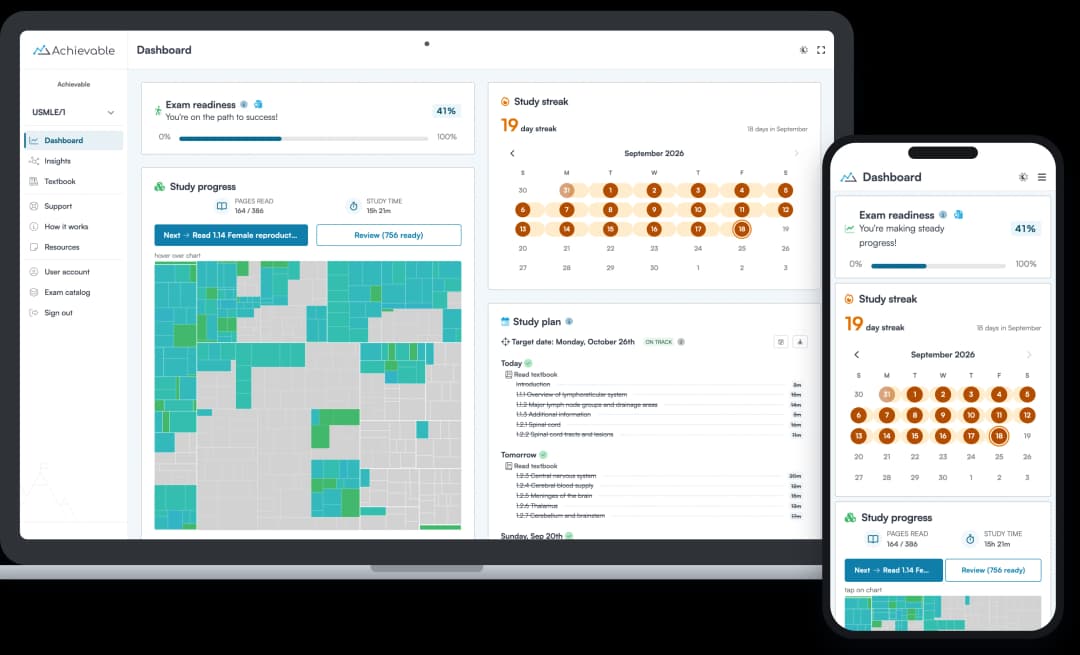
To get you started, Achievable has designed a comprehensive USMLE Step 1 study plan through its official USMLE Content Outline-based course. Our Step 1 course merges our expert author’s extensive experience in guiding both U.S. and international medical students to Step 1 success with Achievable’s efficient, time-saving platform. Our adaptive algorithm personalizes your USMLE study schedule, ensuring that review flashcards are scheduled for optimal memory retention, helping you master the extensive material required for the USMLE Step 1 exam in less study time.
Take the opportunity to preview Chapter 1 of the Achievable USMLE Step 1 course for free and experience our expert-guided approach. Let us help you build the sturdy foundation needed to ace Step 1 and eventually conquer Steps 2 and 3.