Is CLT prep worth it for homeschoolers applying to classical colleges?


Table of contents
- When CLT prep pays off for a homeschooler
- Which classical and faith-based colleges accept the CLT
- What to use: free and paid CLT prep compared
- A month-by-month CLT prep plan for homeschoolers
- Three months before: diagnose and register
- Two months before: learn the content
- Six weeks before: full-length practice
- The last month: test-ready
- CLT scholarships for homeschoolers
- How to register for the CLT
- Why homeschoolers choose the CLT over the SAT and ACT
- Key takeaways
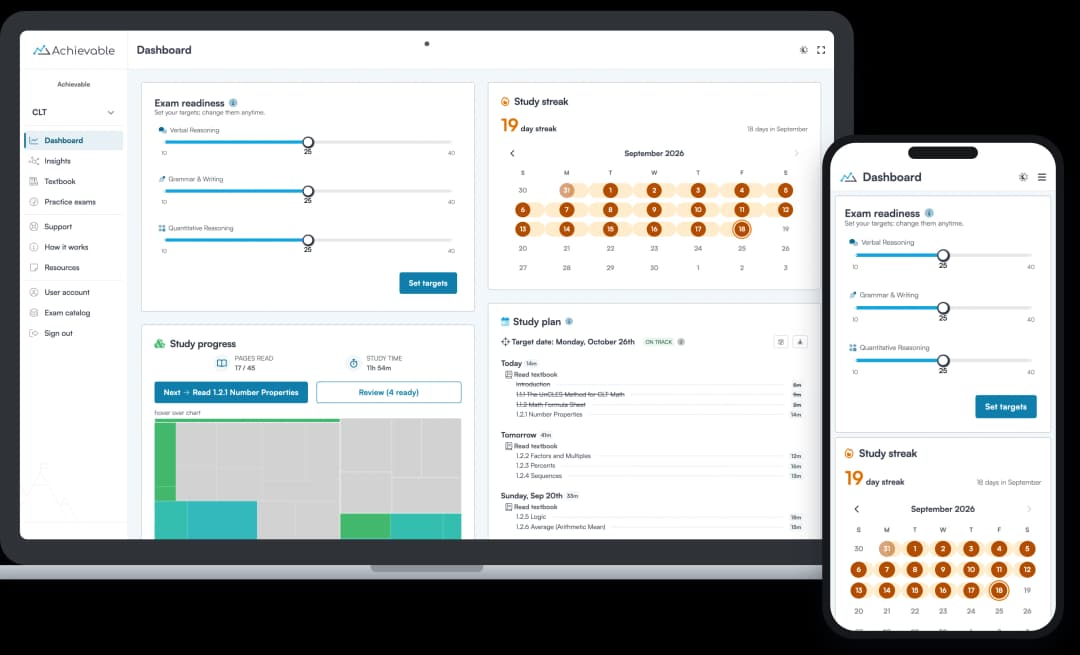
Yes, CLT prep is worth it when the colleges on your list accept the Classic Learning Test for admission or tie scholarships to it, as many classical, Christian and liberal arts colleges do. Start free: take Achievable’s free full-length practice CLT (120 questions, timed at the real test’s 2 hours, every answer explained) and the CLT’s own official practice tests to see where you stand. For structured prep, Achievable’s CLT course covers all three sections for $99 for a year, with 3 full-length practice CLTs, 680+ explained practice questions and a score improvement guarantee.
Achievable’s CLT course was developed with Clayborne Education, a recommended CLT test prep partner. If none of your colleges use the CLT, put your prep time into the SAT or ACT instead: see how to choose between the SAT, ACT and CLT.

When CLT prep pays off for a homeschooler
The CLT doesn’t require any particular prep program, and the CLT itself says extensive prep isn’t necessary. Prep earns its time when one of these is true:
- Your colleges accept the CLT. Over 400 colleges and universities accept CLT scores, including the U.S. Military Service Academies and seven state university systems (Arkansas, Florida, Georgia, Indiana, Iowa, North Carolina and Texas), according to the CLT’s college list.
- A scholarship has a score cutoff. CLT partner colleges tie over $100 million in scholarships to CLT scores each year (CLT), so a few points can be worth far more than a course costs.
- The student hasn’t read widely in the classics. Most Verbal Reasoning passages come from classic literature and historical texts by the authors in the CLT’s author bank. No prior knowledge of the texts is needed, but a student meeting that prose for the first time needs practice reading it under time.
- The student relies on a calculator. The CLT allows no calculator on Quantitative Reasoning (CLT FAQ), so arithmetic and algebra have to be quick by hand.
- It’s a retake. The CLT has an open retake policy, and a student whose first score fell short needs to know which questions cost the points before trying again.
When none of these applies, a free practice test and a look at the format may be all a student needs.
Which classical and faith-based colleges accept the CLT
CLT partner colleges “tend to be private, liberal arts, or faith-based colleges”, in the CLT’s words. All of these were on its college list when we checked:
- Classical and great-books colleges: Hillsdale College, Grove City College, Patrick Henry College, New Saint Andrews College, Thomas Aquinas College (California and New England) and the University of Dallas.
- Catholic colleges: Christendom College, Benedictine College, Franciscan University, Wyoming Catholic College, Ave Maria University and Belmont Abbey College.
- Other Christian colleges: Liberty University, Cedarville University and Covenant College.
- Public universities: the University of Florida and Florida’s other state universities, Christopher Newport University, and the other state systems above.
- Service academies: the U.S. Naval Academy, the U.S. Military Academy at West Point and the U.S. Air Force Academy (see U.S. military academies welcome the CLT).
Search by state on Achievable’s list of colleges that accept the CLT or on the CLT’s own college finder, and check each college’s admissions page before you plan around it, since policies change. A college that isn’t a partner may still consider CLT scores: the CLT suggests calling its admissions office and asking.
What to use: free and paid CLT prep compared
Start with the free options, which give a real read on where you stand, and add a course when the student needs structure, more practice or an explanation of every question.
Resource | Cost | What you get |
|---|---|---|
Free, no account | A full-length CLT: 120 questions timed at 2 hours, every answer explained | |
Free | The key points of every chapter of the course | |
$99 for 12 months | 3 full-length practice CLTs, 680+ explained questions, Quant practice with new numbers every time, score improvement guarantee | |
Free with a CLT account | 3 online practice tests with instant results and answer explanations | |
Official CLT Student Guide (3rd edition) | $45.95 | 3 full-length practice tests in print, essay prompts, an answer key with explanations |
How they fit together:
- Achievable’s free practice CLT first, as the diagnostic. It runs in any browser with no account, and its explanations show why each missed question was missed.
- Achievable’s CLT course for structured prep. Lessons cover Verbal Reasoning, Grammar and Writing, and Quantitative Reasoning, and the Quantitative Reasoning practice doesn’t run out: it draws new numbers every time. Its first lessons are free, with no credit card needed.
- The official practice tests close to test day. They’re the test maker’s own questions in the real online format, and there are three, so once they’re taken there are no more official tests to sit.
- The Official CLT Student Guide for official practice on paper. Its three full-length tests are the same ones as in the 2nd edition, so a family that owns that edition gets no new tests from the 3rd.
Achievable’s score improvement guarantee. If a retake doesn’t raise the student’s score by the points guaranteed, Achievable refunds the course: 15 more points from a starting score below 60, 10 from a score of at least 60 and below 80, and 5 from at least 80 and below 100. A starting score of 100 or more has no points guaranteed. Send us the previous official score report, from a CLT taken in the five years before buying, within 7 days of buying, then retake the CLT while the year of access is active. If the score hasn’t risen by the points guaranteed, email the new score report and a valid ID within 31 days of the test for a full refund. There’s no minimum study time. The CLT course can also be refunded in full within 7 days of purchase, for any reason.
For tutoring, live classes and other courses, see our comparison of the best CLT prep courses, which prices each one from the provider’s own site.
A month-by-month CLT prep plan for homeschoolers
Homeschoolers set their own calendar, so count back from a test date. The CLT is for 11th and 12th graders, and remote test dates run about once a month through the school year. Three months works for many students; start earlier for a scholarship cutoff or a weak section.
Three months before: diagnose and register
- Take Achievable’s free practice CLT in one sitting under real conditions: 2 hours and no calculator.
- Note which of the three sections cost the most points, and look up the score each college and scholarship on your list asks for.
- Pick a test date and register (see below). A student who needs accommodations applies at least four weeks before the test date.
Two months before: learn the content
- Work through the course’s lessons, weakest section first, answering every chapter quiz and reading the explanation of each question missed.
- Read a few passages from authors in the CLT’s author bank each week and summarize each one’s argument in a sentence.
- Do a short set of non-calculator math every day.
Six weeks before: full-length practice
- Take a full-length practice CLT every week or two, timed at 40 minutes for Verbal Reasoning, 35 for Grammar and Writing, and 45 for Quantitative Reasoning.
- Review every missed question, then go back to the lesson behind it before the next test.
The last month: test-ready
- Take the official practice tests in your CLT account.
- Aim for 100% readiness: practice scores comfortably above the score you’re aiming for, consistently, across several full-length practice CLTs, so a good result doesn’t depend on the luck of the draw.
- Set up the computer for the remote test (below) a few days early, not on test morning.
Starting in 9th or 10th grade? The CLT10 is the 9th and 10th grade version ($69 remotely), and sophomores who take it are eligible for the CLT10 National Award, worth $2,500 (CLT FAQ).
CLT scholarships for homeschoolers
Many CLT partner colleges publish the score that earns each award, and the CLT gathers them on its scholarships page: Benedictine College, for example, lists a CLT score of at least 84 to enter its Presidential Scholars Competition, for awards worth up to full tuition. In Florida, CLT scores count toward Bright Futures scholarships, and Bright Futures accepts superscored CLTs (CLT FAQ). For the awards, the cutoffs and how to combine them, see how CLT scores can fund your education and homeschool scholarships. For transcripts, course descriptions and the rest of a homeschool application, see our college admissions guide for homeschool families.

How to register for the CLT
Individual students, homeschoolers included, take the CLT remotely at home; in-school test dates are booked by schools. To register:
- Create a free CLT account on the CLT’s site. The same account holds the official practice tests, the registration and the scores.
- Pick a remotely proctored date. Registration closes about a week before each date, and on test day the student can start any time between 7:00 a.m. and 6:00 p.m. Eastern.
- Pay the fee. The remote CLT costs $112, which includes the student analytics report and unlimited score sharing with colleges. A homeschool group or network membership may bring a discount.
- Set up the computer. The student needs a laptop or desktop computer (the CLT’s FAQ says tablets aren’t currently supported, and phones aren’t allowed), a stable internet connection and the LockDown Browser; read the remote proctoring guidelines before test day.
- Get the scores. Remote scores come out in the CLT account about three weeks after the test (each date’s release day is on the CLT’s test-date list), and they can be sent to as many colleges as you like for free.
The optional essay is offered only on in-school tests, not remotely. A homeschool co-op can schedule a group exam, with paper testing and discounted group rates, through the CLT’s homeschool team. For what the remote test is like on the day, see taking the CLT exam online.
Why homeschoolers choose the CLT over the SAT and ACT
- It’s taken at home. The remote CLT needs no test center, which suits a homeschool schedule.
- Its passages come from the great books. The CLT draws most of its reading from classic literature and historical texts, the kind of prose a classical curriculum already reads.
- It’s two hours of testing (2 hours 20 minutes with the instructions). Three sections of 40, 35 and 45 minutes, each scored from 1 to 40, for a total from 1 to 120, with no penalty for a wrong answer (see CLT scores explained).
- It can also meet state testing requirements. The CLT says its norm-referenced exams satisfy homeschool testing requirements in most states; check yours in state requirements and standardized testing for homeschoolers.
- But not every college takes it. The SAT and ACT are accepted far more widely, so a student applying beyond CLT partner colleges may need one of them too.
Already took the SAT? See whether to take the CLT too, with how the two tests differ and a short prep plan.
Key takeaways
- CLT prep is worth it when your colleges accept the CLT for admission or scholarships; if none do, prepare for the SAT or ACT instead.
- Start free with Achievable’s full-length practice CLT, then use the CLT’s official practice tests close to test day.
- For structured prep, Achievable’s CLT course is $99 for a year, with 3 full-length practice CLTs, 680+ explained questions and a score improvement guarantee.
- Plan about three months back from a remote test date, and aim for practice scores comfortably above your target across several full-length tests.
- Register in a free CLT account; the remote CLT costs $112, and scores come out about three weeks later.