

FINRA Series 10 FAQs
Answers to the most common questions about the Series 10 exam.
How do you get your Series 9/10 license?
The Series 9 is taken as a corequisite with the Series 10, which means you must pass both exams to earn your General Securities Sales Supervisor registration. FINRA also lists the FINRA Securities Industry Essentials (SIE) and General Securities Representative (Series 7) exams as corequisites: you must pass them to hold the registration, and be registered as a General Securities Representative before or at the same time.
To be eligible to sit for the Series 9 and Series 10 exams, candidates must be associated with and sponsored by a FINRA member firm or another applicable self-regulatory organization (SRO) member firm.
What's covered on the Series 10?
The Series 9 and Series 10 exams assess knowledge of laws, regulations, ethics, and supervisory practices necessary for an entry-level principal acting as a general securities sales supervisor.
While the Series 10 covers many of the same core areas as the Series 9, including sales and trade activities, accounts and communications, rules and regulations, and personnel management, it takes a broader approach and places less emphasis on options than the Series 9.

What is the difference between the Series 9/10 and the Series 24?
The General Securities Sales Supervisor Exams (Series 9 and 10) are classified by FINRA as “limited principal” exams. This designation means they qualify you to oversee a broker-dealer's sales activities across a wide range of products, including corporate securities (equity and debt), investment company products, variable contracts, municipal securities, options, government securities, and direct participation programs (DPPs). However, this authority applies only to sales activities. The Series 9 and 10 licenses do not permit supervision of other areas of the securities business, such as underwriting, trading, or compliance.
In contrast, the Series 24 provides broader authority over firm functions, allowing supervision of many operational areas beyond sales. That said, it is more limited in terms of product coverage: you cannot supervise municipal securities or options activities with a Series 24 alone. The Series 24 exam is also generally regarded as more challenging than the Series 9 and 10.
Do I need to take the Series 9 or Series 10 in a particular order?
No, you can decide which exam to take first.
Do I have to take the Series 9 or Series 10 exams on the same day?
No, you're welcome to take them together if you prefer, but it's not required. It's generally recommended to take the exams on separate days to help reduce the strain of studying and test-taking. The Series 10, in particular, is quite long at four hours and can be especially fatiguing.
Keep in mind that you must pass both exams within two years of one another. If you don't, FINRA invalidates the exam you already passed. Be sure to plan ahead and leave yourself enough time to complete and pass the second exam.
How many times can you take the Series 10?
You can take the Series 10 exam an unlimited number of times, though you will need to wait a certain number of days between each attempt. Through January 18, 2027, FINRA requires candidates to wait 30 calendar days after their first and second failed attempts and 180 calendar days after their third and subsequent failed attempts within a two-year period.
Starting January 19, 2027, those waits shorten to 15 and 60 calendar days. The shorter waits apply to any retake enrollment requested on or after January 19, 2027, even if the failed attempt happened before then. Failed attempts more than two years old do not count toward determining the applicable waiting period.
If you requested a retake enrollment before January 19, 2027 and are still in your waiting period on that date, FINRA will adjust your testing window that day to reflect the shorter wait, as long as you haven't scheduled an appointment. If you have, FINRA can't adjust the window without canceling your appointment, and will contact you to review your options.
While FINRA does not limit the number of times you can take the Series 10, passing FINRA qualification exams is generally required for many registered securities and principal positions. Some firms also impose their own policies limiting the number of exam attempts employees may have before affecting promotion eligibility or continued employment. Also note that for each attempt, you will need to re-register for the exam and pay the fee.
More on the Series 10 exam
- Series 10 exam prep courseAchievable's course: online textbook, review quizzes and full-length practice exams.
- Series 10 exam format, content and scoringWhat's tested, how long it takes, what it costs, and the score you need to pass.
- Free Series 10 practice examPractice questions written to match the real thing, with an explanation for every answer.
- Best Series 10 exam prep coursesHow the leading providers compare on content, format and price.
- Series 10 study resourcesGuides and study advice from Achievable's instructors.
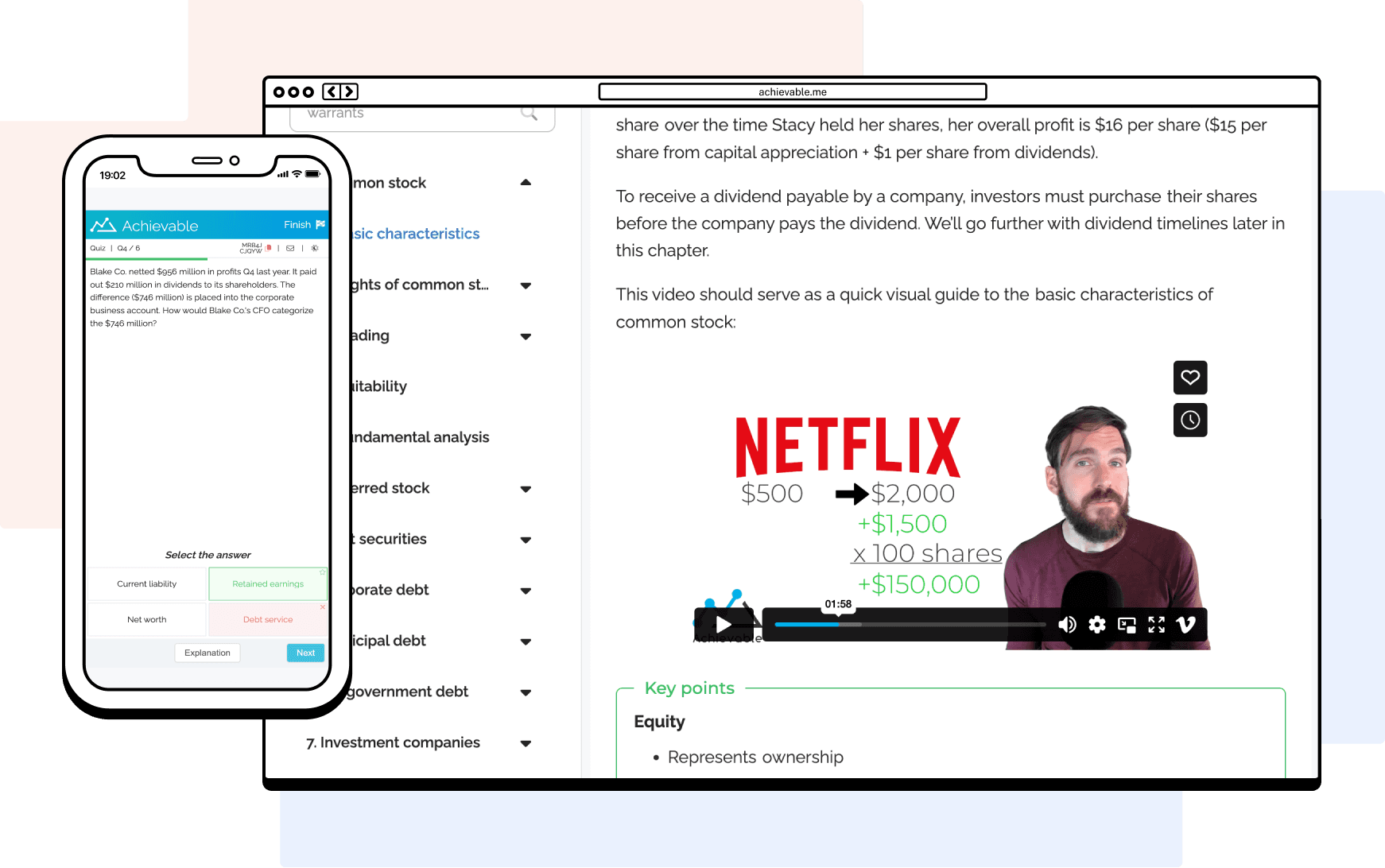
Pass the FINRA Series 10. Guaranteed.
Achievable is the best Series 10 exam prep course: effective, personalized, and convenient. With Achievable, you'll spend less time studying and pass your exam the first time, or your money back.