

Series 10
study guide
Every chapter of the course summarized, with each section linked to its lesson.
Pass the first time
Try Achievable Series 10
No credit card required
This free Series 10 study guide summarizes all 6 chapters of Achievable's Series 10 course: what each covers, the points to remember, and its 41 sections in order. Read each chapter after you study it, or work through the whole guide before exam day.
Each section links to its full lesson in Achievable, with the review quizzes and full-length practice exams.
Chapter 1: Supervision
10 sections
- Associated persons: Partners, officers, directors, branch managers, employees, registered reps, and principals count, but purely clerical or ministerial staff do not.
- Supervisory framework: Member firms bear final responsibility under Rule 3110, must maintain WSPs and licensed principals, and annual compliance meetings are required for all reps and principals.
- Office oversight: OSJs handle key functions and need principal supervision, inspections follow set cycles, and RSLs and the remote inspections pilot add limited remote supervision options.
- Continuing education: All registered representatives and principals must complete the annual Firm element and Regulatory element, and the MQP can preserve qualifications for up to 5 years.
- Records and selling practices: Firms must keep required records by retention period, supervise communications, sales, and discretionary accounts, and maintain AML, CIP, and SIPC-related safeguards.
- Prohibited conduct: Manipulation, insider trading, selling away, improper borrowing or lending, and other deceptive practices are prohibited, and violations can bring censure, fines, suspension, revocation, expulsion, or barring.
In this chapter
- Personnel supervision
- Foundational supervision
- AssociatingFree
- SupervisingFree
- Associating
- Supervision working lifeFree
- Working with outsidersFree
- Company supervision
- Sales supervision
Start this chapter free
Chapter 2: Registrations
5 sections
- U4 and fingerprinting: Natural persons always register on U4, while corporate persons are legal persons, and all industry personnel are fingerprinted with the U4 or risk inactivity after 30 days.
- U4 and U5 changes: U4 changes are amended within 30 days, statutory disqualification amendments within 10 days, and Form U5 ends the association within 30 days while FINRA jurisdiction and reappointment can continue for 2 years.
- Registration categories: Representatives and principals register in each relevant category based on job functions, including S7, S6, S24, S27/28, S4, S39, S57, S79, and S86/87.
- Exemption rules: Exemptions include exempt securities and offerings under Regulation A, Regulation D, Regulation S, Rule 144, Rule 144A, Rule 145, and intrastate offering exemptions under Section 3(a)(11), Rule 147, and Rule 147A.
In this chapter
- Introduction to registrations
- Registration categories
- Securities registration exemptions
Study this chapter in Achievable
Chapter 3: Client issues
8 sections
- Public communications: Rule 2210 separates correspondence, retail communications, and institutional communications, while internal communications stay internal and correspondence and retail communications often get confused.
- Advertising limits: FINRA never approves firms, employees, securities, or recommendations, and communications cannot make predictions, false claims, or unsupported testimonials, while telemarketing and the taping rule impose specific controls.
- Account structures: Cash accounts allow no borrowing, margin accounts allow borrowing and short positions, and retirement and employee plans follow distinct rules for contributions, vesting, and withdrawals.
- Order handling: Day, GTC, market, stop, limit, IOC, AON, FOK, MOC, and LOC orders each have different execution rules, and confirmations must disclose required trade and price details.
- Customer suitability: Firms must know the customer’s essential facts and authority, then make recommendations that fit objectives, risk tolerance, time horizon, liquidity, and the product’s reasonable basis.
In this chapter
- Communications
- Additional communications
- Accounts
- Orders and confirmations
- KYC, objectives, and suitability
Study this chapter in Achievable
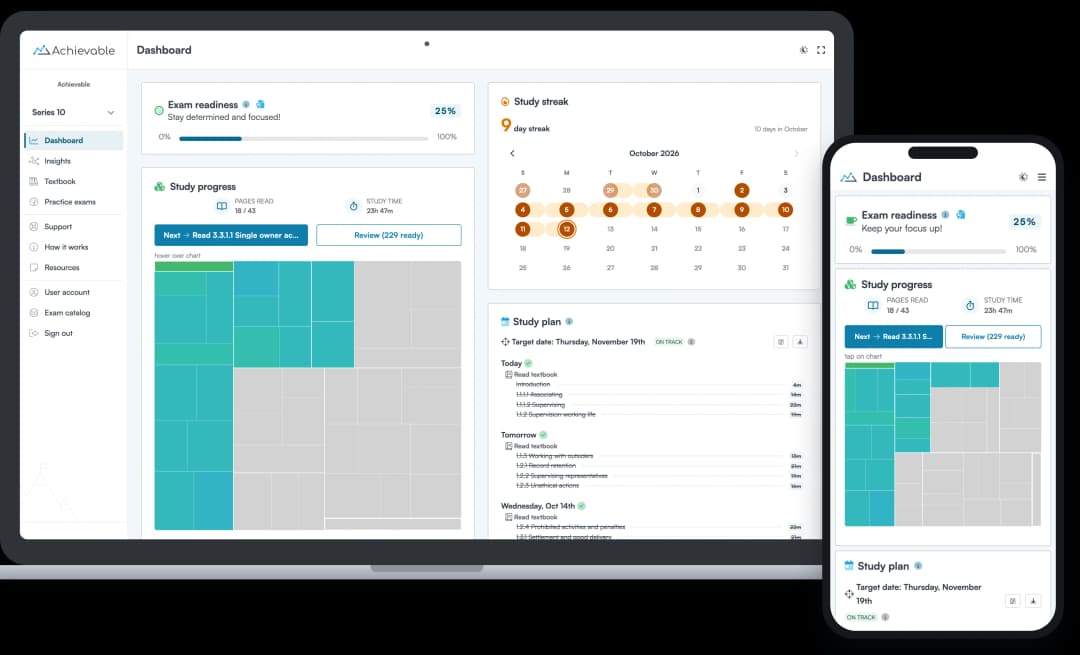
Achievable Series 10
Series 10 exam prep course and study materials with a pass guarantee: online textbook, 1,200+ practice questions, and 3 full-length practice exams.
3 full-length Series 10 practice exams
1,200+ practice questions with explanations
Exams weighted like FINRA's content outline
Pass guaranteed, or your money back
Chapter 4: Investment products
5 sections
- Equity and debt: Equity is an ownership claim, debt is a creditor relationship, and debentures are unsecured while secured bonds are backed by collateral.
- Rights, warrants, options: Rights are issued to existing shareholders to preserve proportional ownership, warrants are long-term sweeteners attached to bonds or preferred stock, and call or put options bet on price direction.
- Variable annuities and DPPs: Variable annuities are insurance products for lifetime income with tax-deferred earnings, while DPPs pass through both gains and losses and are often limited partnerships with illiquidity risk.
- Investment companies and funds: Open-end funds, ETFs, and mutual fund share classes are governed by rules on pricing, distributions, redemption, sales charges, and suitability, while closed-end funds, UITs, and FACCs differ in structure and trading.
In this chapter
- Basic securities
- Investment companies
- Open-end funds and exchange traded funds
Study this chapter in Achievable
Chapter 5: Margin accounts
3 sections
- Margin account basics: Margin accounts let investors borrow money to buy more securities, are the only account type permitting short selling, and use securities in the account as collateral for loans.
- Required documents and rules: Margin account documentation includes a required credit agreement, hypothecation agreement, margin disclosure document, and an optional loan consent agreement, while rehypothecation is limited to securities worth up to 140% of the customer’s debit balance.
- Reg T and requirements: Reg T requires 50% initial margin, 2 business days after settlement for payment, 25% maintenance for long accounts and 30% for short accounts, with marginable securities and margin math determining equity, SMA, buying power, and restricted account treatment.
In this chapter
Study this chapter in Achievable
Chapter 6: Federal rules and regulations
10 sections
- 1933 Act rules: The Securities Act of 1933 regulates the primary (issuer) market and is known as the Paper Act.
- Trust indenture provisions: The Trust Indenture Act of 1939 applies to corporate bond issues over $50M in 12 months and requires an independent, qualified trustee and indenture covenants and default procedures.
- Underwriting and state filing: Best efforts, firm commitment, all-or-none, and mini-max underwritings differ by who bears risk, while Blue Sky Laws require registration by notice filing, coordination, or qualification.
- 1934 Act market rules: The Securities Exchange Act of 1934 created the SEC, gave Regulation T authority to FRB, and governs brokers, dealers, quotes, Rule 10b-18 repurchases, reporting companies, insiders, and insider trading.
- Trading markets and conduct: Nasdaq, OTC, the 5% Policy, MSRB rules, Reg BI, Form CRS, Reg M, S-P, SHO, and NMS rules govern market access, disclosures, quotations, short sales, and customer protections.
- Enforcement and arbitration: FINRA and SEC procedures cover financial exploitation holds, market access controls, erroneous trades, research reports, arbitration, disciplinary actions, sanctions, and appeals.
In this chapter
- The Securities Act of 1933
- The Securities Exchange Act of 1934
- The third market
- MSRB-rules
- Additional federal regulations
- Additional FINRA, SEC, and NYSE rules
- Code of Procedure and Code of Arbitration
Study this chapter in Achievable
Series 10 exam at a glance
- Time
- 4 hours
- Passing score
- 70%
- Exam fee
- $235
More on the Series 10 exam
- Series 10 exam prep courseAchievable's course: online textbook, review quizzes and full-length practice exams.
- Series 10 exam format, content and scoringWhat's tested, how long it takes, what it costs, and the score you need to pass.
- Free Series 10 practice examPractice questions written to match the real thing, with an explanation for every answer.
- Series 10 FAQThe questions asked most about the exam and preparing for it, answered.
- Best Series 10 exam prep coursesHow the leading providers compare on content, format and price.
- Series 10 study resourcesGuides and study advice from Achievable's instructors.
Pass the FINRA Series 10. Guaranteed.
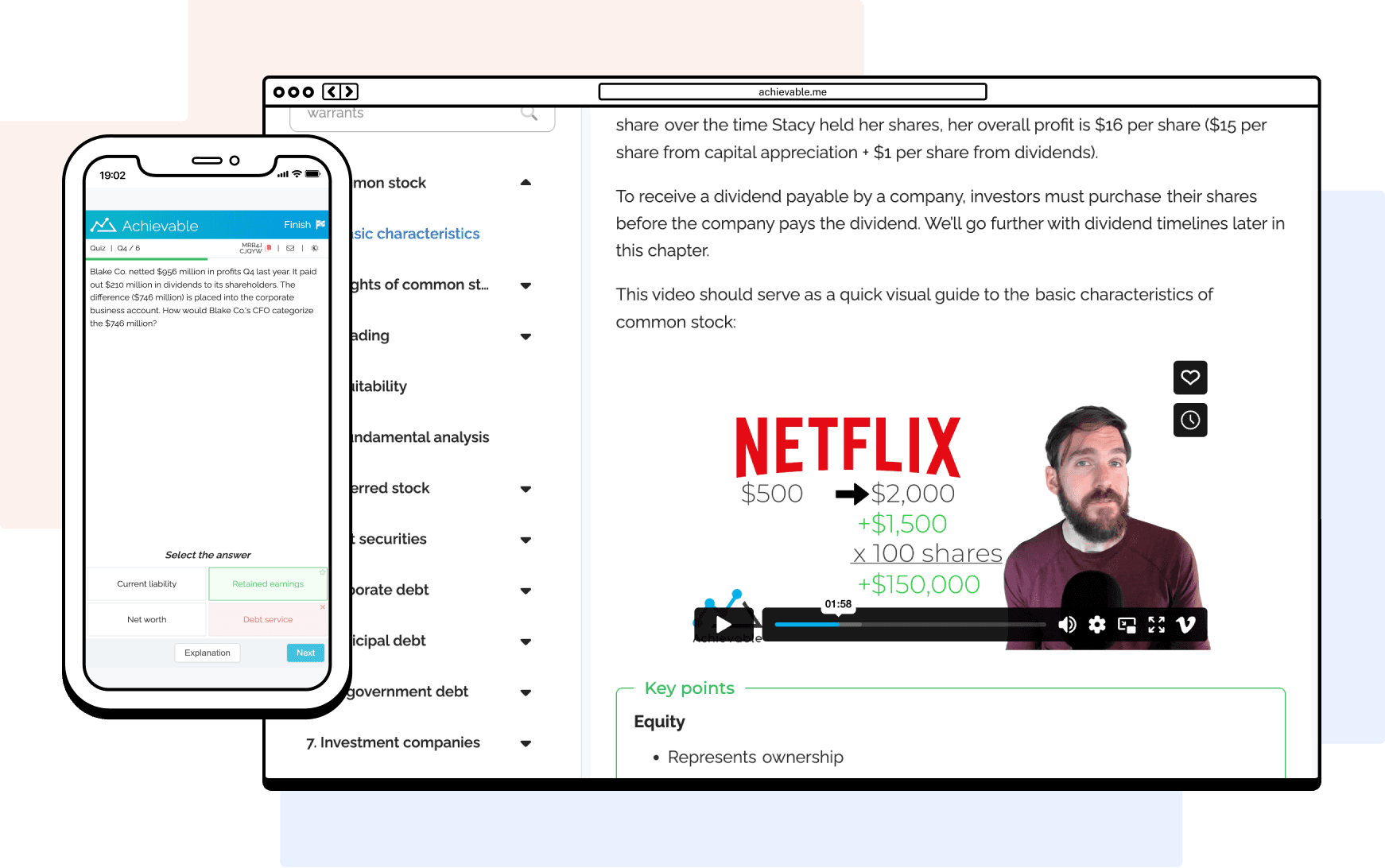
Achievable is the best Series 10 exam prep course: effective, personalized, and convenient. With Achievable, you'll spend less time studying and pass your exam the first time, or your money back.