How to pass the Series 7 while working full-time


Yes, you can pass the Series 7 while working full-time: the key is a consistent daily study plan aligned to your firm’s timeline, built around practice exams and targeted review of your weak spots rather than last-minute cramming.
The Series 7, like all Financial Industry Regulatory Authority (FINRA) Top-Off exams, requires candidates to be employed and sponsored by a FINRA-member firm; by design, candidates are generally studying for the exam while working full-time.
Very often, financial services professionals in training have a limited window to pass the Series 7. Without this vital credential, they are unable to perform the full scope of duties required of early-career financial advisors, client associates, and analysts. While this may seem daunting at first, it doesn’t have to be. Though the stakes are high, the Series 7 can be overcome with motivation, support, and a study plan focused on sustained preparation rather than cramming.

What is the Series 7?
The Series 7, officially called the General Securities Representative Qualification Examination (GS), is a key requirement for advisory and investment roles. It evaluates the knowledge and skills needed for entry-level registered representatives involved in securities sales and financial advising. When paired with a regulatory exam such as the Series 63, 65, or 66, Series 7-holders can legally transact in securities products and/or provide advisory services in their chosen state.
The exam covers core topics such as customer accounts, investment transactions, suitability (the “fit” of investment products and strategies based on client preferences), and important market players in detail. Its length contributes to its difficulty, featuring 125 scored questions (plus 5 unscored pretest questions, for 130 total) to be answered in 3 hours and 45 minutes.
A broad range of investment vehicles is featured on the Series 7 exam, including:
- Equity securities (such as common and preferred stock)
- Exchange-traded funds (ETFs)
- Exchange-traded notes (ETNs)
- Debt securities (like bonds)
- Options
- Investment companies (for example: mutual funds)
- Direct participation programs (DPPs)
- Hedge funds
Series 7 exam questions often describe investment scenarios such as: “A customer has x, y, and z preferences regarding investments. What recommendation would you offer based on these factors?” Providing appropriate investment advice is a skill central to holding the Series 7 license and to working as a registered securities representative.
Tip: You’ll likely notice in your studies that there is a lot of crossover between the SIE, the Series 7’s corequisite (we recommend taking it first), and the Series 7 itself. Instead of relearning topics, make a list of areas you’re comfortable with and those you are less familiar with, and focus on the latter when preparing.
Peter Sim, a New York-based professional who prepared for the SIE, Series 7, and Series 63 in one shot, provided this insight: “Seeing the whole runway at once made the SIE-Series 7 overlap obvious, so I stopped re-learning covered ground.” Dedicating time to deeply learning and retaining information from the SIE will be hugely beneficial to your Series 7 prep.
Series 7 permitted activities
A candidate who passes the Series 7 exam is authorized to solicit, purchase, and sell all types of securities products, such as corporate securities, municipal fund securities, options, direct participation programs, investment company products, and variable contracts.
Series 7 requirements
To take the Series 7 and become registered, there are certain requirements you need to fulfill:
- Passing the Securities Industry Essentials (SIE) exam, the Series 7’s corequisite. You can take it before or after the Series 7, but your registration isn’t official until you’ve passed both. We recommend taking the SIE first, since it doesn’t require firm sponsorship.
- Employment at a FINRA-member firm
- Sponsorship by your firm (they must fill out a Form U4 on your behalf)
Many candidates are hired by a firm after passing the SIE and before completing their Series 7, but passing the exam is necessary to keep their employment in these situations. Many firms have structured preparation programs for candidates, which may include setting aside work hours for practice and providing access to exam-preparation software. Other firms may require candidates to study entirely on their own for the test. Either way, test-takers are preparing while managing full-time employment.
How do I prepare for the Series 7?
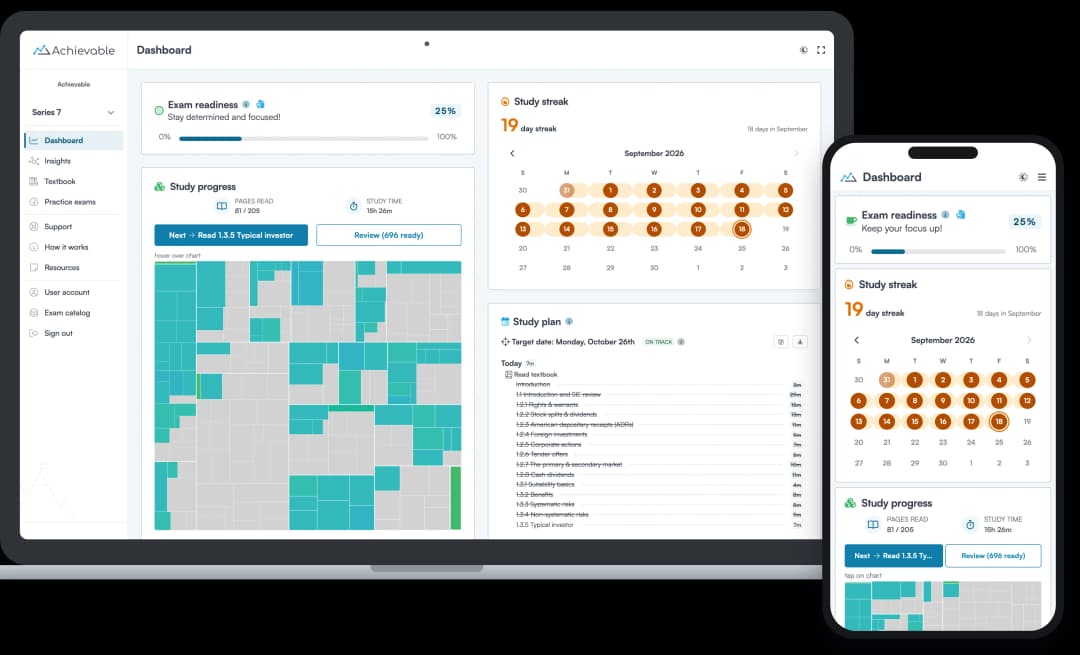
Preparing for the Series 7 as a full-time employee can be difficult, but with the right strategy, it’s achievable. The best approach is to develop a structured study plan that matches your exam timeline. Ideally, you’ll have a few weeks or even a couple of months to prepare, though some firms expect candidates to pass in a very narrow window to speed up the process. When planning your study schedule and exam date, concentrate your efforts on:
- Reviewing content and core concepts
- Completing practice questions designed to closely match FINRA’s exam language
- Regularly taking full-length Series 7 practice exams to gauge readiness
- Targeting your weak spots until the material becomes second nature
- Devoting time every day to study, even if it’s just an hour
- Structuring a regular study plan and test date around the firm’s deadlines
Many students pass the Series 7 while managing a full workload, proof that you can balance both.
Jay Yahnke, an early-career financial professional who passed the Series 7 in seven weeks, emphasizes the importance of staying consistent, even with small daily study goals, and of “relying on a structured study platform.”
For Peter, the important step was to create a rhythm of regular review: “[Full] practice exams, targeted review of the weak chapters, then another full exam. Two exams back-to-back told me nothing. An exam, a day of repair work, then another exam told me whether the repair worked.” Understanding errors is what ultimately allowed him to retain essential knowledge and pass the test on the first try, while starting a new job and caring for an infant.
“I stopped treating practice questions as a measurement tool and started treating them as the study method itself. Reading a chapter felt productive. Getting a question wrong and then reading the explanation of why is what made anything stick.”
Students who pass the Series 7 consistently recommend creating a personalized study plan, maintaining consistent daily habits, seeking support from family and friends, and holding themselves accountable as the keys to their success. Establishing a routine and gradually reviewing material each day, rather than last-minute cramming, leads to improved retention and reduced stress. Customizing your study approach by focusing on difficult areas or by employing techniques such as handwritten notes or chatbots to review questions can be highly beneficial.
Luke Jebb, who changed careers to pursue a meaningful role that offered more work-life balance, has this to say about making the most of your study time: “Putting in 150 hours is a significant commitment, but how you use those hours matters just as much. Having resources that help you identify what you know, what you don’t know, and where you should focus next can make the entire process more efficient. I knew I wanted to make a career shift, and the opportunity to move into financial planning felt like an exciting next step.” Though many candidates are in a time crunch and can only devote a limited number of hours to studying (the recommended study time is between 80 and 150 hours spread out over several weeks), how those hours are used is often more important than the total number. This is how some short-on-time Series 7 holders pass in just 60, 50, or even 25 hours: by being efficient and high-impact in their prep.
By preparing systematically and aligning your efforts with your exam schedule, you enhance both your readiness and your likelihood of passing.
How do I register for the Series 7, and are there any special requirements?
Your hiring firm typically handles Series 7 registration, though you may have some flexibility in when you can register and take your exam. In many cases, firms cover the $395 exam fee and even the associated test preparation costs when using an approved vendor. Visit FINRA’s official website to learn more.

What happens after passing the Series 7?
After meeting the Series 7 exam requirements, you are now officially qualified to provide services related to a large suite of securities products at a FINRA-member firm. If not already done, the next step is to pass one of the three regulatory exams required for general sales representatives and investment advisors. Note that these exams (Series 63, 65, and 66) can be taken before you’re sponsored.
“Passing the Series 66 was a huge milestone for me. It came just three weeks after passing the Series 7,” recounted James Drinkwater, Director of Client Relationships, Drinkwater Wealth Management. “It felt like the final step in completing a challenging but rewarding chapter in my career. Working in wealth management, earning these licenses was an important step toward serving clients and continuing to grow professionally.”
The Series 7 serves as a gateway to advancement in financial advising, planning, and investment advice, allowing you to develop your client base, hone your financial analysis skills, and pursue more advanced licenses down the line.
Closing
As newly hired financial professionals celebrate their hard-earned achievement, the work is not quite over yet: many roles in financial services are secured by passing licensing exams such as the Series 7. Completing Series 7 requirements within your firm’s timeframe allows you to secure your employment and build momentum in your career. With the Series 7 completed, you’ll be ready to start working with clients and making a difference in their financial futures.
As Jay reflected, “Achieving this major licensing milestone has been immensely rewarding, not only because it validates all the late nights, sacrifices, and hard work, but because it clears the runway for me to move forward in financial planning with genuine momentum and focus on delivering real value to clients….
For anyone stepping into this journey, especially those balancing full-time work, family duties, or other major life commitments, my biggest advice is to trust the process early on.”