Failed the Series 9? When to switch prep providers for your retake


Table of contents
- Start with your score report
- Keep your course or switch: a checklist
- Signs the course was the problem
- Signs the study plan was the problem
- Retake waiting periods, fees and the Series 10 clock
- A four-to-six-week retake plan
- Week 1: diagnose and enroll
- Week 2: rebuild the weakest function
- Week 3: the strategy math, then a full exam
- Week 4 (and 5 and 6 if you need them): full-length exams until the scores hold
- What changes if you switch providers
- How Achievable handles a retake
- Series 9 retake FAQ
- Key takeaways
Switch prep providers for your Series 9 retake when the course itself was the problem: you had memorized its questions, its practice scores said you were ready when you weren’t, or it never made you work options strategies with fresh numbers under a 90-minute clock. If the course was sound but your plan wasn’t (too little time, too few full-length timed exams, a weak function left alone), keep it and change the plan. Either way, FINRA makes you wait 30 days after a first or second failed attempt, and that wait drops to 15 days on January 19, 2027.
To find out which it was, take Achievable’s free full-length Series 9 practice exam (55 questions, with an explanation for every answer). Questions you have never seen are the quickest way to tell whether you know the material or remember the answers. If you do switch, Achievable’s Series 9 course costs $249 for a full year, builds each of its 25 full-length practice exams from questions you haven’t seen first, and brings more than 1,100 of its practice questions back with new numbers when you retry them, so you learn to work a strategy, not memorize an answer. It comes with a pass guarantee.
Start with your score report
FINRA gives a failing candidate more than a pass or fail. Its test center guidance says a fail result comes with "your overall exam score and your performance on each of the topic sections on the exam," to help you study for a retake. A pass result comes with no additional scoring details. At a test center, the result appears on screen shortly after you finish, and you leave with a printed copy.
The topic sections are the four job functions in Part 2 of FINRA’s Series 9 and 10 content outline:
Function | Scored questions |
|---|---|
1. Supervise the opening and maintenance of customer options accounts | 18 |
2. Supervise sales practices and general options trading activities | 19 |
3. Supervise options communications | 5 |
4. Supervise associated persons and personnel management activities | 13 |
Total | 55 |
Read it in three passes:
- How far below the line you were. FINRA’s Series 9 and 10 page lists a passing score of 70. As a rule of thumb, a score just under 70 points to a few weak topics and a plan problem, while a score well below it means the foundations need rebuilding, and that is when the course deserves a hard look.
- Which functions dragged you down. Functions 1 and 2 are 37 of the 55 scored questions, about two-thirds of the exam: opening and supervising options accounts (suitability of strategies, margin, disclosure document delivery) and supervising options trading (complaints, trade errors, position and exercise limits, assignment). Don’t skip Function 4 because of its title: its knowledge list includes options strategies and the "calculations of profit, loss, breakeven points, and economics of positions" behind the exam’s strategy questions.
- Whether the weakness was narrow or broad. One weak function points to gaps you can close. Weak results across all four point to how you studied, or what you studied with. Function 3 has only 5 questions, so one or two misses there swing its result a lot; rank your functions by their size as well as their result.
If your report says the score is equated, FINRA has adjusted it for small differences in difficulty between versions of the exam, so don’t try to turn it into a count of the questions you missed. Use it to rank your functions from weakest to strongest.
Keep your course or switch: a checklist
Often the fix is a different plan, not a new course. But some courses do set students up to fail, and the signs are usually clear once you look for them.
Signs the course was the problem
- You had seen the questions before. Your practice scores climbed because you recognized the questions, and the real exam’s wording felt new. That is memorizing a bank, not learning the material.
- Its options math came back with the same numbers. If you could recall a spread’s breakeven from the last time you saw the question, you were remembering an answer, not working a strategy.
- Its practice scores didn’t predict your result. You scored comfortably on its practice exams and still failed. Its tests may be easier, shorter or untimed compared with the real thing.
- It had few full-length timed exams, or none. The Series 9 is 55 scored questions plus 5 unscored pretest questions in 1 hour 30 minutes. A course that never made you sit that never tested your pacing.
- It treated the Series 9 as an afterthought to the Series 10. If your materials spent most of their pages on the Series 10 and little on options supervision, they didn’t match the exam you failed.
- Its explanations didn’t teach you. You could pick the right answer but couldn’t say why the other three were wrong.
Signs the study plan was the problem
- You ran out of time, or crammed most of the material into the last week.
- You took one full-length practice exam, or none, under timed conditions.
- You left a weak function alone, and your score report shows it.
- You sat the exam with practice scores near 70, hoping the real one would go a little better.
- The trouble was on test day: nerves, or changing right answers to wrong ones.
If any sign in the first list fits, switch. If only signs in the second list fit, keep your course (if your access hasn’t run out) and use the plan below. Ask your firm first if it paid for your course or requires a particular provider: some firms do.
Retake waiting periods, fees and the Series 10 clock
- The wait. Under FINRA Rule 1210, you wait 30 days after a first or second failed attempt, and 180 days after a third or later failed attempt within two years. From January 19, 2027, those waits drop to 15 and 60 days (Regulatory Notice 26-18). Our article on the shorter waiting periods explains the change. FINRA sets no limit on the number of attempts.
- The enrollment. Your firm requests the exam again through FINRA’s registration system (CRD), the $175 Series 9 fee is charged again, and a new 120-day window opens to book your appointment.
- Failing close to January 19, 2027. If your 30-day wait would end after January 19, hold off booking. FINRA will move an open window with no appointment to the shorter wait on January 19, but it can’t change a window that already has an appointment. If you’ve booked already, you can cancel free at least 10 business days ahead and rebook after the update, though FINRA can’t promise an earlier slot.
- The Series 10 clock. You need both the Series 9 and the Series 10 for the General Securities Sales Supervisor registration, in either order. FINRA’s Series 9 and 10 page warns that "if both exams are not passed within two years of one another, the exam taken and passed will be invalidated." If you have already passed the Series 10, note its date: your Series 9 pass has to come within two years of it. If that pass is more than about 20 months old, check the dates before you book, because a retake wait plus a 120-day window can run past it.
- Rescheduling. If your practice scores aren’t there yet, move the appointment rather than sit it. FINRA’s cancellation policy charges nothing at least 10 business days ahead, $87.50 from 3 to 10 business days ahead, and $175 (the full fee) within 2 business days or for a no-show. On a firm enrollment, FINRA bills the late fee to your firm.
A four-to-six-week retake plan
Through January 18, 2027, you can retake 30 days after a failed attempt, which makes four weeks the shortest sensible plan; give it six if your score was well below 70. After a third failed attempt the wait is 180 days (60 from January 19, 2027): spend the early weeks on the material, and save the full-length exams for the last four to six weeks. The waiting period is the earliest you can sit again, not a deadline: book the retake for when your practice scores say you’re ready. If you’re starting the material over, Achievable’s four-week Series 9 study plan works through it topic by topic.
Week 1: diagnose and enroll
- Take a full-length practice exam under real conditions: 55 questions, 90 minutes, no notes (the real exam adds 5 unscored questions in the same time). Achievable’s free Series 9 practice exam works for this.
- Put its results beside your score report, and list your two weakest functions and the chapters behind them.
- Ask your firm to request the exam again, so the new enrollment is open when your wait ends.
Week 2: rebuild the weakest function
- Reread the chapters behind your weakest function, then work their quizzes until you can explain every wrong answer.
- If options accounts and margin (Function 1) or trading supervision (Function 2) weren’t your weakest, start on the weaker of them now anyway. Together they are two-thirds of the exam.
Week 3: the strategy math, then a full exam
- Work spreads, straddles and combinations until you can find the maximum gain, maximum loss and breakeven of a position without a formula sheet, on numbers you haven’t seen.
- Take your second full-length timed exam at the end of the week. Review every miss, including the ones you guessed right.
Week 4 (and 5 and 6 if you need them): full-length exams until the scores hold
- Take a full-length timed exam every other day, each on questions you haven’t seen.
- Before you book the Series 9, aim for 100% readiness: score about 80%, 10 points above the 70% passing score, on practice exams, again and again across several full-length exams, so a pass does not depend on the luck of the draw.
- If you aren’t there yet, push the appointment back at least 10 business days ahead and keep going.
What changes if you switch providers
The table compares what a Series 9 retaker gets from each provider at list price, as each provider’s own site showed it in November 2026. Sales come and go, so check the current price before you buy.
Provider | Price and access | Practice exams | Guarantee |
|---|---|---|---|
Achievable | $249, one plan, 12 months | 25 full-length, generated, unseen questions first | Pass guarantee, full refund |
Kaplan | $169 to $339, 5 months | 1 to 3 simulated, by package; unlimited QBank exams | No pass guarantee |
STC | $255 to $424, 6 months | Final exams; 2 Green Light exams (Premier tiers) | Premier tiers ($382, $424) only |
PassPerfect | $286 to $390, 7 months | Chapter, mastery and final exams, retakable | Pass Promise ($390) only |
Knopman Marks | $410, one plan, up to 1 year | Preset readiness exams; Kaplan’s QBank | No pass guarantee |
Achievable costs less than every rival package that carries a guarantee (STC’s start at $382 and PassPerfect’s is $390), and a year of access outlasts Kaplan’s 5 months (a 5-month extension is $49), STC’s 6 and PassPerfect’s 7, so a retake date that slips doesn’t mean buying more time. Its practice exams are generated rather than fixed, which is what a retaker needs most: Kaplan’s Practice and Midterm exams and STC’s Green Light exams can each be taken only once.
Two things are easy to miss when you switch. Knopman Marks’ Series 9 FAQ says its course "includes Kaplan’s textbook and QBank," so moving between Kaplan and Knopman Marks doesn’t bring a new question bank. And each guarantee has its own conditions, read on each provider’s own site:
- Achievable: study with Achievable and pass at least one of the course’s full-length practice exams within the standard time before your exam. Every Series 9 purchase includes it.
- Kaplan: no pass guarantee on the Series 9. Its PassProtection retake policy lets you re-sit a live class within your access period, subject to space, and excludes web-based classes. Its Series 9 page showed "No seminars available" under class options, so ask Kaplan whether its $339 Live Online package qualifies. A second Practice and Mastery Exam pair costs $29.
- STC: complete the Progress Exams (A version), average 75% or better across all final exams, and score 75% or better on one of the two Green Light exams, then send a copy of your failing score. The Standard package has no guarantee.
- PassPerfect: its terms promise a pass "the first time," and if you don’t pass, a full refund or free access until you do. To qualify, pass at least 3 timed final exams at 75% or better, 2 of them back to back, and sit the real exam within 5 days of the last one. Only the Pass Promise package has it.
- Knopman Marks: no pass guarantee. Access runs until you pass or for up to a year, with paid extensions after that.
How Achievable handles a retake
A retake’s problem is getting past the questions you already know to the material you don’t. Achievable’s Series 9 course is set up for that:
- New questions first. Each of its 25 full-length practice exams is generated: it draws 55 questions from a bank of more than 1,400 and gives you the real exam’s 1 hour 30 minutes. Each new exam serves the questions you haven’t seen first.
- New numbers on a retry. Options strategies are math, so more than 1,100 of its 1,600+ practice questions come back with new numbers when you retry them. You learn to work a strategy, not memorize an answer.
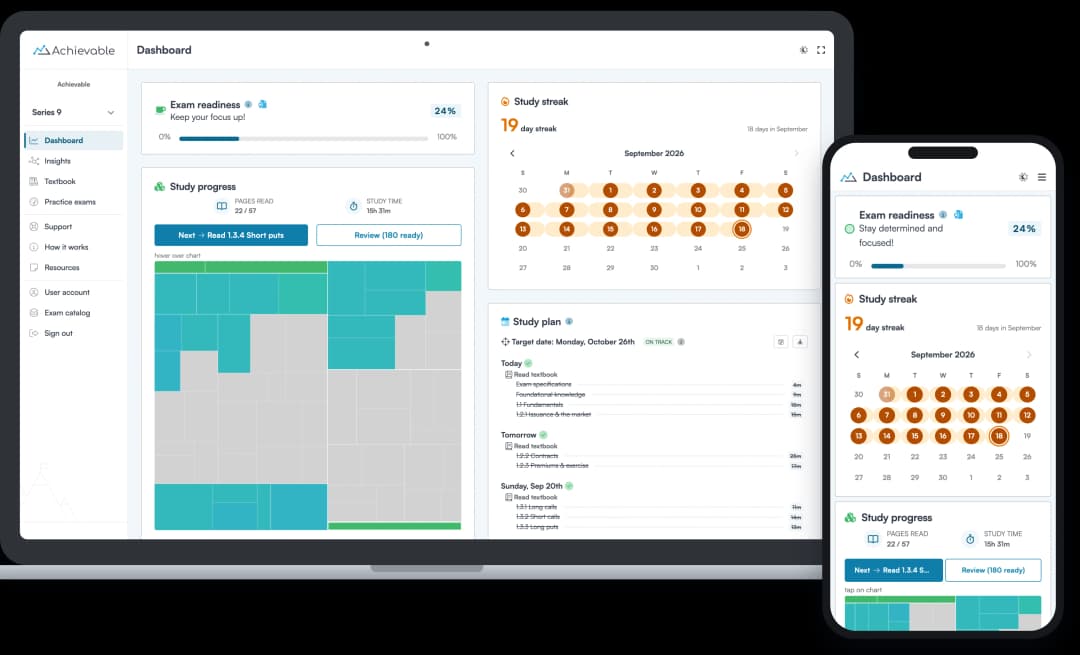
- Adaptive review. Its learning engine tracks your retention of each Series 9 exam learning objective and adjusts your quiz questions toward the topics that matter most for you.
- A readiness score. Achievable’s exam readiness score is calculated from your whole study history. It is not a predicted exam score; your goal is to bring it all the way to 100%.
- 21+ video lessons and audio narration alongside the text, if a long textbook was what lost you the first time.
- $249 for a full year of access, in one plan with no tiers, so a retake date that slips doesn’t cost you another course. The first lessons are free, with no credit card needed.
- A pass guarantee. If you’ve studied with Achievable and passed at least one of its full-length practice exams within the standard allotted time, but didn’t pass your actual exam, you’re eligible for a refund: email a picture of your exam scores with a valid state ID, and once the documents are verified, the refund is issued. There is no minimum study time.
Achievable also has a Series 9 FAQ and a comparison of the best Series 9 courses.
Series 9 retake FAQ
How long do I have to wait to retake the Series 9? 30 days after a first or second failed attempt, and 180 days after a third or later failed attempt within two years. From January 19, 2027, the waits are 15 and 60 days. They apply to any retake your firm requests on or after that date, and on that date FINRA also shortens the window of an earlier enrollment that has no appointment booked. Until then, FINRA’s waiting period FAQ says it can’t shorten anyone’s wait on request.
How much does a Series 9 retake cost? The $175 exam fee again, plus a new course only if you switch. Your firm requests the exam through CRD, FINRA charges the fee again, and a new 120-day window opens to schedule it.
Do I have to retake the Series 10 if I failed the Series 9? No. A waiting period applies only to the exam you failed. But you need to pass the Series 9 within two years of your Series 10 pass, or that pass is invalidated.
Do I have to retake the SIE or the Series 7? No. They are corequisites for the registration, and failing the Series 9 doesn’t affect them.
Should I switch courses after one failed attempt? Only if the course was the problem: memorized questions, practice scores that didn’t predict your result, or no full-length timed exams. Otherwise, change your plan and keep the course. One student who failed a FINRA exam by 1% wrote about switching to Achievable and passing the retake.
How does Achievable’s pass guarantee work? If you’ve studied with Achievable and passed at least one of its full-length practice exams within the standard allotted time, but didn’t pass your actual exam, you’re eligible for a refund. Email a picture of your exam scores with a valid state ID, and once they’re verified, Achievable refunds you. The Series 9 FAQ and the course page have the full terms.
Key takeaways
- Switch providers when the course was the problem: memorized questions, options math with the same numbers every time, practice scores that didn’t predict your result, or no full-length timed exams. Otherwise keep it and change the plan.
- Your failing score report shows your performance in each of the four functions. Functions 1 and 2 are two-thirds of the exam, and Function 4 holds the strategy math.
- FINRA’s wait is 30 days after a first or second failure (180 after a third within two years), falling to 15 and 60 days on January 19, 2027.
- A retake needs a new enrollment from your firm and the $175 fee again, and your Series 9 pass has to come within two years of your Series 10 pass.
- Aim for 100% readiness, and don’t sit again until you score about 80% on practice exams, 10 points above the 70% passing score, again and again across several full-length exams.