How I passed the Series 63 exam while working full-time


Hoa Tan is a rising senior at the University of Maryland, Baltimore County, majoring in financial economics. He is passionate about the finance industry and is looking for opportunities to progress in his professional career.
I passed the Series 63 this summer with about 16 hours of studying over a week and a half, while working 8-to-5 as a summer analyst at Morgan Stanley. It was my second exam with Achievable. I passed the SIE earlier with about 27 hours over two weeks, and the difference between how those two preps went taught me more about studying than either exam did.
I'm a rising senior at UMBC studying Financial Economics, and I'll start my career full-time after graduation. Most people wait for a firm to sponsor them, then cram for licensing in their first weeks on the job. I didn't want to do that. Coming from a non-target school, I don't get to skip steps, so my plan has always been to just do them earlier than everyone else. Walking into full-time recruiting with the SIE and the 63 already done was worth some tired weeknights.
The study routine that kept me focused
My routine was simple. After work and on my off days, I read through each chapter once and immediately took the chapter practice exam. My rule was 72% or better to move on to the next chapter, no rereading for comfort.
After finishing the material, I took full practice exams, drilled chapter practice on weak sections, and only reread where the questions proved I had to. Reading after a full day of work barely sticks, but questions do, so I did the question bank as much as possible. The more practice questions I took, the more angles on the material I got exposed to, and that's how the concepts actually settled in, stuff like federal versus state IARs, or IARs versus agents, and who registers where. I learned those by getting them wrong, reading the explanation, and not getting them wrong again.
Adapting my approach to improve my score
The confidence part is where the two exams flipped on me. For the SIE, I averaged in the 90s on practice the entire time, but I had run through the question bank so many times that some of my score was recognition rather than understanding, and when the real exam worded things differently, I got stressed in the room. That was on me and how I used the tool, not the tool itself, but it changed how I approached the 63.
This time, I took fewer questions overall and focused on explanations and underlying reasons instead of grinding for a score. My chapter exams averaged in the mid-80s, but my first full practice exams came in around the mid-70s, full of concepts I felt I had never seen before. Compared to my SIE numbers, that was uncomfortable. What kept me steady was reviewing every miss and realizing most of them were topics I had never encountered, let alone that style of question.
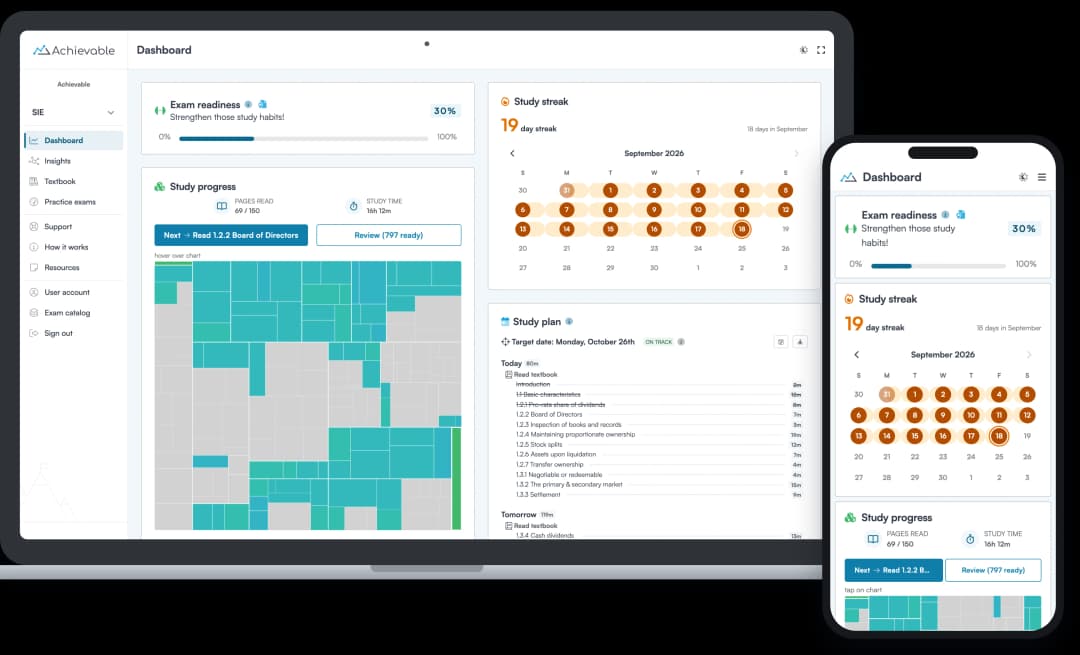
Once I saw that, the low scores stopped bothering me. A flat or even dropping practice score is actually fine if it means you're being exposed to new material, because every unfamiliar question you get wrong now is one that can't blindside you in the exam room. It's only a warning sign if you're repeatedly missing the same types of questions. Mine weren't, so I kept drilling the weak sections, and my final practice exams climbed into the mid-80s, with Achievable showing me at 93% readiness before I booked it. I still walked in less confident than I was for the SIE, and the actual exam felt better than the SIE ever did because, when the wording changed, I understood what was being asked. Achievable's structure is a big reason that the approach was even possible while interning.
Finding small gaps in my schedule to study
Short subsection readings, chapter tests, and question bank sessions fit easily into a work schedule. I could always see exactly where I stood, and reviewing errors did more for my long-term memory than anything else I tried. My advice if you're prepping while working full-time: set a score gate and honor it, mine was 72% per chapter. Do questions instead of rereading when you're tired, because tired reading is fake studying. And don't get discouraged by wrong answers or a dip in score. Check what you're missing first. If it's new material, that's your prep work, and the score will follow.
Also, I didn't take any notes while studying. I find that a lot of people love to write notes by hand, but for me, it never helps. Perhaps if the exam were very long and nuanced, it would be beneficial, but I found that I never refer back to my notes, and it's more time-consuming than anything. Just drilling the underlying concepts is the most important thing. Ultimately, everyone has different studying habits, but this is what helped me pass the exam in a week on my first attempt.