Passing the SIE without a firm behind me


Nick is a recent graduate of the University of Wisconsin–Madison, where he earned a BBA in Finance, Investment and Banking and received the Nathan S. Brand Award for Excellence in Finance. He most recently interned as a Macro Research Intern at WisdomTree Asset Management, building scenario-based equity models and authoring research published alongside the launch of the firm's Quantum Fund (WQTM). On campus, Nick led the M&A analysis for a first-place investment banking case competition pitchbook and co-authored equity research through UW–Madison's student-run Capital Management Club. He also captained the university's nationally ranked club baseball team for two seasons. A Bay Area native, Nick has passed the FINRA SIE and is pursuing analyst opportunities in investment banking and investment research.
The strange thing about taking the SIE exam right after college is that nobody makes you do it. There is no firm sponsoring you, no compliance deadline, and no manager checking in. I graduated from the University of Wisconsin-Madison in May 2026 with a finance degree and walked straight into one of the toughest entry-level markets in years.
Somewhere around my fortieth job application, I realized that every candidate in my pile had a finance degree and a decent GPA. The SIE was one of the few things I could actually control. It is the only FINRA exam you can sit for without a firm behind you, and I figured that showing up to interviews already licensed-adjacent would say something my resume could not.
The biggest mistake I made studying for the SIE exam
I will be honest about my first mistake: I assumed the exam would be easy. I had spent four years building DCFs and pitching stocks, so how hard could an "essentials" exam be? Then I took a diagnostic and got humbled. The SIE is not really a finance exam. It is a rules exam. Nobody in my corporate finance classes ever taught me the difference between a 3(a)(11) intrastate offering and Regulation D, or what a consolidated tape is, or how many days a firm has to send a trade confirmation. My valuation background helped with maybe a fifth of the material. The rest was a foreign language wearing a familiar suit.
The bigger challenge was structure, or the lack of it. When you are unemployed and studying, nobody builds your day for you. I had spent three years on Wisconsin's club baseball team, two of them as captain, and the thing baseball drills into you is that you do not rise to the occasion, you fall to your preparation. So I treated the SIE like a season. Mornings were for studying, before my brain got poisoned by the job boards. Afternoons were for applications and networking calls. I studied in the same spot, at the same time, for about five weeks.
How practice exams helped me pass the SIE
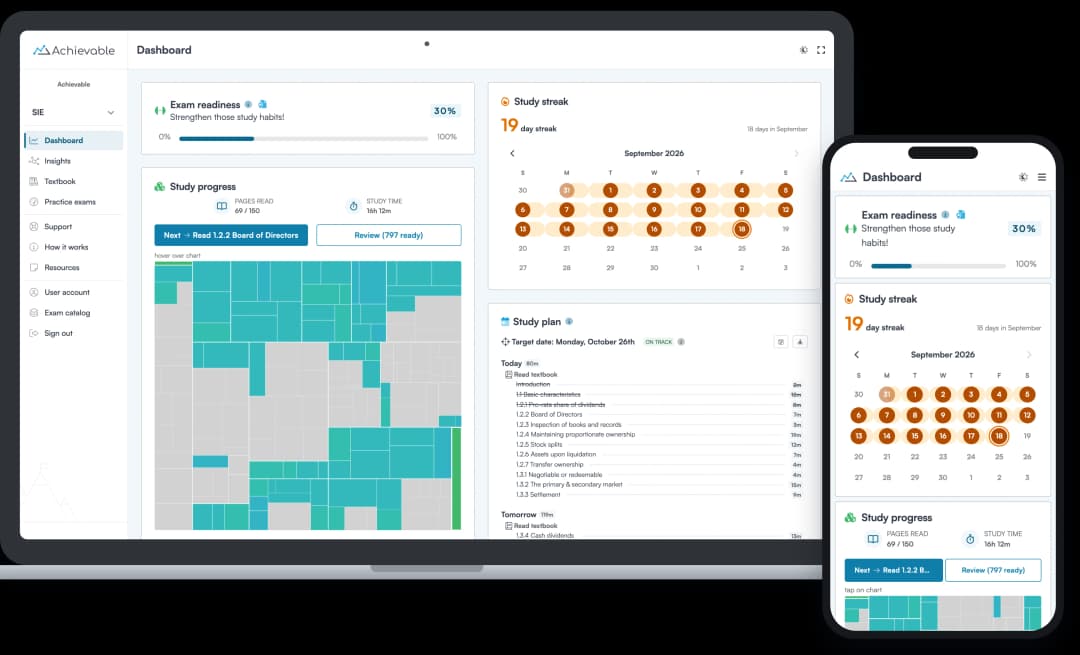
Achievable ended up fitting that routine better than I expected. What actually made the difference for me was the review system. The quizzes kept resurfacing the exact rules I kept getting wrong, usually right when I had comfortably forgotten them. Customer account types and communications rules died on that hill several times each. I also took the practice exams during the last two weeks. My scores climbed slowly, which was frustrating in the moment but turned out to be the honest signal: when my practice scores stabilized comfortably above passing, I stopped second-guessing and booked the test.
Test day nerves were real, which surprised me, because I had taken plenty of exams with much more riding on them. I think it was the binary nature of it. Nobody asks what you scored on the SIE; they ask whether you passed. What calmed me down was the boring part: I had done the reps. When the screen finally showed I passed, the relief was less about the exam and more about the proof that I could still hold myself to a standard with nobody watching.
Advice for future SIE candidates
If I could do it differently, I would have started the practice exams a week earlier and trusted the diagnostic more from day one. Familiarity is not readiness, and a finance degree buys you less on this exam than you think it does. I would also tell anyone starting out: if you are studying while job hunting, guard your study block like a job. The applications will eat every hour you let them.
As for what is next, I am interviewing for analyst roles in investment banking and investment research, and the SIE has already changed the shape of those conversations. It shows up in the "licenses" line on applications, sure, but the real value is being able to say I am ready to sit for the Series 63 and 79 the day a firm sponsors me. For someone trying to break in without a return offer in hand, that's the whole point: control what you can control, and let the preparation speak when the resume cannot.