How long should you study for the GRE? A week-by-week plan


Table of contents
- How long to study, by score gap
- Step 1: Find your score gap with a diagnostic
- Step 2: Work backward from your deadline
- Step 3: Pick a week-by-week plan
- The 4-week plan: a gap of up to 5 points at 10 to 15 hours a week
- The 8-week plan: a gap of 6 to 10 points at 10 hours a week
- The 12-week plan: a gap of 11 to 15 points at 10 hours a week
- What to do every week, whatever the plan
- When you are ready to test
- How Achievable’s course supports the plan
- FAQ
- Key takeaways
Most people need about 40 to 160 hours of study for the GRE, which is one to four months at about 10 hours a week. Where you fall depends on two numbers: the gap between your diagnostic score and your target score, and the hours you can give each week. A gap of about 5 points can close in a month; a gap of 15 points usually takes about three months at 10 hours a week.
ETS doesn’t publish a recommended study time, so the figures below are our advice, built from the gap you need to close. Below: a table of score gap against weeks, how to find your gap, how to work backward from an application or job-offer deadline, sample 4-, 8- and 12-week plans, and how Achievable GRE fits into them.
How long to study, by score gap
Measure your gap in combined Verbal and Quant points (each section is scored 130 to 170, so the combined score runs from 260 to 340). Then find your row, and read across to the hours you can keep up each week:
Score gap | Study hours | 5 hours a week | 10 hours a week | 15 hours a week |
|---|---|---|---|---|
Up to 5 points | About 40 | 8 weeks | 4 weeks | 3 weeks |
6 to 10 points | About 80 | 16 weeks | 8 weeks | 6 weeks |
11 to 15 points | About 120 | 24 weeks | 12 weeks | 8 weeks |
16 points or more | 160 or more | 32+ weeks | 16+ weeks | 11+ weeks |
Weeks are rounded up. Treat the hours as a starting estimate, not a promise: they run longer if it has been years since you last did algebra or read dense academic prose, and shorter if your diagnostic was close on one section and you only need to raise the other. If your Analytical Writing score is below what your programs look for, add 5 to 10 hours of timed Issue essays on top.
Two patterns hold for almost everyone:
- Hours a week matter more than the calendar. Going from 5 to 10 hours a week halves the time to your test. Plan on the hours you can keep up in a hard week, not your best one.
- Longer isn’t better past a point. In his Achievable Insights piece, Mike Bergin argues for a focused prep season of two to four months rather than a year of light study, because a defined prep season keeps motivation high and reduces burnout. If the table gives you more than about 16 weeks, add hours each week instead of adding weeks.
Step 1: Find your score gap with a diagnostic
Your gap is your target score minus your starting score, so you need both numbers before you can plan.
Your starting score. Start with Achievable’s free GRE practice exam: 10 Quant questions, each scored instantly with an explanation, so you see which kinds of math questions you miss and why. Then take one of ETS’s free POWERPREP Online practice tests, timed, in one sitting. It is the official full-length test, and it gives you scaled Verbal and Quant scores to subtract from your target.
Your target score. Look up the GRE scores each program on your list reports for its admitted students, usually on its admissions or class-profile page, and take the highest one as your target. Our guide to what a good GRE score is shows where scores fall by percentile and intended major.
For what counts as competitive in each field, from ETS’s own averages, and whether an online course can close your gap, see can an online GRE course get you to a competitive score?
Split the gap by section. A 10-point gap that is all Quant calls for a different plan than one split evenly, and the sample plans below tell you where to move hours.
Step 2: Work backward from your deadline
If you have an application deadline, a fellowship deadline or a job offer that needs an answer by a set date, plan from that date, not from today. Three ETS rules set the calendar:
- Scores take 8 to 10 days. Your official scores reach your ETS account 8 to 10 days after your test date, and ETS sends them to the programs you chose at the same time. Your fee covers sending scores to up to 4 programs.
- A retake waits 21 days. You can take the GRE once every 21 days, up to five times in any rolling 12 months.
- You can move your date up to 4 days before. The GRE Information Bulletin lets you reschedule no later than four days before your test date, for a $55 fee outside China.
Put together, a first test and one retake with its scores take about a month (21 days, then 8 to 10 days for scores). So:
- Take your first test about six weeks before your earliest deadline. That leaves room for a retake, its scores and a few days of margin.
- Start studying the number of weeks in the table before that test date.
- Book your test date as soon as you have picked it. The GRE runs year-round at test centers and at home; booking early gives you the most choice of dates and times, and a date on the calendar keeps a plan honest.
An example for a college senior. Say you need scores by March 1 to accept a graduate offer, and your diagnostic leaves a 10-point gap. Six weeks before March 1 puts your first test at about January 18, with a retake possible from February 8 and its scores by about February 18. At 10 hours a week, 80 hours takes 8 weeks, so you start by about November 23. If finals will cut you to 5 hours a week in December, start earlier, or plan 15-hour weeks over the winter break to make up the difference.
If a test date comes and your practice isn’t ready, move it: rescheduling costs $55, while a retake costs another $249 and at least three weeks.
Step 3: Pick a week-by-week plan
The GRE is about 1 hour 58 minutes long: one 30-minute Issue essay, then two Verbal and two Quant sections of 12 and 15 questions each, every one timed. Timed practice belongs in every plan from the third week on.
The plans below follow the order of Achievable’s GRE course, from arithmetic through geometry, text completion through reading comprehension, then the Issue essay, but mix Verbal in from the start so it doesn’t wait until the end. As a default, give about half your hours to Quant, a third to Verbal and vocabulary, and the rest to the Issue essay and full-length tests. Then move hours toward your weaker section.
The 4-week plan: a gap of up to 5 points at 10 to 15 hours a week
Week | What to study | Time |
|---|---|---|
1 | Diagnostic. Arithmetic and algebra review: fractions, percent change, exponents, roots, quadratics, inequalities. Text completion and sentence equivalence. Vocabulary every day | 10–15 hours |
2 | Word problems, ratios, statistics and data interpretation, geometry. Reading comprehension. A timed Quant or Verbal section most days | 10–15 hours |
3 | Quant strategies (plugging in numbers, backsolving, comparing quantities). Your mistakes list. A full-length POWERPREP test and two Issue essays | 10–15 hours |
4 | A second full-length test early in the week, your weakest topics, then lighter days before the test | 8–12 hours |
The 8-week plan: a gap of 6 to 10 points at 10 hours a week
Week | What to study | Time |
|---|---|---|
1 | Diagnostic: Achievable’s free Quant exam and a timed POWERPREP test. Arithmetic: positive and negative numbers, odd and even, fractions, decimals, percent change. Vocabulary lists 1–2 | 10 hours |
2 | Algebra: exponents, roots, quadratics, functions, inequalities and absolute value, systems of equations. Single-blank text completion. Vocabulary lists 3–4 | 10 hours |
3 | Number properties (divisors, primes, GCF and LCM), ratios, mixtures, interest, algebra word problems. Sentence equivalence and double-blank text completion. Your first timed sections | 10 hours |
4 | Statistics and data interpretation, sequences, counting and probability. Triple-blank text completion. One Issue essay. Vocabulary lists 5–6 | 10 hours |
5 | Geometry: angles, triangles, polygons, circles, 3D shapes, the coordinate plane. Reading comprehension. Two timed Verbal sections. Vocabulary lists 7–8 | 10 hours |
6 | Quant strategies and time management. Vocabulary lists 9–10. A second full-length POWERPREP test | 10 hours |
7 | Your weakest topics from your mistakes list. Timed long Quant and Verbal sections. One Issue essay. A third full-length test | 10 hours |
8 | A final full-length test early in the week, then review and lighter days before the test | 8–10 hours |
The 12-week plan: a gap of 11 to 15 points at 10 hours a week
Weeks | What to study | Time |
|---|---|---|
1–2 | Diagnostic. Arithmetic and number properties. Vocabulary lists 1–3 | 20 hours |
3–4 | Algebra, functions, inequalities, systems of equations. Text completion and sentence equivalence. Your first timed sections | 20 hours |
5–6 | Word problems, ratios, statistics and data interpretation, probability. Triple-blank text completion. Two Issue essays. Vocabulary lists 4–6 | 20 hours |
7–8 | Geometry and the coordinate plane. Reading comprehension. A second full-length test. Vocabulary lists 7–10 | 20 hours |
9–10 | Quant strategies and time management. Your weakest topics. Timed long sections every week. A third full-length test | 20 hours |
11–12 | Two more full-length tests, a week apart, your mistakes list, then lighter days before the test | 18–20 hours |
On a 5-hour week, double the length of each step: the 8-week plan becomes a 16-week plan with the same order.
If you want a practice book alongside the plan, see the best GRE practice books, compared: use it for drills once you have learned a topic, and save ETS’s official tests for the last weeks.
What to do every week, whatever the plan
- Keep a mistakes list. Write down every question you miss in timed work and why: a concept you didn’t know, a misread, or running out of time. Redo those questions the following week.
- Review on a schedule. Topics from week 2 fade by week 8 unless you see them again. Achievable’s spaced-repetition review brings each topic back just before you would forget it, so this happens without planning.
- Time yourself from week 3. The real sections give you 18 to 26 minutes each, and pacing is a skill of its own.
- Write an Issue essay every week or two. It is the first section on test day, and 30 minutes goes fast.
When you are ready to test
Aim for 100% readiness: your timed section results and your full-length practice scores should sit comfortably above your target score, consistently, across several full-length tests, so your result doesn’t depend on the luck of the draw. One good practice score isn’t the signal. If your scores are still below your target two weeks before your test date, move the date rather than hope.
Use ETS’s official tests for the full-length practice in the second half of your plan: the free POWERPREP Online tests first, then POWERPREP PLUS tests at $44.95 each. They are the closest you can get to the real test’s questions and scoring.
How Achievable’s course supports the plan
Achievable GRE is a self-paced course built for exactly this kind of plan:
- Lessons for every topic in the plan. Each Verbal and Quant topic is taught in an online textbook written by a veteran GRE tutor, then checked with review questions, so one lesson and its questions fit a single study session.
- Review that remembers for you. Achievable tracks how well you remember each topic and schedules review just before you would forget it, so your hours go to what you haven’t mastered.
- Timed practice for every week of the plan. 30 timed Verbal sections, and as many timed Quant sections as you want, drawn fresh every time from 200+ question templates with new numbers. Issue essays are scored the moment you finish. In all, 950+ practice questions with explanations.
- Vocabulary in small doses. 250+ commonly tested vocabulary words, with memory tracking, for the few minutes a day each plan above calls for.
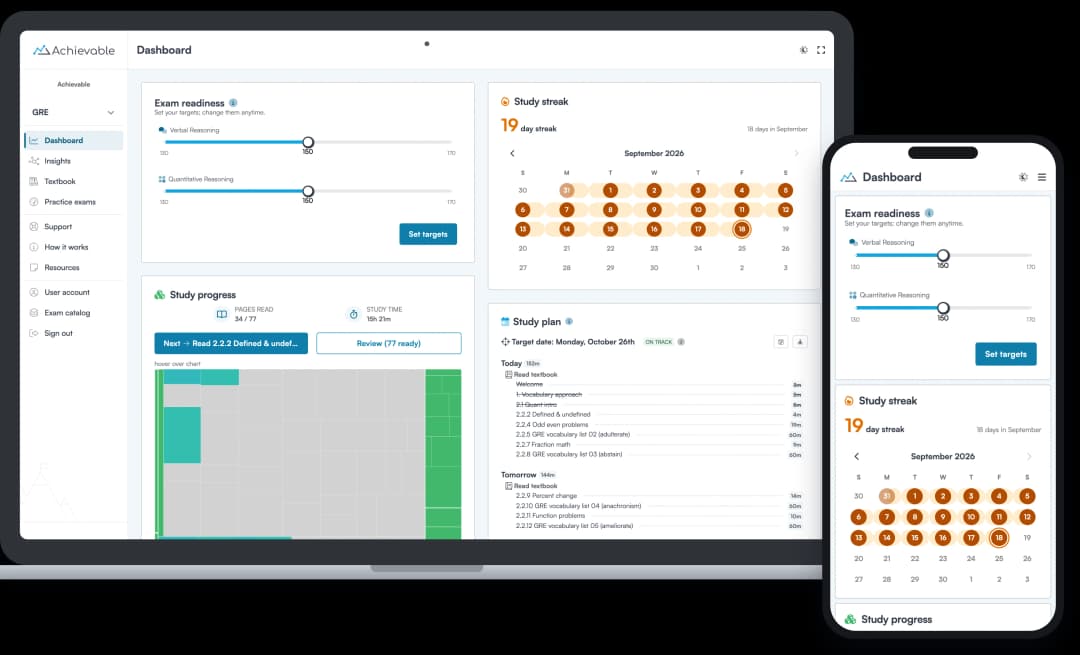
- A study planner. An interactive study planner lays the course out against your test date.
- A year to use it. Achievable GRE is $199 for 12 months of access, so a plan that slips, or a retake, doesn’t mean paying again.
Achievable has no full-length practice GRE, so pair its timed sections with ETS’s POWERPREP tests in the second half of your plan, as the plans above do.
If you work full time, our guide to GRE prep while working full time has a sample week around a 9-to-5, and Vince Kotchian’s Insights piece on flexible GRE study plans covers adjusting a plan as you go.
FAQ
Can I study for the GRE in a month? Yes, if your gap is small. A gap of up to about 5 points takes about 40 hours, which is 10 hours a week for four weeks. A 10-point gap in a month means about 20 hours a week, which is hard to keep up alongside school or a job. If your diagnostic shows a bigger gap than that, push your test date back rather than cram.
How many hours a day should I study for the GRE? About 1 to 2 hours on most days is enough for the plans above: 10 hours a week is roughly an hour and a half a day, or an hour on weekdays plus a longer block at the weekend for timed sections and full-length tests. Short daily sessions with regular review hold up better than a few long ones.
Is three months enough for the GRE? For most people, yes. At 10 hours a week, three months is about 120 hours, enough for a gap of up to about 15 points. A bigger gap needs more hours a week or more time.
When should I take the GRE if I have a deadline? About six weeks before your earliest deadline. Scores arrive 8 to 10 days after the test, and you have to wait 21 days to retake, so six weeks leaves room for a second attempt and its scores.
Key takeaways
- Most people need about 40 to 160 hours, one to four months at 10 hours a week, depending on the gap between their diagnostic and target scores.
- Find your gap with Achievable’s free Quant practice exam and ETS’s free full-length POWERPREP test, against your programs’ reported scores.
- With a deadline, take your first test about six weeks before it, so a retake and its scores still fit, and count your study weeks back from that date.
- Follow the course order, mix in Verbal from the start, time yourself from week 3, and keep a mistakes list.
- Book the test when your practice scores sit comfortably above your target, consistently, across several full-length tests.