Can an online GRE course get you to a competitive score?


Table of contents
Yes. An online course can get you to a competitive GRE score when three things line up: it teaches every Verbal and Quant topic you have forgotten, it gives you plenty of timed practice, and you give it the hours your gap needs. By our estimates, that is about 40 hours to close a 5-point gap and about 120 hours to close 15 points.
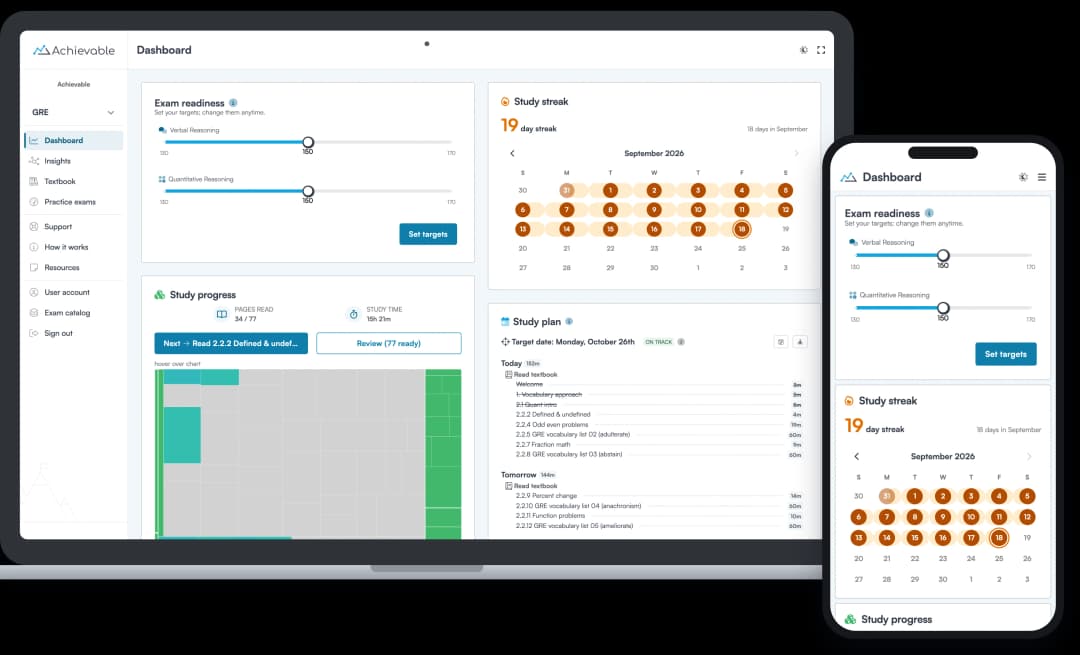
Achievable GRE is built that way: $199 for 12 months of access, an online textbook for every Verbal and Quant topic with spaced-repetition review, 30 timed Verbal sections, as many timed Quant sections as you want (drawn fresh every time from 200+ question templates), and Issue essays scored the moment you finish. For students with an official GRE score below 330 from the last 5 years, it comes with a score improvement guarantee: +8 points for a starting score below 300, +6 points for a starting score of at least 300 and below 315, and +4 points for a starting score of at least 315 and below 330, or your money back. Send us your previous official score within 7 days of buying, then retest while your year of access is active; there is no minimum study time. Achievable has no full-length practice GRE of its own, so pair it with ETS’s official POWERPREP tests, as every plan should, whichever course you choose.
Below: what counts as a competitive score in your field, from ETS’s own data; how much a course can move your score; what to look for in an online course; the score guarantees compared; and a timeline by the size of your gap.
What counts as a competitive GRE score
Competitive means competitive for the programs on your list, not for the GRE as a whole. The number to beat is the one each program reports for the students it admitted, usually a median or a middle-50% range on its admissions or class-profile page. Take the highest one on your list as your target.
When a program publishes nothing, ETS’s own averages by field are the next best benchmark. These are the mean scores in Interpreting Your GRE Scores: 2026–27, for college seniors and graduates not enrolled in school who tested from July 1, 2022, to June 30, 2025, grouped by the field they planned to study:
Intended field | Verbal | Quant | Writing |
|---|---|---|---|
Business | 154 | 160 | 3.7 |
Education | 152 | 150 | 3.7 |
Engineering | 151 | 160 | 3.4 |
Humanities and arts* | 153 | 160 | 3.4 |
Law | 154 | 152 | 3.9 |
Life sciences | 150 | 150 | 3.7 |
Physical sciences | 152 | 162 | 3.4 |
Social and behavioral sciences | 154 | 155 | 3.8 |
Read them as the averages of everyone who planned to study the field, not of the students programs admitted. A competitive program usually admits above its field’s average, so treat these figures as a floor, and set your target above them in the section your programs care about most. If a program is test-optional, send your scores only when they are at or above what it reports for admitted students.
*One row needs care. The 2026–27 edition gives humanities and arts 153 Verbal, 160 Quant and 3.4 Writing, where the 2025–26 edition gave 156, 153 and 4.0, although the two editions share two of their three years of test takers. Until ETS explains the change, lean on your programs’ own figures for a humanities target.
Percentiles show why Quant targets run higher than Verbal ones. Among everyone who tested in the same three years, the average was 151.39 in Verbal and 157.62 in Quant. So a 160 is the 82nd percentile in Verbal but the 50th in Quant, and a 165 is the 95th and the 67th (ETS’s percentile table). A 160 in Quant is about average for test takers headed for engineering; a 160 in Verbal is a strong score in almost any field. Our guides to what a good GRE score is and how the GRE is scored go further.
How much can an online course raise your score?
There is no reliable average to quote. No independent source publishes a current figure for how much a GRE course raises scores, and the gains prep companies advertise come from their own students, measured their own way. What decides your gain is how far you start from your target, which section the gap is in, and how many hours you put in.
Three things hold for almost everyone:
- Teaching closes knowledge gaps. If you have forgotten algebra, geometry or data analysis, or you are out of practice with dense academic reading, lessons that teach each topic are where a course earns its price. Practice questions alone test what you know without teaching what you don’t.
- Timed practice closes pacing gaps. Many test takers know the material and lose points to the clock. The Verbal sections give you 18 and 23 minutes for 12 and 15 questions, and the Quant sections 21 and 26 minutes (ETS’s test structure page).
- Hours matter more than the calendar. A gap of about 5 points takes about 40 hours and a gap of about 15 takes about 120, so going from 5 to 10 hours a week halves the time to your test. The timeline below has the full table.
A guarantee tells you what a company will refund you over, not what a typical student gains. The guarantees are compared below, with what each asks of you.
What to look for in an online GRE course
Check any course you are considering for these:
- Lessons for every topic, not just questions. Achievable GRE teaches each Verbal and Quant topic in an online textbook written by a veteran GRE tutor, checked with chapter quizzes. It is a text-based course with 15 explainer videos on key topics, not a video course, so if you learn best from video lectures, weigh that.
- Plenty of timed practice. Pacing is a skill of its own, practiced section by section. Achievable has 30 timed Verbal sections, and as many timed Quant sections as you want, drawn fresh every time from 200+ question templates with new numbers, so your Quant practice never turns into a test you have memorized. In all, it has 950+ practice questions with step-by-step explanations.
- Full-length tests under test conditions. The real GRE is section-level adaptive: how you do on the first Verbal and Quant sections sets the difficulty of the second, and a full-length test is how you rehearse that. ETS’s POWERPREP tests are the official ones: the POWERPREP Online tests are free (take the timed one, since Practice Test 1 taken untimed gives no Verbal or Quant score), and POWERPREP PLUS tests cost $44.95 each. Achievable has no full-length practice GRE of its own, so pair its timed sections with these.
- Essay practice with a score. The Issue essay comes first on test day, with 30 minutes to write it. Achievable scores each Issue essay the moment you finish, with hundreds of prompts to practice.
- Review that brings topics back. What you study in week 2 fades by week 8 unless you see it again. Achievable tracks how well you remember each topic and brings it back just before you would forget it.
- Enough access for a retake. You can take the GRE once every 21 days, up to five times in any rolling 12 months (ETS). Achievable gives you 12 months of access, so a retake doesn’t mean paying for the course again.
- A guarantee you can actually claim. Read what it asks of you before you pay for it (next section).
Achievable’s GRE score guarantee, and how others compare
Achievable guarantees a higher GRE score for students with an official GRE score below 330 from the last 5 years: +8 points for a starting score below 300, +6 points for a starting score of at least 300 and below 315, and +4 points for a starting score of at least 315 and below 330, or your money back. So the often-quoted “up to 8 points” applies only to a starting score below 300.
How to claim it:
- Have an official score from a test you took in the 5 years before buying the course, and send us its score report within 7 days of buying.
- Take the same official test again while your year of access is active.
- If your new score has not risen by the points guaranteed for your starting score, email us its score report and a valid ID within 31 days of the test, and we’ll refund the course in full.
- There is no minimum study time and no chapter to finish.
Every Achievable course for a scored exam can also be refunded in full within 7 days of purchase, for any reason. See the GRE score guarantee page for the details.
Here is what each provider’s guarantee promises, and what it asks of you, read on each provider’s own pages on November 24, 2026, at list prices before sales:
Course | Price | Guarantee | To claim it |
|---|---|---|---|
$199 for 12 months | +8 points for a starting score below 300, +6 points for a starting score of at least 300 and below 315, and +4 points for a starting score of at least 315 and below 330, or your money back | An official score from the last 5 years; no minimum study time | |
Kaplan | On Demand from $299 | A higher score; 325+ or +10 with Premium Tutoring | Finish the program |
The Princeton Review | $499 Self-Paced; $899 10 Points+ | A higher score; +10 on 10 Points+ | Coursework and 4 or 5 of its tests |
Magoosh | $149 to $179 | +5 points from 320 or below | An earlier official score |
Manhattan Prep | $299 Interact; $1,999 GRE for MBA | None on Interact; a higher score on GRE for MBA | Every session and 4 full tests |
Target Test Prep | $229 a month | More subscription time, not a refund | 100% of the course |
The biggest difference is what each one asks of you. Achievable’s guarantee asks for no minimum study time and no chapter to finish, and Magoosh’s asks for no coursework either, only a GRE score under 5 years old, sent at sign-up. The others want the work done first. Kaplan’s covers first-time Kaplan students who finish the program, and its Premium Tutoring guarantee also asks for every session and all homework, seven full-length Kaplan tests and the GRE within 30 days of the last session. The Princeton Review’s asks for the coursework and at least four practice tests on Self-Paced, and practice tests 1 to 5, all homework and the GRE at least 30 days after access starts on 10 Points+. Manhattan Prep’s guarantee, on GRE for MBA and private tutoring only, asks for every session, all homework, at least four full-length tests and the GRE within 30 days of the last session. Target Test Prep’s asks you to complete 100% of the course and meet its accuracy benchmarks, on its Expert tracks, and pays out in more subscription time rather than money.
The promises differ in the fine print too. Kaplan’s Premium Tutoring guarantee is 325+ for a baseline of 315 or higher, or +10 points below 315, and its other eligible courses promise any higher score. The Princeton Review’s 10 Points+ promises 10 points for a starting score below 307, or 158+ in each section from 307 or higher (not if both sections start at 158+). Manhattan Prep’s private tutoring promises 325+ or 10 points, depending on your baseline. Achievable’s, Magoosh’s and Target Test Prep’s start from an official GRE score you already have, while Kaplan’s, The Princeton Review’s and Manhattan Prep’s can also start from a practice test of their own. Most providers run frequent sales, so the price at checkout can be lower. For every course’s price and access, see how much a GRE prep course costs and the best GRE prep courses.
A timeline by score gap
Your gap is your target score minus your starting score, in combined Verbal and Quant points. For your starting score, begin with Achievable’s 10 free GRE Quant questions, scored instantly with explanations, for a quick read on your math, then take a timed POWERPREP Online test for scores on the real 130–170 scale. Achievable’s score guarantee needs an official GRE score you already have; if this will be your first GRE, it doesn’t apply, but the 7-day refund for any reason does. ETS publishes no recommended study time, so these are our estimates, the same as in our week-by-week GRE study plans:
Score gap | Study hours | At 5 hours a week | At 10 hours a week |
|---|---|---|---|
Up to 5 points | About 40 | 8 weeks | 4 weeks |
6 to 10 points | About 80 | 16 weeks | 8 weeks |
11 to 15 points | About 120 | 24 weeks | 12 weeks |
16 points or more | 160 or more | 32+ weeks | 16+ weeks |
The hours run longer if it has been years since you last did algebra or read dense academic prose, and shorter if your gap is all in one section. If your Writing score is below what your programs look for, add 5 to 10 hours of timed Issue essays.
If you have an application deadline, plan back from it. Your official scores reach your ETS account 8–10 days after the test (ETS), and you can retest after 21 days, so take your first test about six weeks before your earliest deadline. That leaves room for a retake on the 21st day and its scores, as long as you name your programs on test day: ETS sends your scores to up to four programs named then, at no extra cost, when the scores reach your account, and each report after that costs $40. With ETS’s ScoreSelect option you can send your most recent scores, all of them or any test dates you choose, from the last 5 years, though some programs ask for every score you have (ETS).
Book the test when you are fully ready: aim for 100% readiness, and keep scoring comfortably above your target score on full-length practice tests, consistently, across several of them, so your result doesn’t depend on the luck of the draw. One good practice score isn’t the signal, and several full-length tests means adding POWERPREP PLUS tests to the free ones. If you work full time, our guide to GRE prep while working full time fits the plan around a 9-to-5.
When an online course isn’t the right fit
Achievable GRE is self-paced, so it suits students who can keep their own schedule. If you need a teacher on a timetable to keep you studying, a live online course gives you that at a higher price: Kaplan’s Live Online course lists at $1,099, and Manhattan Prep’s GRE for MBA at $1,999. If your gap is 16 points or more and your deadline is under three months away, a tutor’s hours on top of a course can help you cover the ground in time.
If you would rather study from books, see the best GRE practice books, compared, which also covers when a book is enough and when a course is worth it.
Frequently asked questions
Can an online GRE course get me into a competitive program? It can get your score to where your programs admit students, which is the part a course controls. Aim at or above the scores your programs report for admitted students; admission also weighs your record, statement and letters.
Is a self-paced online course as good as a live class? For a student who keeps a schedule, yes: the lessons and the timed practice are what move a score, and a live class adds a teacher and a timetable. Achievable GRE is $199 for 12 months; Kaplan’s Live Online course lists at $1,099.
How many points can I raise my GRE score in a month? About 5 points at 10 hours a week, by our estimates. Closing 10 points in a month takes about 20 hours a week, which is hard to keep up alongside school or a job.
Does Achievable GRE include full-length practice tests? No. Its timed practice is 30 Verbal sections, unlimited Quant sections drawn fresh every time and instantly scored Issue essays, with 950+ practice questions in all. For full-length practice, take ETS’s free POWERPREP Online tests and its POWERPREP PLUS tests at $44.95 each.
What does “up to 8 points” mean in Achievable’s guarantee? It is the top tier, for a starting score below 300. In full: +8 points for a starting score below 300, +6 points for a starting score of at least 300 and below 315, and +4 points for a starting score of at least 315 and below 330, or your money back. It covers students with an official GRE score below 330 from the last 5 years, who send us that score report within 7 days of buying and retest while their year of access is active.
Key takeaways
- Competitive means at or above the scores your own programs report for admitted students. ETS’s field averages, such as 154 Verbal and 160 Quant for business, are a floor, not a target.
- An online course gets you there when it teaches every topic, gives you plenty of timed practice, and you put in the hours: about 40 for a 5-point gap and about 120 for 15 points.
- Pair any course with ETS’s official POWERPREP tests for full-length practice.
- Achievable GRE is $199 for 12 months. For students with an official GRE score below 330 from the last 5 years, sent within 7 days of buying, it guarantees +8 points for a starting score below 300, +6 points for a starting score of at least 300 and below 315, and +4 points for a starting score of at least 315 and below 330, or your money back, with no minimum study time.
- Take your first test about six weeks before your deadline, and book it when you are fully ready: aim for 100% readiness, scoring comfortably above your target on full-length practice tests, consistently, across several of them.