

Property Insurance Exam information
What it is, what's tested, and how it's scored.
Property Insurance exam details
To become a licensed Property Insurance agent and sell both personal and commercial lines of protection, you first need to pass your state's Property exam.
The key topics for the exam include: general insurance terminology and concepts; characteristics of insurance products; insurance policies and contracts; exclusions and limits; additional coverages; and endorsements. You should also be familiar with state-specific rules and regulations, as well as possess a solid understanding of the legal and financial frameworks that oversee insurance transactions.
The structure, number of questions, cost, and details of each exam differ by state. Most states provide separate Property Insurance and Casualty Insurance exams, as well as a combined Property and Casualty (P&C) exam, offering flexibility for agents in their certification process. Some states mandate prelicensing courses before taking the exam and obtaining the license. Be sure to review your state's requirements thoroughly before starting the licensing process.
The Property Insurance exam is hosted by State-administered and costs $40-$60 to register. Participants have ~2 hours (varies by state) to answer ~100 multiple-choice questions (varies by state). The passing score is around 70%.
Time
~2 hours (varies by state)
Format
~100 multiple-choice questions (varies by state)
Exam fee
$40-$60
Passing score
around 70%
Details
The Property Insurance exam is administered online by one of three testing providers. Find a testing location near you:
You can schedule your exam at your preferred location through your state's testing provider website. It's recommended to register as early as possible to secure a convenient time and location.
Most of the Property Insurance exam content is consistent across tests in the U.S. There is typically a small amount that varies by state due to state-specific rules and regulations, which are all covered in our course.
Property Insurance exam summary
Insurance Regulation
The Insurance Regulation section outlines the licensing process for various types of licensees, including producers, business entities, and financial institutions. It emphasizes distinctions between resident and nonresident statuses and temporary licenses. Additionally, it explores aspects related to license maintenance, renewal, reporting actions, and continuing education requirements.
General Insurance
This General Insurance section covers fundamental concepts crucial for understanding insurance principles and operations. It begins by exploring key risk management terms, including risk, exposure, hazard, peril, and loss, along with methods of handling risks such as avoidance, retention, sharing, reduction, and transfer.
Property Insurance
This section covers essential principles integral to understanding insurance fundamentals. It explores key concepts such as insurable interest, underwriting functions, loss ratios, and various types of hazards, including physical and moral hazards.
Dwelling ('02) Policy
This Dwelling Policy section discusses the policy's purpose, coverage forms against basic, broad, and special perils, and various property coverages, such as dwelling, personal property, and more.
Homeowners ('11) Policy
This section covers various aspects regarding Homeowners' insurance, including coverage forms (HO-2 through HO-6), definitions, property coverages, insured perils, exclusions, conditions, and selected endorsements.
Auto Insurance
The Auto Insurance section focuses on subjects such as personal auto policy details, including coverage types, deductibles, and endorsements that are specific to state regulations. Additionally, this portion addresses commercial auto coverage forms, physical damage coverage, exclusions, conditions, definitions, and selected endorsements relevant to commercial auto insurance policies.
Commercial Package Policy (CPP)
This section discusses components like policy declarations, conditions, endorsements, and coverage parts. It also includes details on components of a commercial policy, commercial inland marine insurance, and commercial crime insurance.
Business owners ('10) Policy
The Business Owners Policy (BOP) discusses the characteristics, purpose, and key components of the policy, including property coverage details such as exclusions, limits, deductibles, and loss conditions. The section also addresses common policy conditions and selected endorsements, such as protective safeguards and utility services coverage enhancements.
Achievable Property Insurance content outline
1
General Insurance Concepts
An overview of foundational concepts essential to understanding the insurance industry. Risk management principles, sources of insurance, different insurance marketing systems, the authority of producers, insurance contracts, and the legal principles governing them.
2
Property Insurance Basics
The Property exam is very "definitional." Knowing the terminology is imperative to learning the subject matter and passing the exam. This chapter introduces several "must-know" concepts.
3
Underwriting
The role of the insurance underwriter. Different sources of underwriting information, how premiums are determined, and what it means to "rate" an insurance policy.
4
Claims Settlement
In property, the claims process can be immensely complex. In this chapter, you will learn various ways to value insured property, coinsurance requirements, and coordination clauses used when more than one policy covers an insured event.
5
Dwelling Policies (DP)
An introduction to the simplest forms of property insurance, Basic form (DP1), Broad form (DP2), and Special form (DP3), and their respective coverages.
6
Dwelling Policy Conditions
A deeper look into dwelling policies, conditions, available endorsements, and common exclusions.
7
Homeowners Policies (HO)
This chapter explores the five testable Homeowner forms: HO-2, HO-3, HO-4, HO-6, and HO-8. It focuses on the structure of the HO policy, introducing Section I (property coverage).
8
Endorsements and Scheduled Property
A Homeowner's policy may be customized with several endorsements. This chapter discusses the most common testable endorsements.
9
Flood and Other Limited Policies
This chapter covers the Regular and Emergency flood insurance programs, Comprehensive Personal Liability (CPL), Excess and Umbrella insurance, and miscellaneous personal lines policies.
10
Commercial Package Policy (CPP)
A Commercial Package Policy (CPP) is like a shopping cart into which you can add various commercial coverages. While each coverage part added has its own conditions and declarations page, all coverage parts will be governed by the conditions and declarations of the CPP.
11
Ocean and Inland Marine Insurance
This chapter covers Jewelers Block insurance and Marine insurance, which includes "Instrumentalities of transportation and communication."
12
Business Owners Policies (BOP)
If a business is eligible, a BOP is generally easier and more cost-effective than a CPP. This chapter explores the eligibility requirements, structure, and available coverage parts of the Business Owners Policy.
13
State Regulations and NAIC Insurance Law
While insurance concepts are relatively uniform in all 50 states, state regulations vary. The Achievable Property Insurance course is state-specific and covers exactly what you need to know about the state in which you will be testing.
Property Insurance exam: quick answers
- What is on the Property Insurance exam?
- The Property Insurance exam has ~100 multiple-choice questions (varies by state), and candidates have ~2 hours (varies by state) to complete it. The content outline on this page lists every tested topic with the number of questions and the percentage of the exam it accounts for.
- How long is the Property Insurance exam?
- Candidates have ~2 hours (varies by state) for the Property Insurance exam, covering ~100 multiple-choice questions (varies by state).
- What score do you need to pass the Property Insurance exam?
- The passing score for the Property Insurance exam is around 70%.
- How much does the Property Insurance exam cost?
- Registering for the Property Insurance exam costs $40-$60. Prep materials are a separate cost.
More questions about the exam and how to prepare for it? Property Insurance FAQ
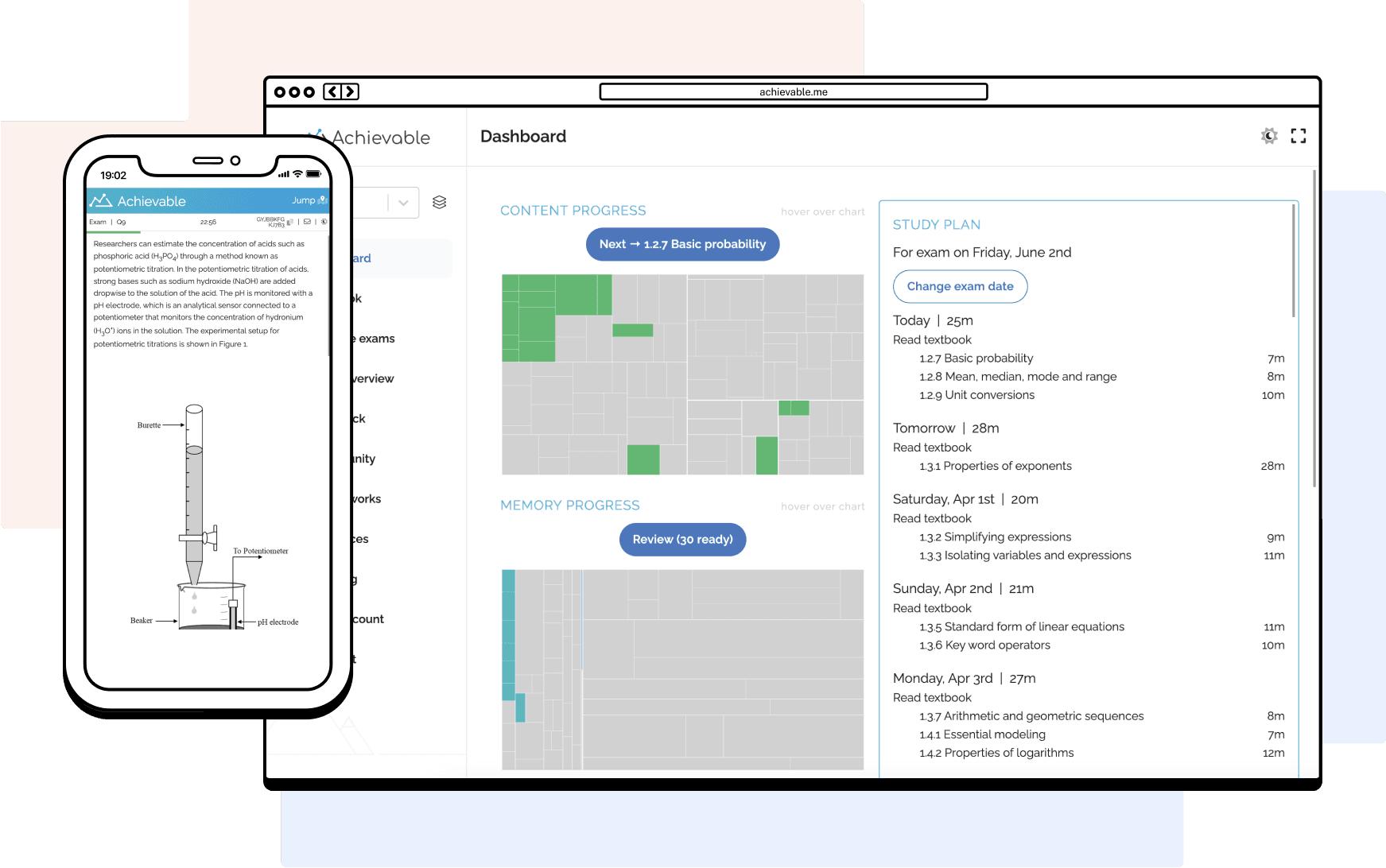
Pass the Property Insurance exam.
Guaranteed.Achievable is the best Property Insurance exam prep course: effective, personalized, and convenient. With Achievable, you'll spend less time studying and pass your exam the first time, or your money back.