Do AI tutors and adaptive study plans help on the MCAT?


Table of contents
- What "adaptive" and "AI tutor" mean in an MCAT course
- What the research shows
- How MCAT courses compare on adaptive study and AI tutors
- Where AI tools fall short
- How to combine an adaptive course with the AAMC’s materials
- Who gets the most from an AI tutor and an adaptive plan
- Frequently asked questions
- Key takeaways
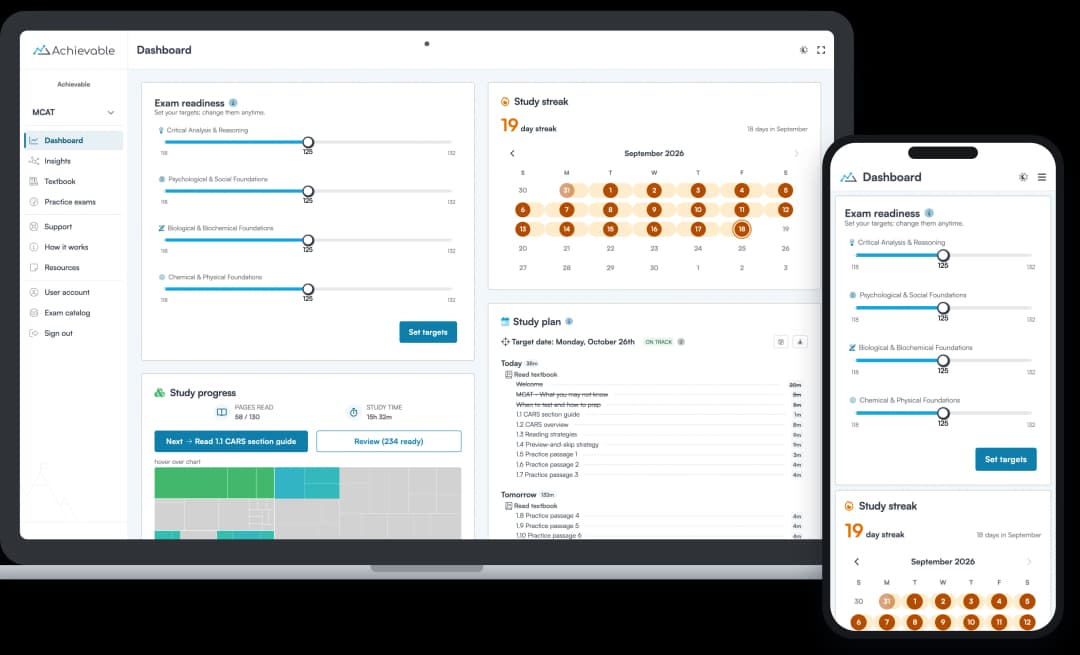
Yes, when they do the right jobs. An adaptive study plan helps because it schedules spaced review and quizzes you on what you haven’t mastered, two of the best-supported techniques in learning research, and an AI tutor helps when it explains a question you just missed. Neither replaces timed passage practice or the AAMC’s official full-length exams. Achievable MCAT combines both for $399 with a full year of access: an adaptive study plan that tracks your mastery of each learning objective, an AI tutor, 1,400+ practice questions and 3 full-length practice exams written for the course.
Below: what "adaptive" and "AI tutor" mean in an MCAT course, what the research shows, how Achievable, Blueprint, UWorld, Kaplan and Jack Westin compare, where AI tools fall short, and how to combine an adaptive course with the AAMC’s materials.
What "adaptive" and "AI tutor" mean in an MCAT course
Three different features go by these names, and a course can have one without the others:
- Adaptive review. The course keeps a record of every question you answer and picks your next quiz questions from what you’re weakest on or about to forget. This is the part the learning research supports most directly.
- An adaptive study schedule. A planner lays out your days from now to test day, so the whole syllabus fits the time you have.
- An AI tutor. A chat assistant answers your questions about a concept, or about a question you just got wrong, at any hour.
Achievable MCAT has all three. Its learning engine builds a personalized model of your memory, tracking your retention and mastery of each MCAT learning objective, and keeps adjusting your quiz questions so you spend your time on the topics that matter most for you, with refresher quizzes timed for the moment you’re about to forget. Its study planner builds a personalized day-by-day plan that gets you through all the MCAT content by exam day. Its AI tutor, Ask Achievable AI, replies immediately with explanations and practical examples, and is fine-tuned to the MCAT’s structure, content, terminology and common pitfalls.
What the research shows
The case for adaptive study rests on two well-tested findings about memory, not on the software itself.
- Spaced practice beats cramming. A meta-analysis by Cepeda and colleagues (2006), covering 839 assessments in 317 experiments, found that spreading study of the same material over separate sessions produced better long-term retention than massing it into one. An adaptive plan does the spacing for you, bringing a topic back just as you’re likely to forget it.
- Testing yourself beats rereading. In Roediger and Karpicke’s experiments (2006), students who took recall tests on a passage remembered substantially more of it two days and a week later than students who restudied it the same number of times, even though restudying made students more confident. Every adaptive quiz is this kind of retrieval practice.
- The two techniques rank first. Dunlosky and colleagues (2013) reviewed ten common study techniques and gave only two a high utility rating: practice testing and distributed practice. Highlighting and rereading rated low.
- Medical students show the same pattern. In a study of 72 medical students, Deng, Gluckstein and Larsen (2015) found that each additional 1,700 unique Anki flashcards was associated with about one more point on USMLE Step 1, controlling for MCAT score and grades. A 2026 systematic review of 11 studies found frequent Anki users outscoring minimal users on Step 1 by 4 to 13 points, while noting that the evidence is largely observational.
What the research doesn’t show is that an AI tutor, on its own, raises MCAT scores: we found no published study that measures it, and none that tests spaced repetition on the MCAT itself. So judge a course by what it makes you do. If it has you retrieving answers on a spaced schedule and explains every miss, the adaptive label means something. If "AI" means a chatbot beside a video library, it adds convenience, not the techniques that move scores.
How MCAT courses compare on adaptive study and AI tutors
Every price and feature below comes from each company’s own site. Prices are list prices for each company’s self-paced option; several of these companies run frequent sales.
Course | Price | Adaptive | AI tutor | Full exams |
|---|---|---|---|---|
$399 for 1 year | Quizzes chosen by your mastery of each learning objective, plus a day-by-day study planner | Ask Achievable AI, included | 3, written for the course | |
Blueprint Self-Paced Course | $1,199 for 3 months ($1,999 for 1 year) | Qbank practice sets tailored to your performance; a study plan that redistributes unfinished work when you reset it | Blue, included; available only while you review a question | 16 (10 Blueprint, 6 AAMC) |
UWorld Core Prep Course | $599 for 90 days ($699 for 1 year) | A study planner that adjusts when you miss a day | UAsk, included | 2 UWorld (the AAMC’s 7 come only with the Comprehensive course, from $1,199) |
Kaplan MCAT On Demand | $1,599 for 4 months ($2,599 for 1 year) | A placement quiz that sets your assignments; you edit the calendar | Kaplan AI Tutor, included | 21, the AAMC’s 7 included |
Jack Westin+ | $29.99 a month | A week-by-week schedule that rebuilds around missed tasks | None listed on its JW+ page | 6 in its free account |
Of the courses here with an AI tutor, Achievable costs the least: $399 for a full year, against $699 for a year of UWorld’s Core course, $1,999 for Blueprint’s self-paced course and $2,599 for Kaplan’s On Demand course. What it gives you for that:
- Adaptive review in every quiz. The learning engine tracks your retention and mastery of each MCAT learning objective and keeps adjusting your quiz questions to the topics that matter most for you.
- An AI tutor at no extra cost. One price covers the whole course, with no package tiers or add-ons.
- Practice written for the course. 1,400+ practice questions with explanations and 3 full-length practice exams, each with all four sections at the real exam’s question counts and time limits. You can’t have met them in a free PDF or a forum, and each practice exam form is taken once, so its score reflects how you reasoned, not what you remember.
- A score improvement guarantee. +5 points for a starting score below 502, +4 points for a starting score of at least 502 and below 508, and +3 points for a starting score of at least 508 and below 515, or your money back. Send us the score report of an official MCAT you took in the 5 years before buying within 7 days of buying, retest while your year of access is active, and if your score hasn’t risen by the guaranteed points, email us the new score report and a valid ID within 31 days of the test for a full refund. There is no minimum study time and no chapter to finish. The MCAT FAQ has the full terms.
The bigger full-length counts mostly include the AAMC’s own exams: Kaplan’s 21 and Blueprint’s 16 count them, and UWorld includes the AAMC’s 7 only in its Comprehensive course. You can buy those exams from the AAMC directly, and Practice Exam 1 is free.
How each course’s AI and adaptive features work:
- Achievable puts adaptive quizzes, a day-by-day study planner and its AI tutor in one $399 price for a year, so nothing on this list is an upgrade.
- Blueprint’s AI tutor, Blue, explains a question only while you review it, using the Socratic method; it isn’t available while you answer or on learning-module questions. Its Qbank serves practice sets tailored to your performance, and its study plan redistributes unfinished assignments across a new schedule when you reset it. The self-paced course starts at $1,199 for 3 months.
- UWorld’s AI tutor, UAsk, is built into its QBank and courses and knows which question or book topic you’re on. UWorld itself says UAsk "enhances your MCAT study plan; it does not replace it." Its planner adjusts when you miss a task. The Core course has 2 UWorld full-lengths and none of the AAMC’s.
- Kaplan’s On Demand course includes Kaplan AI Tutor for explanations, study tips and resource recommendations, and a placement quiz that sets your assignments; when your plans change, you update the calendar yourself. At $1,599 for 4 months, it costs four times Achievable’s price for a third of the access.
- Jack Westin+, a $29.99 monthly subscription, has an adaptive schedule that builds a week-by-week plan from your test date and weekly hours and rebuilds it around missed tasks, plus course videos and homework questions. Its JW+ page lists no AI tutor. Jack Westin’s free account includes 6 full-length practice exams, but not the adaptive schedule, the course videos or the homework questions.
Where AI tools fall short
CARS. Critical Analysis and Reasoning Skills tests how you read and reason through a passage you’ve never seen, 53 questions in 90 minutes. An AI tutor can show you why an answer was right after you’ve chosen one, which helps you see a passage’s argument. It can’t build your reading pace: only timed passages do that. Achievable’s course has a CARS unit that teaches reading strategies and works through nine practice passages, and its free CARS practice exam, at the real section’s 53 questions and 90 minutes, shows you where you start. After that, practice passages on a timer every few days. Our guide to MCAT CARS covers how to work a passage, and the AAMC’s CARS Question Bank has 575 official passage-based questions.
Questions a chatbot writes for you. A general-purpose chatbot will produce MCAT-style questions on request, but nobody has checked them against the AAMC’s content outline, its passage style or its difficulty, and some will be wrong. In one study, ChatGPT-written medical exam questions were about as hard as educators’ questions but did a worse job of telling stronger students from weaker ones, and a systematic review of AI-written medical exam questions found faulty questions in every study it covered. A score on questions like these tells you little about test day. Practice with questions written and reviewed for the exam: a course’s, and the AAMC’s own.
Asking before trying. A tutor that answers instantly makes it easy to skip the retrieval that does the work. Answer the question, or explain the concept from memory, first; then ask the tutor what you missed.
Stamina and timing. The MCAT lasts about seven and a half hours, breaks included. No tutor or schedule prepares you for that: only full-length exams, taken timed and in one sitting, do.
How to combine an adaptive course with the AAMC’s materials
An adaptive course does its best work early and in the middle of your prep, while you’re still learning content. The AAMC’s practice exams, written by the people who write the MCAT, do theirs at the end. A plan that uses both:
- First week: find your starting point. Take Achievable’s free MCAT section practice exams, one for each section at its real length and time limit, or the AAMC’s free Unscored Sample Test. Set your target from the medical schools on your list.
- Most of your weeks: learn and review. Work through the course’s lessons and let the adaptive quizzes bring back what you’re forgetting. Use the AI tutor after you’ve tried a question, not before. Our guide to building an MCAT study schedule helps you size the weeks.
- Mid-prep: Achievable’s three full-length exams. Each has all four sections with the real exam’s question counts and time limits, and an explanation for every answer. Take them while there’s still time to act on what they show.
- Final four to six weeks: the AAMC’s practice exams. Practice Exam 1 is free and Practice Exams 2 to 6 are sold separately; each gives a scaled score and percentile rank. Add the AAMC’s section banks and CARS Question Bank for targeted review. Our plan for the last month before the MCAT schedules them week by week.
When are you ready? Aim for practice scores comfortably above your target total, consistently, across several full-length exams, so your result doesn’t depend on a lucky test day. One good score isn’t the bar. Our comparison of the best MCAT practice tests lists what each provider’s full-lengths include.
Who gets the most from an AI tutor and an adaptive plan
- Students studying around a job or classes. A self-paced course with an adaptive plan spends whatever hours you have on the topics that need them.
- Students whose gaps are content. Biology, biochemistry, chemistry and physics, and psychology and sociology reward spaced review of a large body of facts and concepts.
- Students who get stuck late at night. An AI tutor answers at 11 p.m., when no teacher will.
If your gap is CARS pacing or test-taking strategy and you’ve already worked through a course, a human tutor can watch you work a passage and change how you approach it. Achievable’s MCAT tutor directory lists independent tutors at every price.
Frequently asked questions
Does Achievable MCAT have an AI tutor? Yes. Ask Achievable AI is built into the course and included in its $399 price for a year, with no add-ons. It replies immediately with explanations and practical examples, and it’s fine-tuned to the MCAT’s structure, content, terminology and common pitfalls.
Can ChatGPT replace an MCAT prep course? Not on its own. A general chatbot can explain a concept, but it doesn’t track what you’ve mastered, schedule your review or give you full-length exams at the real timing, and the questions it writes haven’t been checked against the exam. If you use one, check what it tells you against your course or the AAMC’s materials.
Is the MCAT itself adaptive? The AAMC doesn’t describe it that way. It says each test form is a different set of questions measuring the same concepts and skills, your section score is based on the number of questions you answer correctly, with no penalty for wrong or unanswered questions, and scores are scaled and equated so they mean the same whichever form you get. "Adaptive" in MCAT prep describes how you study, not how the test is built.
Is an adaptive course enough without the AAMC’s practice exams? No. Use the course to learn and review, and save the AAMC’s practice exams for your last four to six weeks: they’re the closest thing to the real test.
Key takeaways
- An adaptive study plan helps because it makes you practice retrieval on a spaced schedule, the two study techniques with the strongest evidence behind them.
- An AI tutor helps most when it explains a question you just missed, after you’ve tried it yourself.
- Neither replaces timed CARS passages or the AAMC’s official full-length exams, which belong in your last four to six weeks.
- Achievable MCAT has an adaptive study plan, an AI tutor, 1,400+ practice questions and 3 full-length practice exams for $399 with a full year of access, with a score improvement guarantee of up to 5 points.
- You’re ready when your practice scores sit comfortably above your target, consistently, across several full-length exams.