Choosing an NCLEX review course before graduation: what your school requires and what to buy


Start with what your school’s requirement says. If it lets you choose, pick Achievable’s NCLEX-RN course: it teaches the whole NCLEX-RN test plan in plain English, gives you 7 full-length practice exams in the Next Generation format, comes with a certificate of completion you can hand your school, and lasts a full year for $149, so a course bought in your final semester still covers a summer exam. If your school names a specific program, such as ATI, HESI, Kaplan or Hurst, that program meets the requirement, and Achievable fills the gap it often leaves: access that runs out at graduation, months before your test date.
The rest of this guide shows how to find out exactly what your school requires, what each kind of review course gives you, and how a May graduate can time the whole thing, from the last semester to test day.
First, find out what your school actually requires
"Complete an NCLEX review course before graduation" can mean three different things, and each one changes what you should buy. The National Council of State Boards of Nursing (NCSBN), which writes the NCLEX, doesn’t require a review course at all: its FAQ says it "does not recommend or endorse any review courses or study materials." The requirement comes from your program, so the answer is in your program’s documents.
- A named program, bought by the school. Many programs license one company’s testing and review package for the whole class and build it into a capstone or transition-to-practice course. If this is your school, the review course is chosen for you.
- A benchmark score. Some programs require you to reach a set score on an exit or predictor exam before you can graduate or before they release your paperwork to the board of nursing.
- Proof of any review course. Some programs only ask you to show that you completed or worked through a review course of your choice. Then you choose, and the question becomes what proof the school will accept.
Achievable partners with nursing schools for this, as do longer-established names such as ATI, Elsevier’s HESI, Kaplan, UWorld and Hurst Review. The common benchmark exams are ATI’s RN Comprehensive Predictor and the HESI Exit Exam. ATI’s Comprehensive Predictor expectancy table turns your score into a predicted chance of passing the NCLEX-RN, and Elsevier describes programs that "require a minimum Exit Exam score (commonly 850)" and allow retakes if you miss it.
To find out which one applies to you, look in the syllabus of your final-semester capstone or NCLEX preparation course, then in the student handbook’s progression and graduation policies. If they’re unclear, ask your course coordinator these questions, ideally by email so you have the answer in writing:
- Is a specific review program required, and is it already included in my fees?
- Is there a benchmark score I must reach, on which exam, and how many attempts do I get?
- If I can choose my own course, what proof of completion do you accept, and by what date?
- Does meeting the requirement affect when the school confirms my graduation to the board of nursing?
If your school names a program
Use it. The school has already paid for it, its benchmark exams are usually part of your grade or your graduation clearance, and faculty often build class time around it.
The question for you is whether the school’s program covers everything you need, not whether to replace it. School packages are built around testing: predictor exams, practice assessments and a review period near the end of the program. What they often lack is time. A school license can end at graduation or soon after, while your NCLEX date may fall two or three months later. Before you buy anything extra, find out when your school access ends, and whether its review teaches the content again or mainly tests you on it.
If your access ends before your exam, or you need the material taught again in plain language rather than drilled, add a course that fills that gap. Achievable’s NCLEX-RN course pairs a plain-English textbook with 2,500+ practice questions and 7 full-length practice exams, and its 12 months of access carries you from your final semester through test day. Pick an add-on for the gap you have, not a second version of what your school already gives you. And if your school hasn’t settled on a program, or is reviewing the one it uses, tell your faculty that Achievable works with schools directly (see below).
If you can choose: what to look for
When the choice is yours, five things decide whether a course will still be useful on the day you test.
- Access that reaches your test date. Plans sold by the month or by a 30- to 90-day window can run out before your Authorization to Test (ATT) arrives. Count from the day you start studying to your likely exam date, then add a margin.
- Teaching, not only testing. If you need content reviewed again, choose a course that teaches the test plan. A question bank teaches mainly through the explanation after each question.
- Practice in the real exam’s format. The NCLEX-RN is computer-adaptive, gives you 85 to 150 questions within five hours, and includes Next Generation NCLEX case studies. Practice with the same item types (bow-tie, matrix, drag-and-drop, highlight and cloze questions) before test day.
- Proof your school accepts. If the school wants evidence, check what the course can give you before you pay. A certificate of completion is the usual answer, and not every course issues one.
- A guarantee you can meet. Read what the guarantee pays, a refund or more access, and what you must do first.
The table below sorts the options by type. Achievable’s course is a full self-paced course: it teaches the test plan, tests you on it with full-length practice exams, and comes with a certificate of completion and a pass guarantee, for one price.
Type | What you get | Examples and prices | Fits when |
|---|---|---|---|
Full self-paced course | Teaches the whole test plan, with practice questions and full-length practice exams, at your own pace | Achievable: $149, 12 months. Kaplan PassTrack Self Paced: from $349, 3 or 6 months. Hurst Review on demand: $159 to $339, 30 to 120 days | You choose your own course, or need the content taught again |
Question bank | Thousands of practice questions with explanations, plus adaptive (CAT) practice tests | UWorld: $139 for 30 days to $449 for 730 days. Archer Review: from $89 a month; packages with a live review $189 to $599. NCLEX Bootcamp: $59 to $129, 1 to 3 months, on sale | You know the content and want more questions in your final weeks |
Live review | A two- or three-day instructor-led review, online or in person | Kaplan PassTrack Live Online: from $399. Hurst live reviews, held on many campuses. Archer Review’s 3-day live review, included from its $189 Sure PASS package | You study best with an instructor and a fixed schedule |
School package | Predictor and benchmark exams, practice assessments and a review period, chosen and paid for by your program | ATI (RN Comprehensive Predictor, Virtual-ATI), Elsevier HESI (Exit Exam, HESI Compass), Kaplan integrated testing, UWorld and Hurst school programs | Your school names it; it usually comes with your fees |
Prices are each provider’s list price for the NCLEX-RN when we checked, before promo codes, in U.S. dollars. They change often, so confirm at checkout. School packages are priced by quote for the institution; one individual exception is ATI, which lists Virtual-ATI with a BoardVitals question bank at $567.
Many graduates combine one full course with a short question-bank plan in their final weeks. That works well if the course is your foundation and the question bank adds volume at the end, so you are not paying for two long subscriptions at once. For a provider-by-provider review of these courses, with what each pass guarantee requires, see our comparison of the best NCLEX prep courses.
Why Achievable fits a school requirement
Achievable’s NCLEX-RN course is built for this window: you start it in your final semester, it covers what your school asks for, and it is still there on test day.
- A certificate of completion for your school. Achievable can issue a certificate of completion for the NCLEX-RN course, so you can show your program that you finished a review course. Contact us when you need one, and check which document your school wants and by what date.
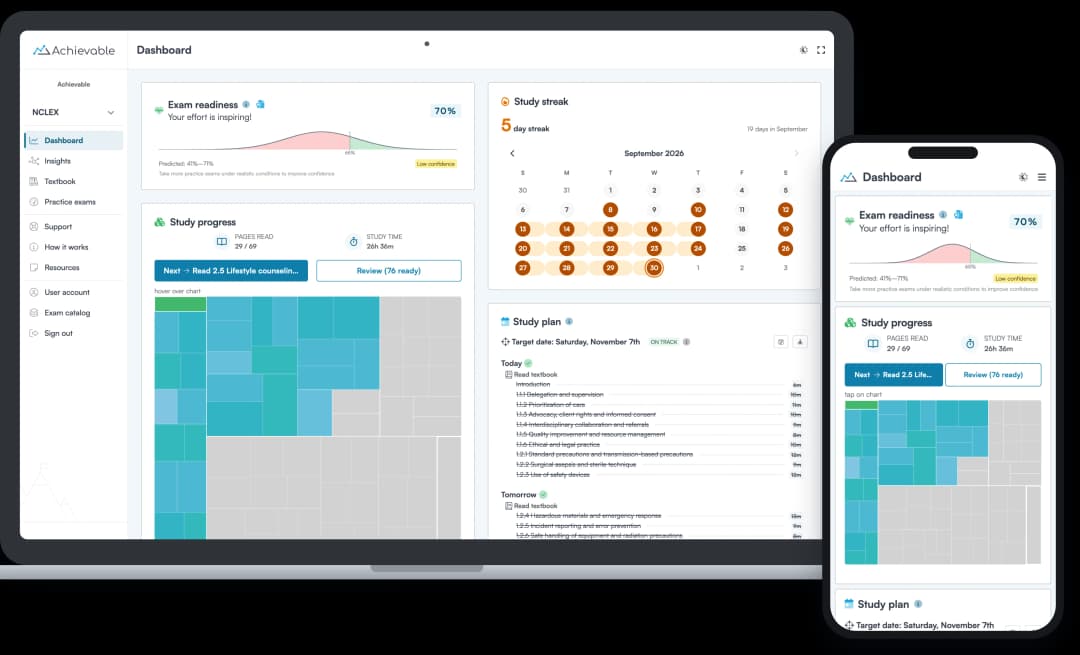
- A study transcript, too. From your course dashboard you can share a link to a page recording your study hours, your progress through the course and your practice exam results, and print it or save it as a PDF. You can revoke the link at any time.
- It teaches, then tests. A plain-English textbook covers the whole NCLEX-RN test plan, with 2,500+ practice questions and a study plan that adjusts as your results come in.
- Practice in the real format. 7 full-length practice exams of 70 scored questions, each with the real exam’s five-hour limit, carry 21 clinical judgment case studies and every Next Generation item type.
- A full year for $149, with no tiers or add-ons, so one purchase covers your final semester, graduation and your test date.
- A pass guarantee. Pass one of the course’s full-length practice exams within the standard time before your exam. If you then fail the exam, email a picture of your score report with a valid state ID, and once they’re verified, Achievable refunds the course in full. There is no minimum study time.
Achievable works with schools as well as students. Achievable partners with nursing schools and other organizations, with a dashboard that shows faculty who is on track and who needs help. If your program is choosing its NCLEX review, or lets students suggest one, point your faculty to Achievable for Organizations.
When to start: a timeline for a May graduate
You can’t take the NCLEX before you graduate, but you can do most of the preparation and most of the paperwork during your final semester. Here is a typical path for a May graduate. Your state board of nursing sets its own steps and deadlines, so check them against its website.
- January, start of the final semester: find out what your school requires, using the questions above. If you are choosing your own course, buy one whose access lasts until at least late summer, and start with a few hours a week alongside classes.
- February and March: work through the content, starting with the client needs areas where your school’s assessments show you are weakest. Take the school’s predictor or benchmark exam when it is scheduled, and use the results to target your review.
- April: apply for licensure with your state board of nursing, then register for the NCLEX with Pearson VUE. Registration costs $200 in the U.S., and the board’s own licensure fee is separate. A Pearson VUE registration stays open for 365 days while the board decides whether you are eligible, according to the NCLEX candidate bulletin. Our guide to registering for the NCLEX covers each step.
- May, graduation: once the board has everything it requires, which typically includes confirmation from your school that you completed the program, it makes you eligible and Pearson VUE emails your ATT.
- June and July, final review and test day: schedule your exam as soon as your ATT arrives. Its validity period is set by your board, averages 90 days, and cannot be extended. Spend these weeks on full-length practice exams under real time limits and on reviewing every miss.
Don’t wait long after you become eligible. NCSBN’s own research on lag time and pass rates found that pass rates fall the longer candidates wait after becoming eligible to test, though waiting itself doesn’t cause failure. In that study, RN candidates tested about 35 days after becoming eligible on average. Most first-time takers pass: NCSBN’s pass-rate dashboard shows 91.2% of first-time, U.S.-educated NCLEX-RN candidates passing in 2026 through mid-November.
How to tell you’re ready
Don’t book your date on one good practice score. Aim for 100% readiness in your course, and pass several full-length practice exams comfortably, one after another, so that passing on test day doesn’t depend on the luck of which questions you get. The NCLEX has no percentage passing score, so a single result on a short quiz says little; what predicts a pass is performing well across several full-length exams in the real format and time limit.
If your school uses a predictor exam, reach its benchmark too, but treat it as one data point alongside your practice exams. You can try a free NCLEX practice exam to see where you stand before you buy anything.
FAQ
How much does an NCLEX review course cost if I pay myself? Achievable’s full course is $149 for a year of access. Among the others we checked, before discounts, question banks run from $59 for a month (NCLEX Bootcamp, on sale) to $449 for two years (UWorld), and on-demand or live review courses from $159 for 30 days (Hurst Review) to $399 (Kaplan’s live online course). A school package costs you nothing extra when it is included in your fees.
Does Achievable give a certificate of completion for the NCLEX course? Yes. Achievable can issue a certificate of completion for its NCLEX-RN course to show your school you completed a review course, and you can also share a study transcript with your study hours, progress and practice exam results. Ask your school which it wants before your deadline.
Does the NCLEX require a review course? No. NCSBN, which develops the NCLEX, doesn’t require any review course and doesn’t recommend or endorse any. A review course requirement comes from your nursing program, so its syllabus and student handbook say what counts.
My school includes ATI or HESI. Do I need to buy another course? Not necessarily. Use the school’s program first, since its benchmark exams may decide your graduation clearance. Buy another course only for a gap the school’s program leaves: access that ends before your test date, or content you need taught again rather than tested.
Can I pick any review course to meet my school’s requirement? Only if the school says so. If it does, ask what proof of completion it accepts and by when, and check that the course you choose can provide it. Achievable’s certificate of completion and study transcript cover the usual requests.
When should a May graduate start an NCLEX review course? In the final semester, ideally in January, at a few hours a week. That leaves time to work through the content before graduation and to switch to full-length practice exams once your ATT arrives in late spring or early summer.
How soon after graduation should I take the NCLEX? As soon as you are ready after your ATT arrives. Your ATT is valid only for the period your board sets, averaging 90 days, and NCSBN’s research found pass rates fall the longer candidates wait after becoming eligible.
Key takeaways
- Achievable’s NCLEX-RN course teaches the test plan, uses the Next Generation NCLEX formats, keeps your access for 12 months and comes with a certificate of completion for your school, all for $149.
- If your school names a program, such as ATI, HESI, Kaplan, UWorld or Hurst, that program meets the requirement; add Achievable only for a gap it leaves, such as access that ends at graduation.
- Ask your school in writing what counts as completion and what proof it accepts, before you buy.
- Apply to your board and register with Pearson VUE in your final semester, then test soon after your ATT arrives: it lasts about 90 days on average and can’t be extended.
- Book your exam when you pass several full-length practice exams comfortably, not after a single good score.