

NCLEX
review & study guide
Every chapter of the course summarized, with each section linked to its lesson.
Pass the first time
Try Achievable NCLEX
No credit card required
This free NCLEX review summarizes all 4 chapters of Achievable's NCLEX course: what each covers, the points to remember, and its 67 sections in order. Read each chapter after you study it, or work through the whole guide before exam day.
Each section links to its full lesson in Achievable, with the review quizzes and full-length practice exams.
Chapter 1: Safe and effective care environment
13 sections
- Delegation and accountability: Delegation extends reach, not responsibility, and the RN remains accountable for outcomes while using the Five Rights of Delegation.
- Roles and assignments: RN, LPN, and UAP roles differ by judgment and complexity, and assignment divides licensed workload while delegation transfers tasks downward within scope.
- Prioritization rules: ABC first, unstable trumps stable, acute beats chronic, systemic over local, and when in doubt oxygen and circulation win.
- Advocacy and informed consent: Nurses witness signatures, providers obtain informed consent, and advocacy means protecting, clarifying, and empowering the client.
- Collaboration and quality improvement: Nurses coordinate other disciplines, use SBAR for handoffs and referrals, and report errors and near misses to support continuous QI.
- Legal and ethical practice: HIPAA, mandatory reporting, factual documentation, and the Nurse Practice Act guide safe practice, with ethics centered on autonomy, beneficence, nonmaleficence, justice, and veracity.
- Safety and infection control: Standard precautions apply to every patient, transmission-based precautions add route-specific barriers, and safety devices, isolation, and PPE reduce harm.
In this chapter
- Management of care
- Safety and infection prevention and control
Start this chapter free
Chapter 2: Health promotion and maintenance
17 sections
- Infancy milestones: Birth weight doubles by 6 months and triples by 12, and object permanence, pincer grasp, and stranger anxiety are expected around 9 months.
- Early childhood growth: Growth slows, but motor and language skills explode, and autonomy and initiative thrive with choice and encouragement.
- School age priorities: Concrete operational thought is logical and organized, and screen time, safety, nutrition, and school performance are major NCLEX priorities.
- Adolescent and adult development: Adolescence brings identity, independence, and emotional intensity, while adulthood centers on intimacy, career-building, generativity, and long-term stability.
- Older adult care: Aging is predictable changes, not inevitable decline, and delirium is acute and reversible while dementia is chronic and progressive.
- Maternal care cues: Fundal height reflects gestational age after 20 weeks, reactive NST is reassuring, and painless bleeding suggests placenta previa while painful bleeding suggests abruption.
- Newborn stabilization: Dry, warm, airway, breathing, and circulation come first, APGAR is for assessment, not decision-making, and acrocyanosis is normal while central cyanosis is not.
- Prevention and safety: Screen asymptomatic patients based on age and risk, use motivational interviewing for behavior change, and preserve independence, dignity, autonomy, and comfort in end-of-life care.
In this chapter
- Growth and development across the lifespan
- Antepartum, intrapartum and postpartum
- Newborn care and developmental milestones
- Health screenings and preventive care (vision, cancer, immunizations)
- Lifestyle counseling and high-risk behaviors
- Aging, transitions, and end-of-life considerations
Study this chapter in Achievable
Achievable NCLEX
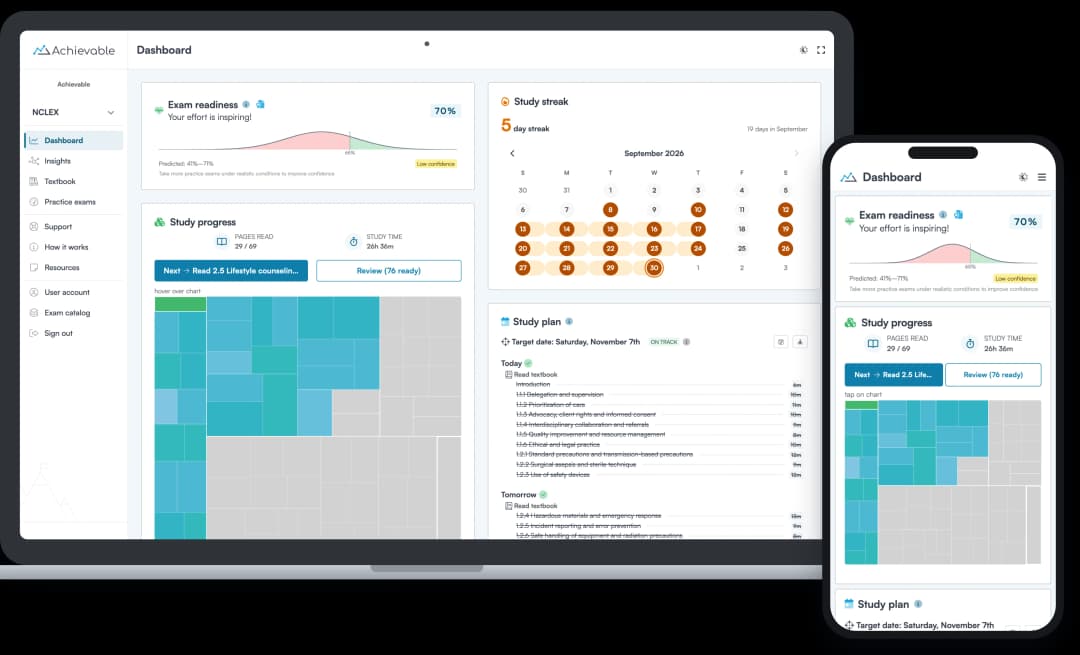
The NCLEX-RN (National Council Licensure Examination for Registered Nurses) is the standardized, computer-adaptive licensing exam required to practice as a registered nurse in the U.S., Canada, and Australia. Achievable's interactive online NCLEX prep course makes complex topics simple and engaging. Our adaptive platform and AI tutor personalize your study plan, while memory science ensures effective exam prep that gets results.
7 full-length practice exams
2,500+ practice questions, explained in depth
21 Next Generation NCLEX case studies
Pass guaranteed, or your money back
Chapter 3: Psychosocial Integrity
12 sections
- Coping and stress: Identify the underlying emotion before choosing an intervention, encourage expression rather than suppression of feelings, and choose therapeutic statements over advice-giving.
- Cultural considerations: Ask clients about cultural, spiritual, and religious needs directly, avoid assumptions based on group identity, and use interpreters, not family members, for medical discussions.
- Communication basics: Always choose the most therapeutic, client-centered response, avoid giving advice or offering false reassurance, and maintain professional boundaries and ensure safety.
- Psychiatric disorders: Mood disorders affect safety and functioning, psychosis affects reality testing, personality disorders involve long-standing behavior patterns, and substance use disorders are chronic conditions.
- Crisis and grief: Crisis care starts with safety and stabilization, restraints are last resort and require close monitoring, and palliative care, hospice, advance directives, and grief support guide end-of-life care.
- Behavioral safety: Therapeutic environments support healing, structure reduces anxiety, consistency prevents manipulation, and least restrictive measures are always preferred.
In this chapter
- Mental health concepts
- Psychiatric disorders
- Crisis intervention and safety
- End-of-life care and grief counseling
- Behavioral Interventions and Safety Precautions
Study this chapter in Achievable
Chapter 4: Physiological Integrity
25 sections
- Assistive devices: Always match the device to the client’s physical and cognitive ability, and walkers, crutches, canes, and mechanical lifts each have specific rules.
- Comfort and nutrition: Reposition immobile clients every 2 hours, use lateral and semi-Fowler’s positions, and daily weights are the best indicator of fluid balance.
- Elimination and rest: Remove indwelling catheters as soon as medically possible, and pain is whatever the patient says it is, so reassess pain 30–60 min after intervention.
- Nonpharmacologic care: Heat increases blood flow, cold reduces inflammation, and guided breathing, therapeutic touch, music, and aromatherapy are all valid interventions.
- IVs and medications: IV therapy requires knowledge of fluids, access types, and complications, and medication administration requires the right patient, right drug, right dose, right route, right time, and right documentation.
- Blood and high-risk drugs: Only use 0.9% NS with blood products, monitor closely for the first 15 minutes, and high-risk drugs require double-checks and close monitoring.
- Calculations and labs: Dimensional analysis ensures unit accuracy, always convert weights to kilograms, and labs guide action because critical values require immediate provider notification.
- Complications and emergencies: Monitoring for complications is continuous, early subtle changes often precede collapse, and medical emergencies require rapid recognition and life-saving actions.
In this chapter
- Basic care and comfort
- Pharmacological and parenteral therapies
- Reduction of risk potential
- Physiological adaptation
Study this chapter in Achievable
NCLEX exam at a glance
- Questions
- 85–150 questions (computer-adaptive, variable-length)
- Time
- 5 hours
- Exam fee
- $200
More on the NCLEX exam
- NCLEX exam prep courseAchievable's course: online textbook, review quizzes and full-length practice exams.
- NCLEX exam format, content and scoringWhat's tested, how long it takes, what it costs, and the score you need to pass.
- Free NCLEX practice examPractice questions written to match the real thing, with an explanation for every answer.
- NCLEX FAQThe questions asked most about the exam and preparing for it, answered.
- Best NCLEX exam prep coursesHow the leading providers compare on content, format and price.
- NCLEX study resourcesGuides and study advice from Achievable's instructors.
Pass the NCLEX-RN. Guaranteed.
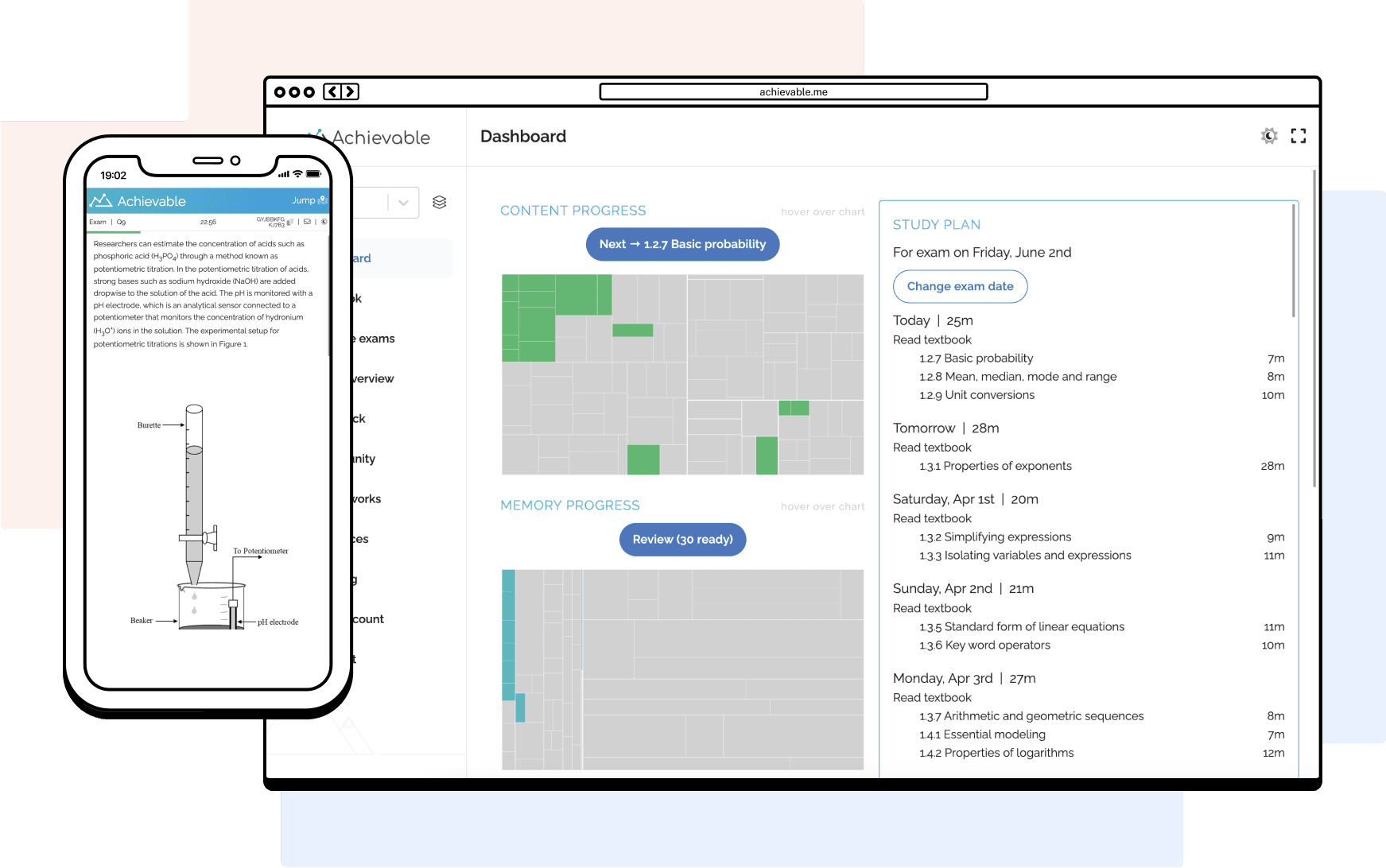
Achievable is the best NCLEX-RN prep course: effective, personalized, and convenient. With Achievable, you'll spend less time studying and pass your exam the first time, or your money back.