What is the NCLEX?: NCLEX study guide


Table of contents
- Is the NCLEX hard?
- How do you study for the NCLEX?
- First step: Review the NCLEX-RN test plan
- NCLEX basics
- What score do I need to pass the NCLEX?
- How do you prepare for the NCLEX?
- 1. Develop an effective NCLEX study plan
- How long should I study for the NCLEX?
- 2. Practice under real NCLEX exam conditions
- 3. Identify and target problem areas
- 4. Prepare for your NCLEX exam day
- 5. Ace the NCLEX-RN!
- Last-minute pro-tips
- Commonly asked questions about the NCLEX
- How many times can you take the NCLEX?
- What is the minimum number of questions I need to answer to pass the NCLEX?
- How long does it take to get NCLEX results?
- How do you know if you passed the NCLEX right away?
- Conclusion
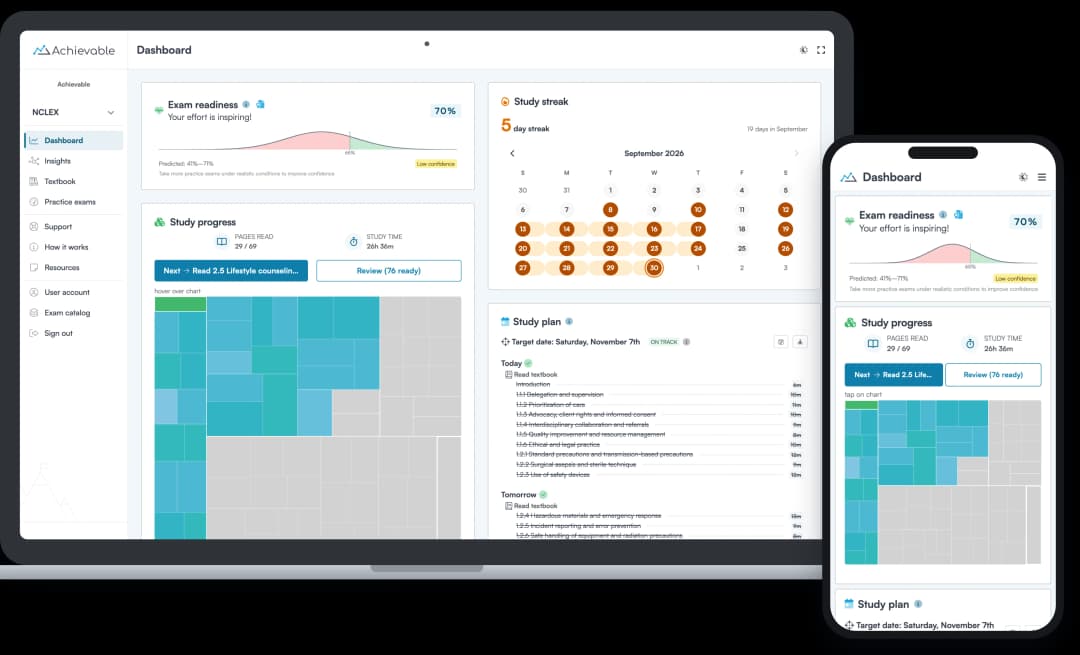
Studying for the NCLEX-RN begins with creating a structured study plan, followed by reviewing content, completing practice questions, and pinpointing the topics and concepts that need the most attention. The NCLEX-RN, which stands for the National Council Licensure Examination for Registered Nurses, is a standardized, computer-adaptive licensing exam for nursing school graduates (i.e., those who have completed bachelor’s, associate’s, or certificate programs in nursing). To practice as a registered nurse (RN) in the U.S., Canada, and, for some internationally qualified nurses, Australia, candidates must first pass the NCLEX.
Most NCLEX-RN questions are organized around four major Client Needs categories: Safe and Effective Care Environment, Health Promotion and Maintenance, Psychosocial Integrity, and Physiological Integrity. The NCLEX also includes case-study items designed to assess clinical judgment, decision-making, and critical thinking in realistic patient-care scenarios. While there is no set number of questions, candidates will typically answer between 85 and 150 items. The exam allows up to five hours to complete, including any breaks, and all scored questions must be answered within that time limit.
Successfully passing the NCLEX confirms that a nursing graduate can provide safe and effective care at the entry level. With a focused approach and the right strategy, you can maximize your chance of passing on the first try and earn your nursing license more quickly.
Please note that while there are two versions of the NCLEX, the NCLEX-RN and the NCLEX-PN for practical nurses, this study guide will be focused on preparing for the NCLEX-RN. However, the study tips below remain valuable for those preparing for the PN exam.
Is the NCLEX hard?
The NCLEX is considered a moderately challenging exam, though completing an accredited nursing program should thoroughly prepare you. While the NCLEX is a wide-ranging exam that demands intentional preparation, the NCLEX pass rate for first-time test-takers is quite high. Year to year, pass rates hover between 85% and 90%: in 2025, the NCLEX-RN and NCLEX-PN pass rates for first-time, U.S.-educated candidates were 86.7% and 86.6%, respectively. The average pass rate for all candidates is lower (around 70%); passing requires effort, though it is certainly achievable to complete the NCLEX soon after finishing your education program.
What makes the NCLEX difficult is both the scope of content covered and the application of nursing knowledge in real-world situations. Future nurses are tested not only on how well they know medication names or standard procedures, but also on when to use this information in context. Just like in real-life nursing practice, NCLEX candidates must be able to apply the content learned in their coursework to ensure safe and effective care.
How do you study for the NCLEX?
Preparing for the NCLEX is similar to getting ready for other standardized exams like the SAT or ACT: the exam is unique in its content and format, so relying on past knowledge alone will likely not be enough. Nursing graduates need to allot time to study for the NCLEX and familiarize themselves with the exam’s unique style of questions and case studies.

First step: Review the NCLEX-RN test plan
Each year, the National Council of State Boards of Nursing (NCSBN), the organization that administers the NCLEX, prepares and publishes an NCLEX test plan that details the exam’s format, any changes to structure or topics covered, and scoring requirements. Students should review the test plan before their test date to ensure they are preparing for the most up-to-date version of the exam. Examinees are given five hours to complete the test, with optional short breaks. The content covered (safe and effective care, treatment plan implementation, maintaining physical and psychological health, etc.) should mirror the curriculum taught at standard nursing programs.
NCLEX basics
The NCLEX includes standard multiple-choice questions plus Next Generation NCLEX item types, such as Select All That Apply (SATA), bow-tie, matrix/grid, drag-and-drop, and drop-down (cloze) items, organized around four Client Needs categories:
- Safe and Effective Care Environment: Evaluates the ability to provide and direct nursing care in a delivery setting while ensuring the protection of clients and health care personnel. Assesses knowledge of steps and protocols that must be taken to ensure clients and health care personnel are safe from health and environmental hazards.
- Health Promotion and Maintenance: Covers aspects of direct nursing care, understanding of treatment plans, prevention, and early detection of health issues, and strategies for optimal health.
- Psychosocial Integrity: Focuses on maintaining patients’ emotional, mental, and social well-being, supporting patients experiencing stress, and protocols for treating patients with mental illness.
- Physiological Integrity: Tests the ability to properly care for and treat patients, promoting physical health, wellness, and comfort while reducing risk through proper medication administration, emergency treatment, and other protocols. These questions also test how well a nurse can adapt to changing situations.
Here’s a breakdown of the percentage of NCLEX questions on the exam by topic. You’ll notice that Safe and Effective Care Environment and Physiological Integrity are split into several subcategories, making them some of the most heavily covered topics on the exam:
| Client Needs | Percentage of items from each category | |
|---|---|---|
| Safe and Effective Care Environment: Management of Care | 15-21% | |
| Safe and Effective Care Environment: Safety and Infection Prevention and Control | 10-16% | |
| Health Promotion and Maintenance | 6-12% | |
| Psychosocial Integrity | 6-12% | |
| Physiological Integrity: Basic Care and Comfort | 6-12% | |
| Physiological Integrity: Pharmacological and Parenteral Therapies | 13-19% | |
| Physiological Integrity: Reduction of Risk Potential | 9-15% | |
| Physiological Integrity: Physiological Adaptation | 11-17% |
The NCLEX also includes a series of case-study questions associated with a client presentation. These questions test candidates’ practical skills through real-world scenarios. Here’s an example of how a question may be asked and structured on the NCLEX:
A nurse is teaching a client with diabetes mellitus how to manage their condition. The client asks, “Why do I need to maintain my blood glucose at about 70 mg/dL and no lower?” How should the nurse respond?
- Glucose in the blood slows the formation of lactic acid, preventing acidosis
- Glucose is the only fuel produced by the body to create the energy that it needs
- Because your brain cannot store glucose, it needs a constant supply of glucose for healthy function
- The body cannot make red blood cells without a minimum level of glucose present
The answer is C: nursing professionals often consult with patients about their conditions and answer related questions about treatment and health. They must be prepared to answer patients’ questions accurately and understandably. Many similar questions will include additional details about the patient, such as their age, weight, and other factors that may influence their health outcomes, all of which must also be considered.
Many case-study questions follow a Select All That Apply (SATA) format, which requires test-takers to select all relevant responses. The current NCLEX format reflects changes introduced by the Next Generation NCLEX that emphasize complex decision-making and clinical judgment. When you’ve familiarized yourself with the exam’s content plan, you can begin to organize your NCLEX study schedule around relevant sections and topics, placing greater focus on heavily weighted topics first.
What score do I need to pass the NCLEX?
There is no set NCLEX passing score. The exam allows students to answer between 85 and 150 questions. The computer-adaptive software continuously assesses performance, making the questions more difficult as the test-taker progresses. Once the system has enough information to determine, with 95% confidence, whether an examinee will pass or fail, the exam ends immediately. There is no way to know how you did right away; you must wait for official results, which are sent within up to six weeks (often sooner) to confirm whether you passed.
To help ensure you pass the first time and avoid signing up for a retake, practice with full-length tests and aim to answer as many questions as possible. Practice exams will help you develop time management, pattern recognition, and other test-taking strategies for the official test day, even without a specific score to aim for.
How do you prepare for the NCLEX?
Preparing for the NCLEX involves more than rereading textbooks and class notes: it requires investing time in answering practice questions, completing full-length exams, and developing a strong familiarity with the NCLEX system. A well-organized plan can help you divide your prep, close knowledge gaps, and focus on high-impact content.
1. Develop an effective NCLEX study plan
Juggling test preparation alongside finishing up school or while working is manageable with a strategy. Follow these steps to build an efficient approach:
- Gather resources: Use reputable online NCLEX study guides, books, practice questions, and flashcards to reinforce learning. If necessary, consider hiring an NCLEX tutor for extra support.
- Take a diagnostic test: Start with a full-length practice exam to assess your current level. Use this as a benchmark rather than worrying about your initial score.
- Prioritize subject areas: Rank topics by importance and difficulty using your diagnostic results.
- Set a timeline: Break down your available study time into manageable blocks dedicated to each content area.
- Define your goal: Determine specific benchmarks for your studying. For example, divide your study time by section, devote a set number of days or weeks to each, and cap off each block with a mini-exam.
Pro tip: The best study plans are tailored to your unique needs. Start large, end small: begin by looking at the content at a high level, then determine which areas make the most sense to focus on based on how often they appear on the test and your understanding of them.
How long should I study for the NCLEX?
Test prep experts recommend spending four to eight weeks preparing for the NCLEX. This allows about half a week to a week to cover each of the eight main categories and subcategories. Setting aside consistent time to study, an hour or so per day, will likely yield better results than cramming a lot of information into long study sessions.
Implement these study strategies to make the best use of your time:
- Summarize each section in your own words after studying.
- Use spaced repetition systems (like Anki or Quizlet) for memorization-heavy material.
- Work through practice problems soon after learning new content.
- Create mind maps or outlines to organize information visually.
- Use memory aids such as mnemonics or acronyms.
- Try to teach concepts aloud as if explaining them to someone new.
- Finish each session by testing yourself rather than re-reading material.
Gradually building knowledge over several weeks and actively (not passively) reviewing improves retention and performance.
2. Practice under real NCLEX exam conditions
Practicing under realistic conditions is a key part of any successful NCLEX study routine. The exam is not just about knowledge; it also tests mental stamina and the ability to make decisions under pressure. While reviewing content is important, simulating actual test conditions with full-length practice exams is equally vital.
- Use high-quality practice tests under timed conditions to self-assess progress.
- Don’t just rely on short quizzes. Set aside time to practice the full exam.
- Simulate the exact format you’ll face on test day by using digital practice tests.
- Reinforce learning by reviewing key concepts after each session.
Consider taking at least three official NCLEX practice tests: one diagnostic at the start of your studies, a mid-prep test to chart progress, and a final exam shortly before your official test date. Supplement your studies with high-quality, third-party full-length exams throughout your prep.
3. Identify and target problem areas
As you use your study materials, prioritize identifying areas that require the most focus. Equal review of all subjects isn’t the best use of time; concentrate on the topics that challenge you the most.
- Begin with broad topics and gradually focus on finer details.
- Maintain an error log of mistakes or confusing topics and review it regularly.
- Dedicate additional time to the weak areas identified by your error log and practice tests.
- Make sure you’re practicing all question types (multiple choice, SATA, bow-tie, matrix/grid, drag-and-drop, and drop-down)
A targeted strategy focuses your effort on the skills that most improve your overall performance.
4. Prepare for your NCLEX exam day
Well ahead of your exam, double-check that you have a valid government-issued ID for admission at your testing center and that you’ve followed all required steps to sit for the test:
- First, you need to have completed a state-approved nursing education program. This may include a bachelor’s degree in nursing (BSN), an associate degree in nursing (ADN), or a hospital-based diploma program.
- Apply for licensure or registration with the nursing regulatory body (NRB) in the state or jurisdiction where you intend to practice. Depending on the location, this may be the state board of nursing, an office within the state education department, or another designated regulatory authority.
- Register with Pearson VUE, the organization that delivers the exam.
- Pay the $200 registration fee.
- Receive your Authorization to Test (ATT) email, which will confirm your eligibility to test.
- Schedule an appointment to take the NCLEX at your local testing center. Have your ATT email prepared for your appointment.
The night before the NCLEX should be about mental preparation, not last-minute cramming. Make sure you have all your materials in order (a government ID with a photograph and the ATT email to confirm entry). Dress comfortably, but avoid bringing hats or scarves into the test room (religious exceptions apply).
Always plan to arrive at your testing site 30-45 minutes early: late arrivals may not be admitted. Remember that you cannot bring your own calculator; one will be provided for you.
Additional pre-test advice:
- Get 7-9 hours of sleep before exam day
- Eat a nutritious breakfast
- Bring snacks or water for break times
- Quickly review key summaries or flashcards and avoid learning new material
- Expect to be at the testing center for several hours
You’ve put in weeks of preparation; trust your process and avoid unnecessary stress before test day.
5. Ace the NCLEX-RN!
Exam day is your chance to bring together everything you’ve learned from your practice sessions. Use these strategies for peak performance:
- Calm nerves with deep breathing techniques and positive self-talk.
- Pace yourself; don’t dwell on any single question. Remember that you cannot return to previous questions, so keep that in mind when managing your time.
- Read the entire question carefully and use the process of elimination to quickly weed out obviously wrong answers.
- If stuck on a difficult item, move on: answering carefully and moving forward beats sacrificing time on many others.
NCLEX results are typically available within a few weeks (up to six weeks) after your test date. If you’re satisfied with your results, you can proceed to the next steps in your nursing licensure process: registering with the state, applying for entry-level roles or a residency program, and completing any outstanding requirements.
By following an organized study plan and using effective tactics, you’ll be well-prepared to pass the NCLEX and open doors to a rewarding career in healthcare.

Last-minute pro-tips
Go into your NCLEX study routine with a plan and purpose:
- Seek out quality NCLEX study materials
- Develop the effective study strategies laid out above
- Track your progress throughout the process
- Consistently reassess your strategy
Constantly evaluating your progress will make studying more dynamic and effective, helping you achieve the results you want and avoid the need for a retake.
Commonly asked questions about the NCLEX
How many times can you take the NCLEX?
The NCLEX can be taken up to eight times in a single year, and candidates must wait at least 45 days between attempts. While NCSBN technically sets no lifetime limit, some states impose their own restrictions on NCLEX retakes and licensing. Note that you will need to pay the $200 registration fee for each attempt.
What is the minimum number of questions I need to answer to pass the NCLEX?
The NCLEX does not have a fixed number of questions for each test-taker. Instead, the test automatically ends once the computer-adaptive format determines, with 95% confidence, whether a candidate is above or below the passing standard, or when the five-hour time limit is reached. If an examinee answers all 150 available questions within five hours, pass or fail results are determined based on their overall performance.
The only definitive way to know whether you’ve passed is to wait for your official exam results, which are usually available within a few weeks of your testing date. You can also check your state’s Board of Nursing (BON) registry, which publishes active RN license numbers for NCLEX candidates who passed. Candidates who fail the exam receive a Candidate Performance Report (CPR), which helps them assess their performance and pinpoint areas for improvement.
How long does it take to get NCLEX results?
Official results are sent to candidates within up to six weeks after their exam, according to the NCLEX website, via their jurisdiction’s nursing regulatory body (NRB), though many boards post results in a few days to a few weeks.
How do you know if you passed the NCLEX right away?
There is no way of officially confirming that you’ve passed the NCLEX right away. In the U.S., candidates can obtain unofficial results for $7.95 through Pearson’s NCLEX Quick Results Service, typically within 2 business days after testing. These preliminary reports, however, are not sufficient to certify someone as a nurse.

Conclusion
The NCLEX exam is a critical step in becoming a nurse, as it is required in all U.S. states and territories and all Canadian provinces. After finishing your nursing program, the final major hurdle to nursing licensure is passing the NCLEX. To maximize your results, use a comprehensive study plan and regularly take NCLEX practice tests as part of your preparation.
Studying for the NCLEX does more than prepare you for the test: it gives you a head start in the kind of clinical practice and critical thinking needed to succeed in the field. With an organized schedule and a clear understanding of how to study for the NCLEX, you can approach each section confidently and improve your overall performance.