Series 9 and 10 exams: Format, difficulty, and how to prepare


Table of contents
- How hard is the Series 9 exam, and is the Series 10 exam more difficult?
- The Series 9/10 exams: Key stats
- Series 10 exam (Part 1): Key information
- Series 9 exam (Part 2): Key details
- What subjects are covered on the Series 9/10 exams?
- Official FINRA Series 10 (Part 1) outline
- Supervise Associated Persons and Personnel Management Activities
- Supervise the Opening and Maintenance of Customer Accounts
- Supervise Sales Practices and General Trading Activities
- Supervise Communications with the Public
- Official FINRA Series 9 (Part 2) outline
- Supervise the Opening and Maintenance of Customer Options Accounts
- Supervise Sales Practices and General Options Trading Activities
- Supervise Options Communications
- Supervise Associated Persons and Personnel Management Activities
- What license do the Series 9 and 10 give you?
- How do the Series 9 and 10 compare to the Series 24?
- How to study for the Series 9/10
- Review exam requirements
- Analyze the content and rate your knowledge
- Prepare a study schedule
- What if I have no time for a study schedule?
- Use quality study materials
- Practice under real conditions
- Prepare for exam day
- Series 9/10 retake policy
- Series 9 and 10 exam FAQ
- Is the Series 9 exam hard?
- Are the Series 9 and 10 hard?
- What is the hardest FINRA Series exam?
- Should I take the Series 9 or 10 first?
- Final thoughts
The Series 9 and 10, officially known as the General Securities Sales Supervisor Exams, are the core stepping stones to promotion to a managerial position at a securities or brokerage firm. These qualifications are required for financial professionals seeking to supervise Series 7-licensed general securities representatives in transacting a range of financial instruments.
The Series 9 exam and Series 10 exam are distinct tests, but you must pass both within two years of each other to obtain the General Securities Sales Supervisor registration, a limited principal registration. Below, we provide a comprehensive overview of both exams, followed by a Series 9 and 10 study guide to help direct your preparation strategy.

How hard is the Series 9 exam, and is the Series 10 exam more difficult?
The Series 9 and Series 10 exams are both challenging, upper-level tests that play a key role in qualifying individuals as limited securities principals. Success requires a solid grasp of all material covered in the FINRA Series 7 exam, as well as advanced concepts for managing various securities transactions and supervising associated persons.
When comparing Series 9 vs. Series 10, significant differences emerge in exam structure and focus areas. The Series 10 exam lasts four hours and consists of 145 questions, making it substantially longer than the Series 9 exam, which allows 90 minutes for 55 questions. While the Series 10 covers a broader range of general securities trading activities and supervision, the Series 9 delves deeper into specific options trading activities and their associated supervisory processes. Candidates must tackle options questions that are as difficult, if not more challenging, than those on the Series 7 exam.
FINRA does not publish an official pass rate for either the Series 9 or Series 10 exam, and the passing score of 70% is often mistaken for one. Thorough preparation using a targeted Series 9 study plan is recommended for this notoriously tricky test. Achievable recommends planning 50-60 hours of focused study for the Series 9 exam, and closer to 100 hours for the comprehensive material in the Series 10.
The Series 9/10 exams: Key stats
The Series 9 and Series 10 exams are distinct FINRA licensing exams, each with its own specific format, cost, and focus areas. To earn the General Securities Sales Supervisor registration, candidates must pass both exams. FINRA’s content outline calls the Series 10 “Part 1” and the Series 9 “Part 2,” though you may take them in either order.
Series 10 exam (Part 1): Key information
The Series 10 exam emphasizes supervisory responsibilities, including personnel management, oversight of customer accounts, sales practices, trading activities, and public communications. The Securities Industry Essentials (SIE) and Series 7 exams are corequisites: you need to pass them to hold the General Securities Sales Supervisor registration, but you don’t need them to sit for this test. Below are the essential details for the Series 10 exam (Part 1):
Series 10 (Part 1) | Key stats |
|---|---|
Time | 4 hours |
Format | 145 scored multiple-choice questions, plus 10 unscored pretest questions (155 in all) |
Passing score | 70% |
Exam fee | $235 |
Corequisites |
Series 9 exam (Part 2): Key details
The Series 9 exam, which is Part 2 of the General Securities Sales Supervisor exams, focuses on supervising options sales activities. The content covers customer options accounts, options sales practices and trading, options communications, and related supervisory responsibilities. Like the Series 10, the Series 9 has the SIE and Series 7 as corequisites: you need them for the registration, not to sit the exam. Below are the main stats for the Series 9 exam (Part 2):
Series 9 (Part 2) | Key stats |
|---|---|
Time | 1 hour and 30 minutes |
Format | 55 scored multiple-choice questions, plus 5 unscored pretest questions (60 in all) |
Passing score | 70% |
Exam fee | $175 |
Corequisites |
The combined exams total five and a half hours, with 200 scored multiple-choice questions (55 + 145) plus 15 unscored pretest questions (5 + 10), and cost $410. You can schedule both exams on the same day or take them separately, based on your preference.
Only the scored questions count toward your result, and FINRA places every candidate’s score on a common scale (see equating, below). Each candidate’s exam includes additional, unidentified pretest items that do not contribute toward the candidate’s score. You do not know which of the questions are experimental, so it is recommended that you answer all of the questions and do not attempt to determine which questions are experimental. There is no penalty for guessing, so candidates should make sure to answer every question by the end of the test period, even if they do not know the answer.
Raw test scores are placed on a common scale using a statistical adjustment process known as equating. Equating scores to a common scale accounts for slight variations in difficulty across the different sets of exam items candidates receive. This allows for a fair comparison of scores and ensures that every candidate is held to the same passing standard regardless of which set of exam items they received.
What subjects are covered on the Series 9/10 exams?
Official FINRA Series 10 (Part 1) outline
The official FINRA content outline for the Series 9/10 exams breaks the exam content into eight sections: four for Series 10 and four for Series 9. Let’s start by reviewing the Series 10 topics, essential for your Series 10 study guide preparation:
Topic | Questions | Share of exam |
|---|---|---|
1. Supervise Associated Persons and Personnel Management Activities | 28 | 19% |
2. Supervise the Opening and Maintenance of Customer Accounts | 49 | 34% |
3. Supervise Sales Practices and General Trading Activities | 52 | 36% |
4. Supervise Communications with the Public | 16 | 11% |
Total | 145 | 100% |
Below, we’ll go into each section as outlined in the official FINRA guide in detail:
Supervise Associated Persons and Personnel Management Activities
28 questions: 19% of the exam
A core focus of this section is supervising personnel and managing associated persons. Topics include verifying new hires, maintaining current registrations and disclosures, enforcing disciplinary actions with employees, ensuring ongoing product and market knowledge (including compliance and continuing education requirements), and conducting branch office inspections while delegating supervisory duties.
Supervise the Opening and Maintenance of Customer Accounts
49 questions: 34% of the exam
This section covers reviewing new account documentation to determine client suitability, overseeing customer account transactions for appropriateness, evaluating margin accounts and margin requirements, and ensuring ongoing administrative maintenance of customer accounts.
Supervise Sales Practices and General Trading Activities
52 questions: 36% of the exam
This section focuses on supervising sales practices and trading activities. Key content includes identifying customer complaints and taking corrective action; overseeing trade error corrections; daily monitoring of trade activity for accuracy and compliance; supervising employee trading activity; and ensuring that all product sales by employees comply with regulatory standards.
Supervise Communications with the Public
16 questions: 11% of the exam
This section addresses oversight of public communications. Topics include telemarketing regulations, retail communications such as social media, adherence to content standards, reviewing both incoming and outgoing correspondence (with approvals as needed), and monitoring institutional communications.
Official FINRA Series 9 (Part 2) outline
And now, let’s revisit the official FINRA Series 9/10 exam outline as a key resource for your Series 9 study guide. Understanding this breakdown is essential for anyone preparing with a comprehensive Series 9 study guide, as it highlights the specific content areas covered on the Series 9 exam:
Topic | Questions | Share of exam |
|---|---|---|
1. Supervise the Opening and Maintenance of Customer Options Accounts | 18 | 33% |
2. Supervise Sales Practices and General Options Trading Activities | 19 | 35% |
3. Supervise Options Communications | 5 | 9% |
4. Supervise Associated Persons and Personnel Management Activities | 13 | 24% |
Total | 55 | 100% |
Let’s break down each section of the Series 9 exam as outlined:
Supervise the Opening and Maintenance of Customer Options Accounts
18 questions: 33% of the exam
This section covers reviewing new account documentation and approvals, monitoring client options trading activities to ensure compliance with regulatory standards, and assessing margin accounts for proper handling and adherence to margin requirements.
Supervise Sales Practices and General Options Trading Activities
19 questions: 35% of the exam
This critical section focuses on handling customer complaints and taking appropriate actions, correcting options trade errors, reviewing daily options trade activity for accuracy and exceptions, and overseeing the overall options trading process within your branch or department.
Supervise Options Communications
Five questions: 9% of the exam
This section helps prepare you to review options, retail communications, and related approvals; examine both incoming and outgoing options correspondence for compliance; and evaluate institutional communications pertaining to options.
Supervise Associated Persons and Personnel Management Activities
13 questions: 24% of the exam
This portion of the Series 9 covers maintaining up-to-date market, product, and regulatory knowledge related to options, as well as overseeing personnel management activities.
As this overview shows, the Series 9 exam is essentially a focused version of the Series 10 exam, focusing exclusively on options trading supervision. That may be why FINRA lists the Series 10 as Part 1 of this exam pair and the Series 9 as Part 2: the assessments begin with broader content areas and then home in on more specific topics.

What license do the Series 9 and 10 give you?
There’s no separate Series 9 or Series 10 license. Passing the Series 9 and 10 qualifies you for the General Securities Sales Supervisor registration, a limited principal registration. It lets you supervise sales activities within a broker-dealer, specifically in key areas of the securities business. With this registration, a branch manager can oversee sales of:
- Corporate securities (equity and debt)
- Investment company products and variable contracts
- Municipal securities
- Options
- Government securities
- Direct participation programs (DPPs)
However, the General Securities Sales Supervisor registration obtained through the Series 9 and 10 exams does not authorize you to supervise other facets of a broker-dealer’s operations, such as underwriting, trading, or compliance functions.
How do the Series 9 and 10 compare to the Series 24?
The Series 24 leads to the General Securities Principal registration, which covers most areas of a firm’s securities business, including underwriting, trading, and overall compliance, but not municipal securities or options. To see how the two paths compare in scope, format, and career options, read our guide to the key differences between the Series 24 and Series 9/10.
How to study for the Series 9/10
Review exam requirements
To sit for the Series 9 and 10, and to get the registration, you’ll need to meet these requirements:
- SIE and Series 7: These are corequisites, not prerequisites. You can sit the Series 9 and 10 first, but you need to pass the SIE and the Series 7, and be registered as a General Securities Representative, to hold the General Securities Sales Supervisor registration.
- Sponsorship: The Series 9 and 10 require sponsorship by a FINRA-member firm or a self-regulatory organization (SRO). Employment by a FINRA-regulated company or organization is necessary for sponsorship.
- Form U4: The Uniform Application for Securities Industry Registration or Transfer (Form U4) is filed by your sponsoring firm on your behalf. Your firm also arranges your fingerprinting, which is part of the background check.
- Scheduling: Once your firm’s filing enrolls you, FINRA opens a 120-day window in which you must schedule and take the exam at a Prometric test center. Your firm pays the exam fee through the Central Registration Depository (CRD).
To find out if your firm is a FINRA member, look it up on BrokerCheck. A compliance team member at your company will help you throughout the process and submit the U4 through the CRD. Exam fees are processed with your form filings through the CRD, and your FINRA-member firm is responsible for submitting payment on your behalf. In many cases, firms will cover the cost of exams or reimburse you if you pass. For details on registration requirements, consult FINRA Rule 1210.
Please note that while the enrollment window for the Series 9 or 10 exams is 120 days, you must pass both exams within two years of each other, or the one you passed is invalidated. If you take the second of the two exams after your first enrollment window expires, you will need to open a new enrollment window. Speak with your firm's compliance officer for their recommendation on how to approach this process. For complete details, please visit FINRA’s Series 9/10 page.
Analyze the content and rate your knowledge
When preparing for either exam, make sure to review each section using reliable Series 9 and 10 study materials. Work through a few practice questions from every section to identify your strengths and areas needing improvement. You’ll likely notice which topics on both exams require additional focus. Track your confidence level for each section as you go. Taking a diagnostic followed by regular Series 10 and Series 9 practice exams is an excellent way to assess your current readiness and adjust your prep strategy.
Prepare a study schedule
Give yourself a time budget for how many hours you plan to dedicate to your Series 9 and 10 exam prep between today and test day. Setting an achievable schedule is key to thorough and effective preparation, so be pragmatic. As a guideline, Achievable recommends allocating around 150 hours to thoroughly master the content on both exams. If you’ve already reviewed much of the material and are now focusing on your final review, 30-50 hours of targeted prep may be sufficient.
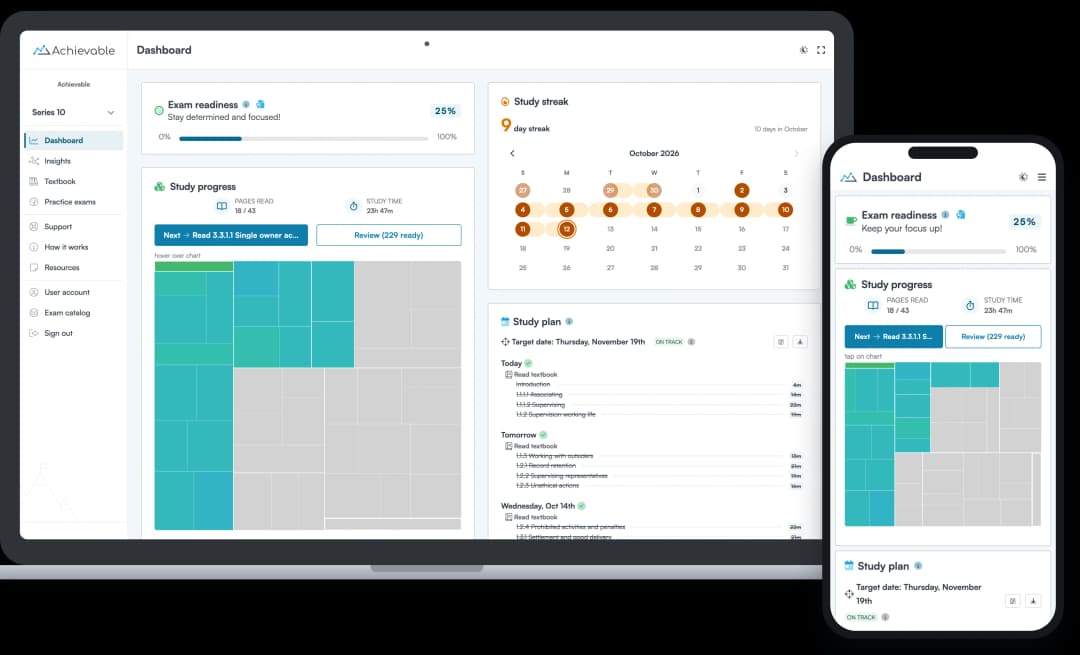
Once you have determined your total study hours, divide your time based on two important factors: your confidence level with each exam section, and the weight of each section on the exam. Spend more time on high-value topics where you have the greatest opportunity to improve and maximize your score. Achievable makes it easy to plan a study schedule with our interactive study planner, no matter your schedule or time constraints.
What if I have no time for a study schedule?
But what if you’re way behind and the test is only a few days away? The good news is that you can usually cover more material than you think. Cramming isn’t an efficient long-term strategy, but in a pinch, focused study sessions with regular breaks can help you push through. The study planner can be modified to accommodate truncated study plans, but try to plan ahead and avoid cramming.
Use quality study materials
Because the Series 9 and 10 exams are complex and challenging, using high-quality prep materials is highly recommended for effective preparation. Self-guided preparation courses and programs with virtual or live instruction are available at a variety of price points. Make sure you’re using a Series 9 and 10 textbook and course plan complete with review questions and guided instruction. Use flash cards, Series 9 and 10 “cheat sheets,” and videos to review and reinforce key exam topics. Choose a study program with comprehensive resources and a pass guarantee, so you can trust your platform to fully prepare you. Get a head start on your prep by exploring Achievable’s Series 9 and Series 10 resources, built to fit any learning style.
Many firms offer lists of approved or recommended study vendors for Series 9 and 10 materials, or provide direct access to courses and resources. However, some firms may expect you to pay for exam prep out of pocket, with the possibility of reimbursement upon passing.
Practice under real conditions
One of the best test-preparation strategies is to use realistic practice exams and questions under timed conditions. This crucial studying practice will help you become familiar with the format of the test and find out if you’re able to answer all the required questions in the allotted time.
Both exams give you about one and a half minutes per question (90 minutes for 60 items; four hours for 155), so pacing matters. You’ll need a thorough grasp of the test material and the ability to access knowledge quickly to get through it all. As you study, keep an error log of your mistakes and revisit key topics at the end of each week to address any weak points.
Prepare for exam day
On exam day, be sure to bring a valid government-issued ID, such as a driver’s license or passport. Plan to arrive at the test center at least 30 minutes early to allow plenty of time for check-in. Skip any last-minute cramming: just give your notes a quick review, get a full night’s rest, and focus on staying calm and clear-headed during the test. Bringing reference materials, including notes, textbooks, or study aids, is strictly prohibited in the testing environment.
The Series 9 and Series 10 exams are computer-based assessments administered at Prometric test centers. Online testing is available only to candidates with an approved accommodation, such as living more than 150 miles from a test center. Before you begin, the test center will provide a tutorial on navigating the exam interface to help you prepare for the Series 10 and Series 9 exam experience.

Series 9/10 retake policy
Until January 18, 2027, the FINRA exam retake policy is as follows: if you fail the Series 9 or 10 once or twice, you will need to wait 30 calendar days before you can retake that exam. After three or more failures in a row within two years, the wait is 180 days.
From January 19, 2027, a rule change FINRA adopted in October 2026 shortens these waits (here's how the new rule works). If you don’t pass the Series 9 or 10 on your first or second try, you’ll have to wait 15 days before you can retake the exam. After a third or later failure within two years, the wait is 60 days. If you failed before January 19 but request your retake enrollment on or after that date, the shorter wait applies to you. There is still no limit to how many times you can retake the test.
If your first attempt doesn’t go as planned, use that opportunity to refine your study strategy and practice before you try again.
Series 9 and 10 exam FAQ
Is the Series 9 exam hard?
It’s short but demanding: 55 scored questions in 90 minutes, all on supervising options sales, and you need 70% to pass. FINRA doesn’t publish a pass rate for the Series 9, so there’s no official measure of how many candidates pass.
Are the Series 9 and 10 hard?
Together, they’re a big commitment: 200 scored questions over five and a half hours of testing, with a passing score of 70% on each exam. The Series 10 is the longer of the two, with 145 scored questions in four hours. Note that FINRA doesn’t publish pass rates for either exam, so any pass rates found online are estimates rather than official citations.
What is the hardest FINRA Series exam?
FINRA doesn’t rank its exams by difficulty, so there’s no official answer. Difficulty depends on your background: the Series 9 is short but focused entirely on options supervision, while the Series 10 covers a broader range of supervisory topics over four hours. To see how the Series 9/10 compares with the Series 24, read our Series 24 vs. Series 9/10 guide.
Should I take the Series 9 or 10 first?
It’s up to you. FINRA lets you take the exams in either order, on the same day or on different days, but you must pass both within two years of each other. For more on choosing an order, see Series 9 vs. Series 10: What’s the difference?
Final thoughts
Passing the Series 9 and 10 exams is a crucial milestone in advancing a career in securities sales supervision. Taken together, both exams prepare you for the heightened responsibility and technical knowledge expected of general securities sales supervisors. Preparing for the exams may feel challenging given the scope of both tests, but with a structured plan, you can build an effective study routine that covers all the required material. With the right approach, you’ll be well-positioned to pass your Series 9 and 10 on the first attempt and elevate yourself to a management position in finance.
Achievable offers extensive prep courses for the FINRA Series 9 and Series 10, designed to make your preparation clear and efficient. Try them for free today and see how our expert textbook, interactive study tools, and technology-driven platform can support your success.