How long to study for the Series 63: Hours, weeks and a study plan


Table of contents
- How long to study for the Series 63, by background and pace
- How to split your hours across NASAA’s outline
- The 4-week Series 63 study plan at a glance
- Week-by-week breakdown
- Week 1: Definitions and registration
- Week 2: Exemptions, enforcement and ethics
- Week 3: Ethics, then the first full exams
- Week 4: Full-length practice exams
- How the plan is built
- A 1- or 2-week Series 63 plan for a short deadline
- Two weeks at about 2 hours a day
- One week at 3 to 4 hours a day
- When to book the Series 63
- Adjust the plan to your schedule
- The last few days before the exam
- Build your own Series 63 plan in Achievable’s study planner
- Series 63 exam-day facts
- Series 63 study time: common questions
- Is 1 week enough for the Series 63?
- Can I study for the Series 63 in a weekend?
- How long if I’m taking it with the Series 7?
- Key takeaways
Plan on about 20 hours of study for the Series 63, over about five weeks. That’s what Achievable’s Series 63 students log on average before exam day, as our Series 63 prepare page shows: about 7 hours reading, 5 on chapter quizzes and 8 on timed practice exams. At 1 to 2 hours a day, 20 hours takes one and a half to three weeks; at 3 to 4 hours a day, about a week.
Your background changes the total less than you might expect. The Series 63 tests state securities law, the Uniform Securities Act, which the SIE and the Series 7 don’t test in depth. If you’ve just passed the Series 7 or the SIE, you know the vocabulary but not the state rules, so plan on the same 20 hours. If you’re new to securities, plan on the full four-week plan below, about 25 hours, since every term is new. Either way, a free Series 63 practice exam shows where you’re starting from.
How long to study for the Series 63, by background and pace
| Background | Total hours | At 1–2 hours a day | At 3–4 hours a day |
|---|---|---|---|
| Just passed the Series 7 | About 20 | 1½ to 3 weeks | About 1 week |
| Just passed the SIE | About 20 | 1½ to 3 weeks | About 1 week |
| New to securities | About 25 | 2 to 3½ weeks | 1 to 1½ weeks |
The 20 hours is Achievable students’ average; the 25 is the full four-week plan below, with every checkpoint and seven full-length practice exams. The weeks are those hours at each daily pace, studying every day. Studying only on weekdays stretches the calendar, not the hours.
How to split your hours across NASAA’s outline
NASAA’s content outline spreads the 60 scored questions over eight areas. Achievable’s course teaches them in four chapters, so give each chapter time in line with the questions it covers:
| Outline area | Share | Questions | Course chapter |
|---|---|---|---|
| Regulations of investment advisers | 5% | 3 | 1 and 2 |
| Regulations of investment adviser representatives | 5% | 3 | 1 and 2 |
| Regulations of broker-dealers | 12% | 7 | 1 and 2 |
| Regulations of agents of broker-dealers | 13% | 8 | 1 and 2 |
| Regulations of securities and issuers | 9% | 5 | 1 and 2 |
| Remedies and administrative provisions | 11% | 7 | 3 |
| Communication with customers and prospects | 20% | 12 | 4 |
| Ethical practices and obligations | 25% | 15 | 4 |
That puts 45% of the exam in chapter 4 (ethics and communication with customers), 44% in chapters 1 and 2 (definitions, registration and exemptions) and 11% in chapter 3 (enforcement). Weight your review the same way, with one exception: learn chapter 1’s definitions first and precisely, because questions in every other area turn on them. Keep about 8 of your hours, as Achievable students do, for timed full-length practice exams.
The 4-week Series 63 study plan at a glance
At under an hour a day, four weeks covers Achievable’s Series 63 course with room to review: two and a half weeks through its four chapters (definitions, registration, enforcement and ethics), then full-length practice exams with review between them. The plan uses the same time estimates as the study planner in our app.
Week | What to study | Approx. time |
|---|---|---|
1 | Chapter 1 (definitions) and its checkpoint, then most of chapter 2 (registration of broker-dealers, agents, advisers and securities) | 6 hours |
2 | The rest of chapter 2, the chapter 2 checkpoint and the midterm, chapter 3 (enforcement) and its checkpoint, then most of chapter 4 (ethics) | 7 hours |
3 | The rest of chapter 4 and its checkpoint, then Final exams A and B and the first full practice exam | 6 hours |
4 | Four more full-length Series 63 practice exams, with review between them | 6 hours |
Each week’s time covers reading, the review questions at the end of each section, and the checkpoints and exams, all at the planner’s estimates. A checkpoint or the midterm is 30 questions, and a full practice exam is 60 questions, the length of the real exam.
Week-by-week breakdown
Week 1: Definitions and registration
Start with the introduction and chapter 1. The Series 63 tests the Uniform Securities Act, and almost every question turns on its definitions: who counts as a broker-dealer, an agent, an investment adviser or an investment adviser representative, who is excluded or exempt, what counts as a security, and what counts as an offer or a sale. Learn them precisely before moving on, then take the chapter 1 checkpoint. Chapter 2 covers registration for each of those persons (the disclosures and fees, financial requirements, when registration takes effect and the obligations after it) and how securities are registered or notice-filed with a state.
Week 2: Exemptions, enforcement and ethics
Finish chapter 2 with exempt securities and exempt transactions, which are easy to mix up, then take the chapter 2 checkpoint and the midterm on chapters 1 and 2. Chapter 3 covers enforcement: the state administrator’s powers, punitive and non-punitive actions, and criminal and civil penalties. Take its checkpoint, then start chapter 4 on ethics: compensation, disclosures, performance guarantees, customer agreements, advertising, handling customer funds and securities, and unethical practices.
Week 3: Ethics, then the first full exams
Finish chapter 4 with criminal actions and fraud, protecting vulnerable adults, and cybersecurity, then the wrapping-up section and the chapter 4 checkpoint. Ethics and communications with customers make up almost half the exam, so give this chapter’s checkpoint a careful review. End the week with Final exams A and B and your first full practice exam, a day or two apart. Sit each one in a single, timed session of 75 minutes, as on test day.
Week 4: Full-length practice exams
Take the full Series 63 practice exam four more times, every other day or so. Each sitting draws a fresh set of questions from the course’s question bank. On the days between, review every question you missed or guessed on, and reread the sections they came from. When you score about 82%, around 10 points above the 72% passing mark, on several of these exams in a row, you’re ready to book or keep your test date.
How the plan is built
The plan totals about 25 hours over four weeks, under an hour a day on average, with practice exam days at about an hour and a half. Reading takes about 10 of those hours, including the review questions at the end of each section. Checkpoints, the midterm and the practice exams take the other 15, at the planner’s estimate of each exam’s time limit plus a fifth for reviewing your answers.
That’s a little more than the 20 hours or so Achievable Series 63 students log on average, because the plan schedules seven full-length practice exams. If your scores are already well above passing after the first few, you can skip the rest. The order follows the course: each checkpoint comes right after its chapter, and the full-length exams only after you’ve read everything.
A 1- or 2-week Series 63 plan for a short deadline
If your firm wants the Series 63 passed within a week or two, compress the same course rather than skipping parts of it. Keep every chapter checkpoint and the midterm, keep at least three full-length exams, and take no more than one full-length exam a day, so you can review each one before the next.
Two weeks at about 2 hours a day
| Days | What to study |
|---|---|
| 1–3 | Chapter 1 (definitions) and its checkpoint, then registration in chapter 2 |
| 4–5 | Exempt securities and exempt transactions, the chapter 2 checkpoint and the midterm |
| 6 | Chapter 3 (enforcement) and its checkpoint |
| 7–8 | Chapter 4 (ethics and communication with customers) and its checkpoint |
| 9–10 | Final exams A and B, one a day, reviewing every question you missed |
| 11–14 | A full practice exam a day, reviewing every question you missed |
One week at 3 to 4 hours a day
| Day | What to study |
|---|---|
| 1 | Chapter 1 and its checkpoint, then start chapter 2 |
| 2 | The rest of chapter 2, its checkpoint and the midterm |
| 3 | Chapter 3 and its checkpoint, then start chapter 4 |
| 4 | The rest of chapter 4 and its checkpoint |
| 5 | Final exam A, then review every question you missed |
| 6 | Final exam B, then review every question you missed |
| 7 | A full practice exam, then review every question you missed |
The one-week version leaves no slack. If you aren’t scoring about 82% by day 7, add days of full practice exams before you book.
When to book the Series 63
Aim for 100% readiness: score about 82%, around 10 points above the 72% passing score, on several full-length practice exams, not just once. One good score can be the luck of the draw; several in a row means you’re ready. For reference, Achievable’s Series 63 students average about 83% on their final practice exam.
Don’t book early to meet a deadline you might miss anyway: after a failed attempt, NASAA makes you wait 30 days before you can sit again, longer than the one-week plan takes.
Adjust the plan to your schedule
Four weeks at under an hour a day fits around a job or other licensing exams, but the plan stretches or shrinks:
- Less time: use the 1- or 2-week plan above, and keep at least three full-length exams.
- Weekends only: read on weekends for two or three weekends, then take two practice exams each weekend.
- Right after the Series 7 or Series 6: much of the product knowledge is fresh, but the Series 63 is about state law, not products. Don’t skip the definitions.
- Practice scores short of about 82%: add a week. Many Series 63 questions turn on a definition or an exemption, so reread chapters 1 and 2 and retake their checkpoints.
The last few days before the exam
Don’t start new material in the last two or three days. Go over the definitions and exemptions one more time, review the questions you keep missing, and take your last full exam no later than two days out. The day before, confirm your appointment: the test center or online setup, the ID you need, and the time. You’ll see your result on screen when you finish.
For more on how candidates approach the exam, read our Series 63 study tips.
Build your own Series 63 plan in Achievable’s study planner
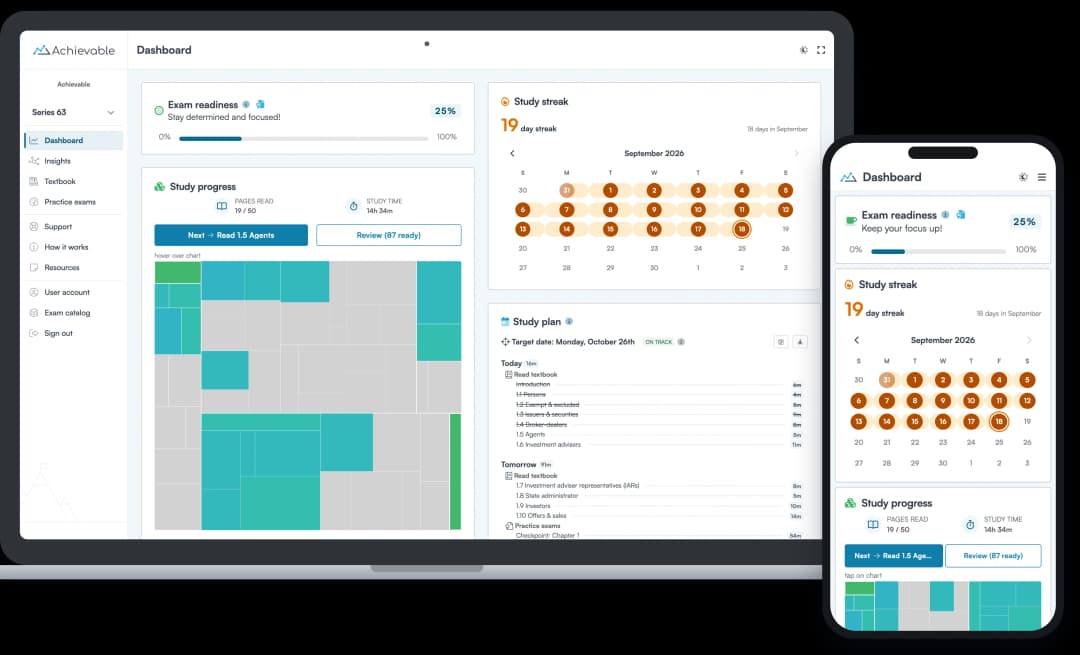
This calendar is a fixed version of what the study planner in Achievable’s Series 63 course does for you. Enter your exam date and choose which days you’ll study (every day, weekdays or weekends), and it lays out every textbook section, checkpoint and practice exam across those days, with a time estimate for each. As you check tasks off, it shows whether you’re on track for your date, and you can print the plan.

The course includes the online textbook, the checkpoints and midterm in this plan, and the full-length practice exams. You can also try a free Series 63 practice exam before you start.
Series 63 exam-day facts
The Series 63 exam, the Uniform Securities Agent State Law Exam, is a NASAA exam that FINRA administers. Most states require it before you can act as a securities agent there. The facts, from NASAA and FINRA:
- Questions: 65 multiple-choice, 60 scored and 5 unscored, mixed in so you can’t tell which
- Time: 1 hour 15 minutes
- Passing score: 43 of the 60 scored questions, about 72%
- Content: the eight areas in the outline table above
- Corequisites: none
- Fee: $147
See our Series 63 exam information page for more, and FINRA’s page on scheduling your exam when you’re ready. If you’re deciding between the state exams, compare the Series 63, 65 and 66.
Series 63 study time: common questions
Is 1 week enough for the Series 63?
For many people, yes, if they can give it 3 to 4 hours a day: that covers the 20 hours Achievable students average. Follow the one-week plan above, and book only once you’re scoring about 82% on several full-length practice exams. At an hour a day, give it three weeks instead.
Can I study for the Series 63 in a weekend?
Not well. Twenty hours in two days is 10 hours a day, with no time between practice exams to review what you missed. If weekends are all you have, read the four chapters over two or three weekends, then take two full-length practice exams each weekend until you’re scoring about 82%.
How long if I’m taking it with the Series 7?
Study for them one at a time, in the order your firm sets. Achievable’s Series 7 students log about 63 hours over about 11 weeks, and the Series 63 adds about 20 more, so plan on roughly 83 hours in all. The Series 7 covers products and FINRA’s rules and the Series 63 covers state law, so give the Series 63 its own week or more rather than squeezing it into the end of your Series 7 prep. Our Series 7 study plan lays out that exam week by week, and the Series 7 also requires the SIE.
Key takeaways
- Plan on about 20 hours for the Series 63, over about five weeks: that’s what Achievable students log on average. At 3 to 4 hours a day, it takes about a week.
- Spend two and a half weeks on the four chapters, with the most care on definitions and exemptions, and take each chapter’s checkpoint as you finish it.
- Use the rest of the time for seven full-length practice exams, with review between them.
- Book your test once your practice scores sit around 82%, about 10 points above the 72% pass mark, on several full-length exams.
- Achievable’s study planner builds this kind of plan around your own exam date and study days.