SIE study guide: Pass the first time


Table of contents
- What is the SIE exam?
- Is the SIE exam hard? How hard is the SIE?
- How many questions are on the SIE, and how long is the exam?
- What’s on the SIE?
- Understanding Products and Their Risks
- Understanding Trading, Customer Accounts, and Prohibited Activities
- Knowledge of Capital Markets
- Overview of the Regulatory Framework
- A note on experimental questions
- Do I need a sponsor to take the SIE exam?
- SIE exam sign-up instructions
- How to study for the SIE exam
- Review exam requirements
- Analyze the content and rate your knowledge
- Prepare a schedule with the recommended SIE study time
- Study schedule? I have no time!
- Use quality SIE study materials
- Practice under real conditions
- Prepare for exam day
- Preface: Preparing for test day
- Checking in
- The SIE exam test experience
- Wrapping up the SIE exam
- SIE retake policy: How many times can you take the SIE?
- Final takeaways
If you’re pursuing a career in finance, the Securities Industry Essentials (SIE) exam is your first step. It’s an entry-level FINRA exam covering the fundamentals of investing, and passing it opens the door to advanced licensing and specialized roles. This guide walks you through what’s on the SIE, how hard it is, and how to pass it on your first try, whether you’re coming from an MBA program, an entry-level bank job, or a career switch.

What is the SIE exam?
The Securities Industry Essentials (SIE) exam is an entry-level financial assessment administered by the Financial Industry Regulatory Authority (FINRA), the organization responsible for licensing financial professionals and regulating the securities industry. The SIE test focuses on fundamental concepts in financial services and requires a core understanding of investment vehicles such as stocks, bonds, and mutual funds. Throughout the exam, you’ll encounter questions on basic investing principles, different types of investment products, important regulatory guidelines, and common practices within the financial industry. Passing the SIE requires you to demonstrate the foundational knowledge expected of anyone starting a career in finance, from dedicated MBA students to diligent career-switchers.
Is the SIE exam hard? How hard is the SIE?
The SIE is considered moderately challenging yet approachable for early-career finance professionals. Thousands of candidates take (and pass!) the SIE every year, including many without a “traditional” finance background. Per FINRA’s most recently published figures, about three-quarters of first-time test takers pass on their first attempt, and a score of 70% or above is required to pass. The SIE’s difficulty depends on the level and experience of each test-taker. Finance students and those with industry experience will likely be familiar with much of the content. Candidates with less finance-heavy backgrounds will need to take time to learn and review the financial and mathematical concepts on the test.
How many questions are on the SIE, and how long is the exam?
The SIE covers the foundations of financial markets, products, risk evaluation, and regulatory practices. When considering the exam’s difficulty, it helps first to understand its structure and the SIE time limit: the SIE consists of 80 multiple-choice questions that must be completed in one hour and 45 minutes. Of these questions, 5 are unscored “experimental” questions that are not factored into your final score. Thus, only 75 questions contribute to the results that determine your passing status.
Note: Before October 27, 2025, the SIE had 85 questions (10 unscored). FINRA reduced the number of unscored pretest questions from 10 to 5, so the exam now totals 80 questions.
What’s on the SIE?
The SIE divides its 75 scored questions into four main content categories:
| Section | Questions | % of exam |
|---|---|---|
| Understanding Products and Their Risks | 33 | 44% |
| Understanding Trading, Customer Accounts, and Prohibited Activities | 23 | 31% |
| Knowledge of Capital Markets | 12 | 16% |
| Overview of the Regulatory Framework | 7 | 9% |
Keep in mind that actual numbers and weighting may shift slightly depending on how your study materials align with the official FINRA content outline. Still, this blueprint gives you an accurate idea of what to expect.
A detailed look at each subject area can help you pinpoint which parts of the test may require extra preparation. Below, we’ll explore each section individually, starting with the most heavily weighted topics, so you can focus your SIE study strategies on the areas that impact your score the most.
Understanding Products and Their Risks
33 questions: 44% of the exam
If you have a basic understanding of the financial industry, you’re likely aware of stocks and bonds. But there are many financial products investors can choose from. The SIE focuses on a small selection of commonly traded investments, which include:
- Equity securities (common and preferred stock)
- Exchange-traded funds
- Exchange-traded notes
- Debt securities (bonds)
- Options
- Investment companies (for example: mutual funds)
- Direct Participation Programs
- Hedge funds
Each product has its own benefits and risks and suits a specific type of investor. The exam requires knowledge of investment characteristics, how they function, and how they’re taxed, as well as the underlying ethics, rules, and regulations for each type of financial product.
Understanding Trading, Customer Accounts, and Prohibited Activities
23 questions: 31% of the exam
After you learn the various financial products, you’ll need to learn the rules of trading them and the types of accounts that hold them. Some rules and ethics govern how financial professionals operate.
Trading securities can be detailed and complicated, but the SIE tends to focus on the basics. You’ll need to understand how investors execute transactions and the different ways to submit orders to the market. Investors can specify certain requirements for a trade: for example, requesting that a stock be bought for $50 or less. You’ll need to demonstrate proficiency in the basics of trading securities and the mechanics of the financial markets.
Customers can open and maintain several different types of accounts. You’ll be asked questions on the specifics of these accounts, including ownership status, tax status, and paperwork required to open them. The accounts typically tested include:
- Individual
- Joint (with rights of survivorship and tenants in common)
- Business accounts
- Discretionary accounts
- Options accounts
- Margin accounts
- Retirement accounts
- Educational accounts
FINRA values registered representatives who understand and follow ethical principles. In this section, you’ll also be asked questions on topics ranging from market manipulation to insider trading. Your job is to demonstrate a general knowledge of what practices to avoid and how to operate ethically in finance.
Knowledge of Capital Markets
12 questions: 16% of the exam
You might be wondering what a capital market is. Capital is another term for an asset, typically money, in finance. When a company or organization wants to raise large sums of money, it can do so through various means. You may have heard of an IPO, or initial public offering, as that’s one of the most common ways to raise capital.
Along with understanding how companies and organizations raise money by selling financial products, you’ll need to know about different finance regulators and how they operate. The Securities and Exchange Commission (SEC), a government agency, and FINRA write rules that govern and regulate these markets at the national level. The MSRB (Municipal Securities Rulemaking Board) issues rules for municipal (city and state) securities markets.
Economic conditions can also greatly affect financial markets and investment choices. The SIE will test your knowledge of the basics of the economy and how economic trends drive markets. Government decisions around spending and setting interest rates (monetary and fiscal policy) are also tested.
Overview of the Regulatory Framework
7 questions: 9% of the exam
Rules, rules, and more rules. Whenever the word “regulatory” appears, you’ll be required to recall laws, regulations, and general rules of the industry. As a registered representative, there are many conduct rules you must understand and follow to work in the industry. Typical questions from this section focus on:
- Customer complaints
- Outside business activities
- Entertaining customers
- Gifts given and received
- Political contributions
- Required disclosures to FINRA and customers
A note on experimental questions
On the SIE, you’ll encounter 80 multiple-choice questions total, including 5 unscored “experimental” questions that do not impact your final result. These trial questions can be from any category and are interspersed with the rest, so approach each question as though it were scored. Avoid getting stuck on any one question: it’s crucial to keep moving and answer as many questions as you can within the time limit. There’s no penalty for guessing, so try to answer every question in the allotted time.

Do I need a sponsor to take the SIE exam?
The answer is: No! You can take the SIE without sponsorship from a FINRA firm. This is a great way to improve your resume and show firms that you’re serious about a career in finance and that you understand key industry concepts.
SIE exam sign-up instructions
Prepare for the exam using a FINRA SIE exam prep course (see our comparison of different SIE exam prep vendors). Once you’re ready, sign up to sit for the SIE by first registering for an account on FINRA’s website and then visiting the Schedule An Exam page.
However, the SIE alone does not fully qualify you for any of the licensed finance roles. To complete your license, you need to take a top-off exam.
The FINRA Top-Off Exams are:
- Series 6: Investment Company Representative (IR)
- Series 7: General Securities Representative (GS)
- Series 22: DPP Representative (DR)
- Series 57: Securities Trader (TD)
- Series 79: Investment Banking Representative (IB)
- Series 82: Private Securities Offerings Representative (PR)
- Series 86 and 87: Research Analyst (RS)
- Series 99: Operations Professional (OS)
You’ll need to be sponsored by a FINRA firm to be eligible to attempt the above exams. Once you pass the SIE and the corresponding top-off exam, you’ll earn the license listed above and expand your credentials.
How to study for the SIE exam
If you’re wondering, “What do I need to pass the SIE?”, it’s vital to remember that you don’t need years of experience in finance. What you do need is a study plan, a willingness to learn new terminology and material, and the right tools to master each topic. Unlike other FINRA licensing exams, anyone can take the SIE, and you don’t need to be employed at a FINRA-member firm or sponsored by an employer.
Review exam requirements
How much is the SIE exam, and how do you register? Before you begin preparing, there are certain eligibility requirements you must meet to sit for the SIE:
- Age: You must be at least 18 years old.
- Exam fee: Once you’ve completed the prerequisites, you must schedule your exam at a Prometric test center near you and pay the $100 test-taking fee.
Analyze the content and rate your knowledge
When you’re planning your SIE study plan before test day, spend a bit of time assessing your knowledge of each section. Do a couple of practice questions from each one, as well as a diagnostic SIE practice test. Take note of your confidence with each section to see which areas need the most improvement.
Prepare a schedule with the recommended SIE study time
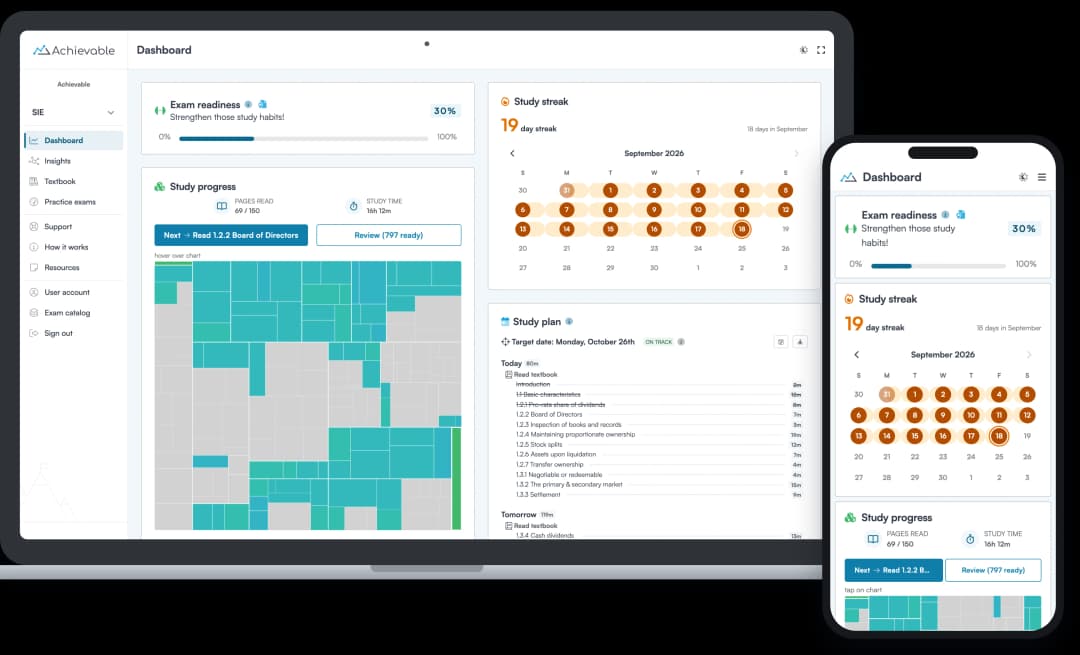
Give yourself a realistic time budget for studying. Carefully consider how many hours you can dedicate to preparation between now and test day. The key is establishing a smart study schedule tailored to your needs. Most comprehensive SIE courses suggest around 50 hours of study time to fully learn the material. However, if you’ve already built a strong knowledge base and are focused on a final review, a targeted 20 hours is usually sufficient. Companies will sometimes have entry-level employees complete a one- to two-week SIE “crash course” designed to prepare candidates to pass quickly. No matter how much time you have, Achievable makes it easy to plan an SIE study schedule with our interactive study planner.
After determining your total study hours, divide your time based on two factors: your confidence with each subject area and the weight each section carries on the exam. The best strategy for SIE mastery is to concentrate on high-value topics where you have the greatest opportunity for improvement. This focused approach ensures you maximize your score increase within your timeframe. Be sure to complete plenty of SIE practice questions throughout your studies to verify you’re fully prepared for exam day.
Study schedule? I have no time!
But what if you’re way behind and the exam is only a few days away? The good news is that you can usually cover more material than you expect. Many students find their focus fades after a few hours of continuous study, but with just a one-hour break, they can often put in another few productive hours. Starting your prep a few days before the test isn’t ideal, but in a pinch, devoting time and taking breaks works.
For the best results, use a steady, consistent approach over a longer stretch of time: study for at least a couple of weeks and regularly review what you’ve already learned to reinforce it. Starting early will also give you time to make a game plan with some flexibility built in.
Use quality SIE study materials
Study with an SIE textbook and a structured course plan that includes review questions and guided instruction. Working with a tutor who specializes in the SIE can help you master difficult concepts and stay accountable to your schedule. Supplement your learning with flashcards, quick-reference “cheat sheets,” and videos to reinforce the most important topics. When choosing a study program, look for one that provides a variety of resources and even a pass guarantee, so you know you’ll be fully supported. To jump-start your prep, check out Achievable’s SIE library, featuring free videos, podcast episodes, and reference sheets.
The learning science powering Achievable offers a proven strategy for studying for the SIE exam. Our platform monitors your progress through each section of the SIE content and optimally schedules review sessions to maximize your memory retention. This ensures you get the most value from every minute spent preparing, making your study plan both thorough and time-efficient.
Practice under real conditions
One of the most effective ways to prepare is by practicing with realistic, timed questions. Simulating actual test conditions helps you get comfortable with the format and ensures you can complete all the questions within the time limit.
For the SIE, you’ll have one hour and 45 minutes to answer 80 questions, which translates to about one minute and 19 seconds per question. Success requires more than just knowing the material; you’ll also need to be confident in interpreting question wording and applying your knowledge quickly. To strengthen your performance, keep an error log of missed questions and review key topics at the end of each week. This consistent reflection will help you identify and close any gaps in your understanding.
Prepare for exam day
One of the most commonly asked questions of FINRA instructors is “What is taking the test actually like?” Here are some insights from our FINRA course author, Brandon Rith:
Preface: Preparing for test day
Before we talk about what happens on test day, remember that how you approach it makes a big difference. Make sure you’re bringing your best self: get plenty of sleep the night before, eat a bit of food beforehand, and maybe perk yourself up with a workout or some jumping jacks. This also helps a lot with nervous energy: you’re going to perform much better if you’re cool, calm, and confident going into the exam.
Checking in
When you first walk in the door of your testing center, you’ll need to tell them what test you’re taking and give them a current government ID, like a driver’s license or passport. Then you’ll sign a pretty straightforward disclosure form: no cheating, don’t bring weapons into the test center, etc. After that, you put your belongings into a locker except for that same ID. They’ll also ask you to turn off your cell phone before putting it in the locker.
Once that’s done, you’ll be taken to another part of the test center to be “admitted” to the test environment. This consists of answering a couple more questions and being patted down, similar to an airport security checkpoint, to ensure you’re not bringing in notes. They’ll also take a picture of you for their records to confirm that no one else took the test on your behalf. To ensure a smooth check-in, try to arrive at the test center 30 to 60 minutes before your scheduled test time.
The SIE exam test experience
Once you’re admitted, you’ll enter a completely silent room with a bunch of computers and other test takers. They’ll often be taking different tests than yours, so there’s no sense in trying to take a peek. The room is also fully covered by security cameras.
You’ll be seated at your computer and given “scratch paper,” which is really a laminated sheet and a dry-erase marker. You’re also given a pair of noise-canceling headphones, which is great for concentration (some test centers will also give you earplugs if asked). You then need to take a tutorial on the computer test system to ensure you know how it works. Then, finally, it’s time to take the test.
If there’s anything you want to keep track of, i.e., key equations, notes, or frameworks, write them down immediately after your test starts. That way, you won’t need to re-remember them later and can stay “in the zone” of answering questions. And don’t be distressed if you get nervous at this point. Even experienced test takers get nervous at the start of a new test: focus on answering the first 10 questions, and your nervousness should fade.
Wrapping up the SIE exam
Once you finish, you’ll be prompted (sometimes at length) to confirm that you’re happy with your answers and ready to submit. For most FINRA tests, you’ll get a score back immediately after that screen, telling you whether you passed right away.
Then you just need to gather your belongings and head out. You may be asked to fill out a survey about your experience (e.g., whether the test center was accommodating), but otherwise, you can pick up your stuff from your locker and sign out. When signing out, be sure to get a printout documenting your score if you passed, for your records. And that’s it: your test is complete.

SIE retake policy: How many times can you take the SIE?
You can take the SIE multiple times if needed, but there are specific waiting periods between attempts that you must follow. The FINRA SIE follows the same retake rules as other FINRA exams. Until January 18, 2027, they are:
- After your first failed SIE attempt, you must wait 30 days before retaking the exam.
- If you do not pass on your second attempt, you must wait another 30 days before sitting for the SIE again.
- Failing the SIE a third time means you must observe a 180-day waiting period before you can retake the exam.
These rules change on January 19, 2027. FINRA adopted a rule change in October 2026 that cuts the wait to 15 days after a first or second failure and 60 days after a third or later failure within two years. January 18, 2027, is the last day the old 30/30/180-day waits apply. If you failed before January 19 but request your retake enrollment on or after that date, the shorter wait applies to you.
It’s reassuring to know there’s no lifetime limit: you can take the SIE as many times as needed, provided you observe the required waiting periods. Staying committed to your SIE study plan and reevaluating your strategy if you don’t succeed the first time can make a significant difference in your success.
Final takeaways
Building a long-term career in finance and moving up in the industry begins with passing the SIE. Preparing for your first FINRA test can seem overwhelming, but with the right plan, you can set yourself up to pass the first time. Consistent study over several weeks, along with regular review, is the most reliable way to retain what you’ve learned. With a focused strategy, you’ll increase your chances of passing the SIE on your first try, opening up a world of opportunities in the financial sector and making future licensing exams more manageable.
Achievable offers comprehensive prep courses for the FINRA SIE exam and several top-offs. We’re here for you every step of the way: try our courses for free today.