Is a P&C exam prep course worth it, or can you self-study?


Table of contents
- What self-study and a course actually cost
- Does your state require a pre-licensing course?
- How many people pass on the first try
- Who can self-study, and who should pay for a course
- Free first, then upgrade: the Achievable path
- How ready to be before you book
- Is a P&C prep course worth it? FAQ
- Key takeaways
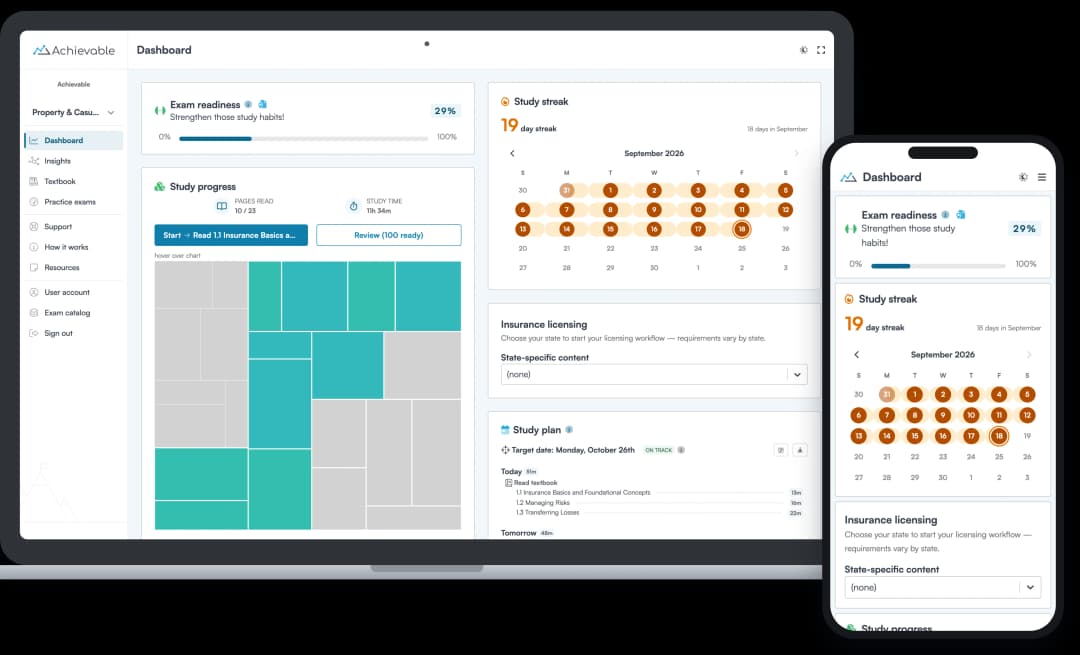
You can self-study for the property and casualty (P&C) exam in states that require no pre-licensing course before the exam, such as Texas, Virginia, Washington and California. For most first-time candidates, though, a structured prep course is worth it: 40% of first-time P&C test takers failed in 2025 in the states that reported results, and every failed attempt costs the exam fee again plus the weeks you spend getting ready for another try. Achievable’s Property and Casualty course costs $149 for a full year and gives you 5 full-length practice exams built for your state, 1,300+ practice questions explained in depth, and a pass guarantee, and its first chapter is free to try.
Before you decide, find out where you stand. Take Achievable’s free P&C practice exam: 96 questions in 120 minutes, with every answer explained. It covers the general part of the exam, not your state’s law, so it tells you how much of the core material you already know before you spend anything.
What self-study and a course actually cost
Self-study isn’t free so much as unstructured. The official materials tell you what’s on the exam but don’t teach it or test you on it, so a self-studier still needs a way to learn the material and enough practice to know they’re ready. Here’s what each option costs and what it gives you.
Option | Price | Access | Practice | Guarantee |
|---|---|---|---|---|
Achievable P&C course | $149 | 1 year | 5 full-length exams built for your state; 1,300+ questions | Full refund if you pass a full-length practice exam within the standard time, then fail |
Achievable free practice exam and study guide | Free | Online | 96 questions in 120 minutes (general part) | None |
Exam vendor’s content outline and handbook | Free | Download | None: topics only | None |
Pearson VUE practice tests | $19.95 per test | One attempt | 75 questions per test; no explanations | None |
Kaplan | $139 to $349 | 60 days | Question bank exams and a Mastery Exam | Refund, with conditions |
ExamFX | $169.95 to $299.95 | 60 days | Exam simulations and a Readiness Exam | Refund, first attempt only |
A.D. Banker | $169.95 to $296.85 | 60 days | Simulated exams; count not stated | Material costs refunded, with conditions |
America’s Professor | $199 | 100 days, then extended until you pass | 700+ question bank | Satisfaction only |
XCEL Solutions | $199 or $299 | 30 days, plus 30 of review | 3 exam simulators | Premier package only |
Achievable is one price in every state. The other providers’ prices are their Texas P&C packages, read on each company’s own site in November 2026 (Kaplan, ExamFX, A.D. Banker, America’s Professor, XCEL Solutions), and they vary by state. Sales are common, so check each provider’s current price. Pearson VUE’s practice tests are sold separately for Property and for Casualty ($39.90 for both), each with 50 general and 25 generic state questions. Pearson VUE offers "only one version of each test", so buying one again repeats the same questions.
What sets Achievable apart in that table:
- A full year for $149. Most packages give you 60 days, so a slipped exam date or a busy month means paying $29 to $49 for a Kaplan extension, or starting over. A year covers a delayed exam and a retake.
- Full-length exams built for your state. Each of the 5 practice exams is generated for your state from 860+ property and casualty questions plus your state’s law questions, so your scores reflect the exam you’ll actually take.
- Every answer explained in depth, where Pearson VUE’s paid practice tests show only right or wrong.
- A guarantee you can meet before you book. Its terms are below.
The rivals’ guarantees come with conditions you meet in the last days before your exam: Kaplan’s requires 80% on its Mastery Exam and the state exam within 3 business days; ExamFX’s requires 80% on its Readiness Exam no more than 3 days before your first attempt, and excludes packages an employer paid for; A.D. Banker’s refunds material costs after 80% on its Guarantee Exam within 3 days before your first attempt (not in Ohio); XCEL’s covers only its Premier package, after 85% on its final simulator and the state exam within 48 hours. America’s Professor offers a satisfaction guarantee, not a pass guarantee.
Does your state require a pre-licensing course?
This is the first thing to check, because in some states it settles the question for you. A pre-licensing course is a state requirement: a set number of approved hours you must finish before you test or before your license is issued. Exam prep is what gets you ready to pass. Some courses are both, but many approved courses are long on hours and short on practice.
Several states have dropped or cut the requirement recently: Pennsylvania ended its pre-licensing course in 2025 and North Carolina in October 2025, and Georgia cut its hours to 8 per line. Here’s where 14 large states stood in November 2026, from each state’s law, insurance department or exam bulletin:
State | Required before the P&C exam |
|---|---|
Arizona | None |
California | None before the exam; a 12-hour ethics and Insurance Code course before your license is issued |
Florida | A 200-hour approved course, finished within the 4 years before you apply |
Georgia | 16 hours (8 for property, 8 for casualty) |
Illinois | 20 hours per line, so 40 for property and casualty |
Michigan | 40 hours (20 for property, 20 for casualty) |
New Jersey | 40 hours (20 for property, 20 for casualty) |
New York | 90 hours |
North Carolina | None, for applications from October 1, 2025 |
Ohio | 20 hours per line, so 40 for property and casualty |
Pennsylvania | None, since Act 142 of 2024 took effect in 2025 |
Texas | None |
Virginia | None: the exam is the only requirement |
Washington | None, since 2023 |
Sources: Arizona (NIPR), the California Department of Insurance, Florida’s 2-20 requirements, the Georgia insurance commissioner, the Illinois Department of Insurance, Michigan law, the New Jersey Department of Banking and Insurance, the New York Department of Financial Services, the North Carolina Department of Insurance, Ohio law, Pennsylvania’s insurance department, the Texas Department of Insurance, the Code of Virginia and Washington’s 2023 rule. Washington’s PSI candidate bulletin still says pre-license education is required, but the state dropped it in 2023. Where hours are required, some states (Michigan and Ohio among them) let them be done as self-study through an approved provider.
What it means for the decision:
- Texas, Arizona, Pennsylvania, North Carolina, Virginia and Washington: you need no pre-licensing course at all, so self-study is a real option, and the question is only whether you’ll be ready without a structured course.
- California: the 20-hour pre-licensing course per line ended on January 1, 2026. You need the 12-hour ethics and Insurance Code course before your license is issued, not before the exam, so how you prepare for the exam is up to you. Achievable sells the 12-hour course separately.
- Florida: unless you qualify through a year of full-time P&C work or the exemption for members and veterans of the armed forces and their spouses, you must finish a 200-hour approved course, so you’re paying for a course either way. Achievable’s course is approved for the 200-hour 2-20 requirement (DFS course 139269), so the hours and the exam prep come in one course.
- New York, New Jersey, Michigan, Illinois, Ohio, Georgia and other states with required hours: take an approved course for the hours, then check whether it has enough full-length practice for your state’s exam. If it doesn’t, add practice before you book.
For the rules in more states, and how a pre-licensing course differs from exam prep, see what course you need to pass the P&C exam, and your state’s page in our insurance licensing guide.
How many people pass on the first try
About six in ten. In 2025, 60% of first-time takers of the combined property and casualty exam passed (29,661 of 49,492) in the states that reported to the National Association of Insurance Commissioners, compiled in our P&C, life and health pass rates for all 50 states.
- Texas: 59% of first-time takers passed the property and casualty exam (6,638 of 11,246).
- California: 57% passed the Property Broker-Agent and Casualty Broker-Agent exam (3,150 of 5,479).
- Florida: didn’t report results for its General Lines exam for 2025.
- The range: on the combined P&C exam, from 33% in New Mexico to 75% in Indiana.
Retakes go worse. Pearson VUE’s 2025 Texas pass rates show 37% of repeat attempts on the property and casualty exam passed (3,183 of 8,543), against 59% of first attempts. Repeat attempts were more than four in ten of the exams graded that year. So the cheapest attempt is a first one you pass. A failed one costs the exam fee again ($49 in Texas, $44 in Florida, and $55 in California plus PSI’s $43 fee at most test sites), and often a course extension and a later start date with your agency.
Who can self-study, and who should pay for a course
Self-study can work when all of these are true:
- Your state requires no pre-licensing hours, or you’ve already finished them.
- You already know insurance: you’ve worked in an agency, handled claims or held a life and health license, so the vocabulary isn’t new.
- Your first practice exam, before much study, already comes in comfortably above passing, and full-length exams for your state confirm it, again and again.
- You can study on a schedule without anyone checking on you, and you don’t mind building your own plan from the content outline.
A course is worth it when any of these is true:
- You’re new to insurance. General insurance knowledge (types of policies, terms such as coinsurance and subrogation, and policy provisions) makes up most of the exam, 100 of the 130 scored questions in Texas, and a course teaches it in order.
- Your exam date is fixed: an agency start date, or a temporary license that runs out.
- You’re below passing on your first practice exam, or you’ve already failed once.
- You study around a full-time job and need a plan that fits your week.
- Your state’s law section is long. It’s 30 of the 130 scored questions in Texas, and an outline won’t teach it.
Free first, then upgrade: the Achievable path
You don’t have to choose before you start. Use what’s free, and pay only once you know you need more:
- Read the first chapter of the course free, with no credit card, at Achievable’s P&C course. It shows you how the course teaches before you buy.
- Take the free practice exam to get a baseline on the general part of the exam.
- Work through the free P&C exam study guide, which walks through every topic on the exam.
- Download your state’s content outline from your exam vendor (Pearson VUE, PSI or Prometric), so you know how many state law questions you’ll face.
- Upgrade when the baseline says you need to, or when you want full-length exams for your state to prove you’re ready before you book.
Once you upgrade, the course gives you:
- 5 full-length practice exams built for your state, with its law questions included. Where your state splits the license into separate Property and Casualty exams, you practice both.
- 1,300+ practice questions, including 480+ review questions across every chapter, each explained in depth.
- State law for all 50 states and Washington, D.C., so the course matches the state you test in.
- Adaptive review, which keeps steering your quiz questions toward the topics you’re missing.
- A study planner that builds a day-by-day plan to your exam date.
- A full year of access for $149.
- A pass guarantee. Pass one of the course’s full-length practice exams within the standard time before your exam; there’s no minimum study time. If you then fail the exam, email a picture of your score report with a valid state ID, and once they’re verified, Achievable refunds the course in full.
How ready to be before you book
Whichever way you study, don’t book the exam on hope. Aim for 100% readiness, and for practice exam scores about 10 points above your state’s passing score, repeatedly, across several full-length exams: about 80% where the exam passes at 70% correct, as in Florida, and about 70% in California, where it passes at 60%. Texas’s 70 is a scaled score, not a percentage, so there aim for practice scores comfortably above passing, consistently. One good score can be the luck of the draw; several in a row mean you’re ready.
That’s also why the kind of practice matters. A small question bank you can memorize makes practice scores look better than they are, which is why some providers tell you not to rely on practice tests at all. Full-length exams generated from a large pool of questions you haven’t seen tell you whether you know the material or just remember the answers.
Is a P&C prep course worth it? FAQ
Can I pass the P&C exam with self-study alone? Yes, if your state requires no pre-licensing hours and you’re already scoring comfortably above passing on full-length timed practice exams. Most first-time candidates who are new to insurance do better with a course: 40% of first-time takers failed in 2025 in the states that reported results.
How much does a P&C prep course cost? Achievable is $149 for a year. Kaplan’s Texas packages run $139 to $349, ExamFX’s $169.95 to $299.95, A.D. Banker’s $169.95 to $296.85, America’s Professor’s $199, and XCEL’s $199 or $299, most with 60 days of access or less.
Is the cheapest course good enough? Compare what you get, not only the price: how long your access lasts, how many full-length practice exams for your state it has, whether every answer is explained, and what its guarantee requires. A 60-day package that needs an extension can cost more than a year of Achievable.
Will my agency pay for my P&C course? Ask before you buy. An agency or carrier that’s hiring you may pay for the course or name one it wants you to use. Agencies licensing several people can buy Achievable for their team through Achievable for Organizations, with a manager dashboard that shows who’s on track and who needs help. If your employer pays for a different course, check its guarantee: ExamFX’s excludes packages an employer paid for.
How long should I study for the P&C exam? Until your practice scores are about 10 points above passing across several full-length exams, not for a set number of hours. Achievable’s study planner sets a daily pace to your exam date.
What if I fail? Retake rules, fees and waiting periods vary by state. See Failed the P&C exam? When to switch prep courses for your retake.
For a side-by-side look at the courses, see the best P&C exam prep courses.
Key takeaways
- You can self-study for the P&C exam where your state requires no pre-licensing course before the exam, such as Texas, Virginia, Washington and California, but most first-time candidates are better off with a structured course.
- 60% of first-time P&C test takers passed in 2025 in the states that reported results, and repeat attempts in Texas passed only 37% of the time, so the first attempt is the one to get right.
- Pennsylvania and North Carolina dropped their pre-licensing courses in 2025; Florida still requires 200 hours, New York 90 and New Jersey, Michigan, Illinois and Ohio 40.
- Achievable costs $149 for a year, with 5 full-length practice exams built for your state, 1,300+ questions and a pass guarantee; most rival packages give 60 days for a similar or higher price.
- Start free with Achievable’s first chapter and practice exam, and book the exam only when you’re scoring about 10 points above passing, repeatedly, across several full-length exams.