MCAT retake strategy: should you switch prep courses?


Switch prep courses for your MCAT retake only if your score report and practice history show the course was the problem: its practice exams didn’t predict your real score, you ran out of questions you hadn’t seen, or it never had you take timed full-length exams. Otherwise, keep your materials and change how you use them: less rereading, more timed passages and a review of every miss, with the AAMC’s official full-length exams as your benchmark in the final weeks.
Start with a fresh baseline from Achievable’s free MCAT practice exams, one for each section at the real question count and time limit. If you need practice you haven’t seen, Achievable MCAT is $399 for a full year, with three full-length practice MCATs written for the course, 1,400+ practice questions with explanations, and an adaptive study plan and AI tutor that keep you on the content you haven’t mastered. Its score improvement guarantee starts from your previous official score: +5 points for a starting score below 502, +4 points for a starting score of at least 502 and below 508, and +3 points for a starting score of at least 508 and below 515, or your money back.
You have room to do this properly. The AAMC allows three attempts in a single testing year, four in two consecutive years and seven in a lifetime, and medical schools see every exam you choose to score. The goal is a retake that raises your score, not the earliest seat you can book.
Read your score report and practice-test trend first
Your score report gives a score from 118 to 132 for each of the four sections and a total from 472 to 528, plus three tools the AAMC explains on its score report page:
- Percentile ranks. Where each score sits among recent test-takers. The ranks in use from May 1, 2026 to April 30, 2027 are based on everyone who tested in 2023, 2024 and 2025 (AAMC percentile ranks).
- Confidence bands. The range around each score where, in the AAMC’s words, your "true scores" likely lie. Two sections a point apart may not really differ, so don’t build a retake around a one-point gap.
- The score profile. Your strengths and weaknesses across the four sections. The AAMC says it "can be used to help you determine areas to focus on, should you decide to retake the exam."
The report stops at the section level: it doesn’t break a section into topics. The topic-level diagnosis has to come from your own practice records, which is why your practice history matters as much as the report.
Two scoring rules also shape the retake. The MCAT isn’t graded on a curve, so your score doesn’t depend on who tested with you. And wrong answers are scored the same as unanswered ones, so you lose nothing by answering every question (how the MCAT is scored). If time ran out with questions left blank, that alone cost you points.
Then line up your practice history. List every full-length you took, in order, with its date, its source and its score, next to your real score. If your last full-length was weeks ago, take Achievable’s free section exams under timed conditions for a current baseline: Chem/Phys, CARS, Bio/Biochem and Psych/Soc. Then read the trend:
- Practice scores ran well above your real score. Either test day went differently from practice (pacing, stamina, nerves), or the practice scores were inflated, for example by a form you had taken before. The fix is fresh, timed full-lengths, not more content.
- Practice scores stayed flat for weeks. Hours went in but the score didn’t move. That usually points to passive study: rereading and watching instead of doing questions and reviewing misses.
- Practice scores were still climbing on test day. The plan was working, but you tested before you were ready. It needs more weeks and more full-lengths, not a new course.
- One section stayed low on every test. A targeted problem, often CARS or one science section, that a plan for that section fixes.
Diagnose the cause, then fix it
Match what you see in your report and practice history to a cause. More than one row can apply; fix the one costing you the most points first, which is the low section your score profile and your practice tests agree on.
Cause | How it shows up | Fix |
|---|---|---|
Content gaps | Misses trace back to topics you never learned or have forgotten; one or two science sections lag | Relearn those topics actively: a short lesson, then questions on that topic the same day, then spaced review until they stick |
Passive studying | Many hours of reading or video, flat practice scores, misses on topics you "covered" | Move most of your time to questions and passages, and keep an error log: for every miss, why you missed it and what you’ll do next time |
Timing | Unfinished sections, rushed final passages, a run of guesses at the end | Do every set timed, practice a steady pace per passage, and take full-lengths with the real breaks to build stamina |
CARS | CARS lags the science sections even when your content is strong | Read humanities and social-science passages daily under time, and check each miss against the passage’s own wording |
Too few full-lengths | Fewer than six full-lengths before test day, or test day was your first full-length sitting | Plan six to ten full-lengths over the retake, one every week or two, under real conditions |
Whichever rows apply, the common thread is active practice. A retake built on the same hours of reading as the first attempt tends to produce the same score.
When switching prep courses makes sense, and to what
Switch when the course itself was the problem:
- Its practice exams didn’t predict your score. If its practice scores ran well above your real result, or you had taken its forms so often you remembered the answers, it can’t tell you when you’re ready.
- You’ve run out of fresh questions. If you’ve finished its question bank and recognize passages on sight, retaking the same questions tests your memory, not your reasoning.
- It never had you take a timed full-length exam. Pacing and stamina are trained by full-lengths under real conditions.
- The format didn’t fit how you study. A live class whose schedule you couldn’t keep, or video lectures you watched without doing questions.
- Your access ends before your new test date.
Keep your course when it wasn’t the problem: you didn’t finish it, you skipped its practice exams, or your score report points to one section to fix. Moving to a new course then costs you weeks of learning a new platform and fixes nothing.
If you do switch, switch to what the first attempt lacked:
- A course whose questions you haven’t seen, with timed full-length exams, an explanation for every answer and tracking of what you’ve mastered. Achievable MCAT is built that way (next section).
- The AAMC’s official practice exams you haven’t taken. The AAMC writes the MCAT, so its exams are the most representative of the real test. It offers two free full-lengths (the Unscored Sample Test and Practice Exam 1) and five more at $35 each (AAMC full-length exams). Save the ones you haven’t used for your final weeks: a score on an exam you’ve already seen tells you less.
- A tutor for one section, if a single section such as CARS hasn’t moved despite steady practice. Achievable’s MCAT tutor directory lists MCAT tutors and what they offer.
Where Achievable fits for a retake
A second attempt needs practice you haven’t seen, review aimed at your weak spots, and a plan to a new date. Achievable MCAT covers all three, and it pairs well with the AAMC’s official practice exams:
- Practice you haven’t seen. Three full-length practice MCATs, each with all four sections and the real exam’s question counts and time, and 1,400+ practice questions in all, every one with an explanation. They’re written for the course, so you won’t have met them in a free PDF or a forum’s question dump, and each practice exam form is taken once, which keeps its score honest.
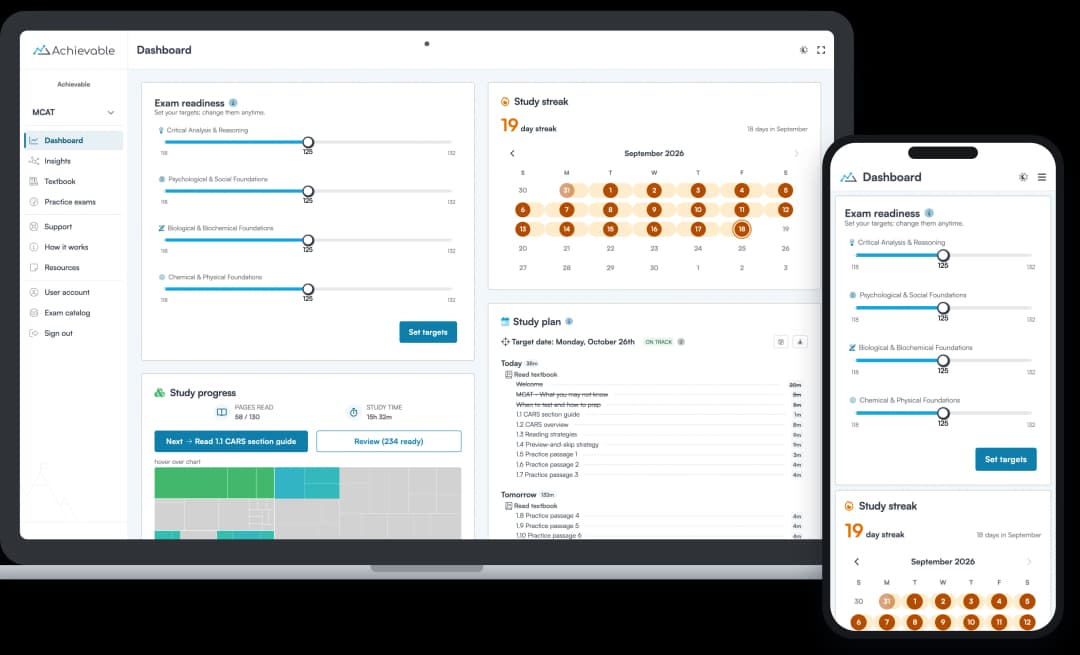
- Review aimed at your weak spots. The course tracks your retention and mastery of each MCAT learning objective and adjusts your quiz questions to focus on the topics that matter most. Progress charts show your current strength in each section, and the AI tutor replies to your questions with clear explanations as you study.
- A plan to your new date. The study planner builds a personalized day-by-day plan so you finish the content by exam day.
- A full year of access for $399, with the first lessons free and no credit card needed.
The score improvement guarantee starts from your last official score. Achievable MCAT’s guarantee: +5 points for a starting score below 502, +4 points for a starting score of at least 502 and below 508, and +3 points for a starting score of at least 508 and below 515, or your money back. To claim it:
- Have an official score from a test you took in the 5 years before buying the course, and send Achievable its score report within 7 days of buying.
- Take the same official test again while your year of access is active.
- If your new score has not risen by the points guaranteed for your starting score, email Achievable its score report and a valid ID within 31 days of the test, and the course is refunded in full.
- There is no minimum study time and no chapter to finish.
Every course for a scored exam can also be refunded in full within 7 days of purchase, for any reason. The full terms are on the MCAT FAQ.
A retake timeline
The AAMC releases scores about 30 to 35 days after each test day, and 2027’s U.S. test dates run from January 15 to September 11 (AAMC 2027 calendar). If you think you may retake, the AAMC suggests testing earlier in the testing year, so your scores arrive in time to find a later seat (when to take the MCAT). Here is a sample plan, counted from the day your score comes out:
When | What to do |
|---|---|
Score release | Read your score report: section scores, confidence bands and score profile. Don’t book a new date yet. |
Week 1 | Line up your practice history, take a timed baseline with Achievable’s free section exams, and pick your causes from the diagnosis table. |
Weeks 2 to 6 | Fix the causes: targeted review with questions on each topic, timed passages every day and an error log. A full-length every two weeks, from practice you haven’t seen. |
Weeks 7 to 10 | A full-length every week, moving to the AAMC’s scored practice exams you haven’t taken. Book your seat once your scores sit comfortably above your target. |
Final week | No new full-lengths. Review your error log and rest. |
Stretch the middle weeks if content gaps were the cause; a pacing problem alone can take less. Book once your practice scores sit comfortably above your target, consistently, across several full-length exams. Aim for 100% readiness, so your result doesn’t depend on the luck of the draw.
Rescheduling costs more the closer you get. For 2027 test dates it’s $55 at least 60 days out, $110 at 30 to 59 days and $210 at 10 to 29 days, and no changes are allowed in the last 10 days (AAMC scheduling fees). You can hold only one seat at a time. For the last stretch before test day, see how to use your last month before the MCAT.
Frequently asked questions about retaking the MCAT
How many times can you take the MCAT? Three times in a single testing year, four times in two consecutive years and seven times in a lifetime. Voids and no-shows count toward those limits, according to the AAMC’s MCAT FAQ.
Do medical schools see all of your MCAT scores? They see every exam you chose to score. They don’t see an exam you voided or didn’t show up for, though it still counts as an attempt. Schools treat several scores differently: some weigh them all equally and note improvement, others use only the most recent, an average, the highest set or your highest section scores, according to the AAMC’s score FAQ, so check each school’s policy.
Does retaking the MCAT hurt your application? The AAMC says "taking the exam more than once does not put you at a disadvantage," and that each program has its own policies. What matters is that the new score is higher, which is why the retake should wait until your practice scores show it will be.
How long should you wait before retaking the MCAT? The AAMC limits the number of attempts, and you can hold only one seat at a time. The better guide is your practice: wait until your scores sit comfortably above your target across several full-lengths, then book the next date you can make.
How much does it cost to retake the MCAT? The same as the first attempt: $360 for 2027 test dates, or $145 through the AAMC’s Fee Assistance Program. The AAMC’s Unscored Sample Test and Practice Exam 1 are free, and Practice Exams 2 to 6 are $35 each.
Should you void your MCAT if test day goes badly? A voided exam never reaches medical schools, but it still uses one of your attempts. Void only if you’re sure the score would hurt you more than the lost attempt.
How long are MCAT scores valid? The AAMC says medical schools generally accept scores from two or three years back (how long MCAT scores are valid). Check each school you’ll apply to.
Does Achievable’s MCAT guarantee work for a retake? It’s built on your previous official score: send its report within 7 days of buying, take the MCAT again while your year of access is active, and if your score hasn’t risen by the points guaranteed for your starting score, the course is refunded in full. The tiers and terms are on the MCAT FAQ.
What should you score on practice tests before you retake? Comfortably above your target score, consistently, across several full-length exams, not on one good day. For timing your official practice exams, see the best MCAT practice tests.
Key takeaways
- Switch prep courses only when the course was the problem: practice that didn’t predict your score, no fresh questions left, or no timed full-length exams at all.
- Read your score report’s section scores, confidence bands and score profile, then your practice history, to find the cause. The report gives no topic breakdown.
- Fix the cause, not the hours: questions and an error log over rereading, timed passages for CARS and pacing, more full-lengths for stamina.
- Use practice you haven’t seen through most of your prep, such as Achievable’s three full-lengths, and the AAMC’s scored exams you haven’t taken in the final weeks.
- Book the retake once your practice scores sit comfortably above your target across several full-lengths. You have three attempts in a testing year, four in two consecutive years and seven in a lifetime.