The fastest way to prepare for the PTCE: a 2- or 4-week plan


Table of contents
- Before you start: apply now so your date is set
- What the PTCE tests
- The four steps that make prep fast
- 1. Take a timed diagnostic first
- 2. Study by weight, weakest heavy area first
- 3. Drill questions every day and review every miss
- 4. Finish with full-length timed exams
- The 2-week plan, if you already work in a pharmacy
- Fitting the plan around pharmacy shifts
- The 4-week plan, if you’re newer to pharmacy
- What to skip when time is short
- How Achievable fits a fast plan
- How to use PTCB’s Practice Bank and Pre-PTCE alongside it
- Frequently asked questions
- How long do I need to study for the PTCE?
- Can you pass the PTCE in 2 weeks?
- What score do I need to pass the PTCE?
- When should I take the Pre-PTCE?
- Do I need a prep course, or are free resources enough?
- Key takeaways
The fastest way to prepare for the PTCE is to take a timed, full-length practice test first, then study by the weight of PTCB’s four knowledge areas, starting with your weakest heavily weighted one. Drill practice questions every day and review every miss, then finish with full-length timed exams until your scores sit comfortably above passing on several of them. If you already work in a pharmacy and your first test lands near passing, a focused 2-week plan can be enough; if you’re new to pharmacy or unsure of the math, plan on 4 weeks.
Start with Achievable’s free PTCE practice test: 80 questions with a 2-hour limit, the same number of questions the real exam scores. The plans below say what to do on every day after it.
Before you start: apply now so your date is set
The PTCE is the exam for PTCB’s Certified Pharmacy Technician (CPhT) credential. To be eligible, you need to have completed a PTCB-recognized education/training program (or be within 60 days of finishing one), or to have at least 500 hours of work experience as a pharmacy technician. If you’re certifying because your pharmacy requires it, check the work-experience pathway: the 500 hours have to be complete when you apply.
The $129 fee covers your application and one exam attempt. Once PTCB approves your application, you have 90 days to sit the exam at a Pearson VUE test center, and the window can be extended if you need more time. So apply in the first days of your plan, and book the earliest date you can be ready by. The full rules are on PTCB’s CPhT page and in our PTCE exam information.
What the PTCE tests
The PTCE has 90 multiple-choice questions in 1 hour 50 minutes. Only 80 are scored; the other 10 are unscored trial questions that aren’t marked, so treat every question as if it counts. The exam is scored from 1,000 to 1,600, and 1,400 is the passing score. The scored questions follow PTCB’s content outline, in effect since January 6, 2026. Here are its four knowledge areas, sorted by weight:
Knowledge area | Share of the exam | Scored questions (about) | What it covers |
|---|---|---|---|
Medications | 35% | 28 | Brand and generic names, drug classes, therapeutic duplications, interactions and contraindications, doses and dosage forms, side effects, stability and storage |
Patient safety and quality assurance | 23.75% | 19 | High-alert and look-alike/sound-alike drugs, error prevention, issues that need a pharmacist, event reporting, types of prescription errors, infection prevention |
Order entry and processing | 22.5% | 18 | Pharmacy calculations, sig codes and abbreviations, equipment and supplies for drug administration, NDC numbers, lot numbers and expiration dates, returns |
Federal requirements | 18.75% | 15 | DEA schedules and controlled substance rules, hazardous waste, REMS and pseudoephedrine limits, FDA recalls, the Drug Supply Chain Security Act |
Medications alone is more than a third of the exam, and patient safety plus order entry make up nearly half. That’s where a short plan’s hours go.
The four steps that make prep fast
1. Take a timed diagnostic first
Take a full-length test under exam conditions before you open a book, then sort your misses into the four knowledge areas. A strong area needs only a light review. A weak area that carries a lot of weight gets your first and longest sessions. Without that map, it’s easy to spend days on what you already know.
2. Study by weight, weakest heavy area first
Rank the four areas by weight and by your diagnostic score together. A weak score in medications costs you far more than the same score in federal requirements, because medications has almost twice as many questions. Start where the two overlap.
3. Drill questions every day and review every miss
Answering questions from memory builds recall better than rereading. Do a set every day, then go through every miss and sort it: a concept you didn’t know, a calculation slip, or a question you misread. Each needs a different fix: relearn the concept, rework the calculation step by step, or slow down on the question. Review the right answers you guessed, too. Keep every miss in an error log and reread it before each practice exam.
For the learning science behind these steps (spaced review, active recall and why cramming backfires), read Dr. Aum Patel’s Building a study strategy that actually works for the PTCE.
4. Finish with full-length timed exams
The last part of either plan is full-length timed exams, each followed by a review of every miss. Between our free practice test, the course’s four full-length exams and PTCB’s Pre-PTCE, you have six to work with, and each is meant to be taken once, so the plans save the last ones for the final days. Aim for 100% readiness: practice scores comfortably above passing, consistently, across several full-length exams, so a pass doesn’t depend on the luck of the draw. If you’re not there by the end of the plan, move your exam date: your 90-day window leaves room.
The 2-week plan, if you already work in a pharmacy
Mostly 2 to 3 hours a day. It suits a working technician whose diagnostic lands close to passing.
Day | What to do | Time |
|---|---|---|
1 | Take a full-length timed practice test. Review every miss and rank the four areas by weight and by your score. Apply to PTCB if you haven’t yet. | 3 hours |
2 | Medications: the top drugs by class, with brand and generic names and what each treats. Answer 40 questions and review every miss. | 2–3 hours |
3 | Medications: therapeutic duplications, interactions, contraindications, side effects, dosage forms and storage. Answer 40 questions. | 2–3 hours |
4 | Order entry and processing: days’ supply, quantity, dose, concentration and dilution calculations, worked by hand. | 2–3 hours |
5 | Order entry and processing: sig codes, abbreviations, conversions, NDC numbers, lot numbers and expiration dates, returns, and the equipment and supplies for drug administration, then a mixed calculation drill. | 2 hours |
6 | Patient safety: high-alert and look-alike/sound-alike drugs, error-prone abbreviations, types of prescription errors, what needs a pharmacist, MedWatch and VAERS. | 2 hours |
7 | Federal requirements: DEA schedules, controlled substance rules, hazardous waste, REMS, pseudoephedrine limits, recalls and the DSCSA. | 2 hours |
8 | Full-length timed practice exam. Review every miss and add it to your error log. | 3 hours |
9 | Your weakest area from day 8: relearn the concepts behind your misses, then 40 questions on it. | 2–3 hours |
10 | Your next weakest area, plus a mixed medications review. | 2 hours |
11 | PTCB’s Pre-PTCE as a final check (recommended), or another full-length exam. Read every explanation. | 2–3 hours |
12 | Fix what day 11 showed, reread your error log and do a calculation drill. | 2 hours |
13 | Full-length timed practice exam. Check that your score is comfortably above passing again. | 3 hours |
14 | Light review of your error log and the top drugs. Confirm your test center, ID and start time, then sleep. | 1 hour |
Sit the exam once your last practice exams are comfortably above passing. If they aren’t yet, spend a few more days on the review-question drills for your weakest areas and on your error log, then take one of the full-length exams you haven’t used.
Fitting the plan around pharmacy shifts
Your job already teaches much of the workflow, the sig codes and the drugs you fill every day. Spend your study time on what it doesn’t: federal rules you rarely handle (DEA schedules, controlled substance records, recalls, the DSCSA), calculations you don’t do by hand (concentrations and dilutions), and drugs outside your setting (hospital drugs if you work retail, and the other way round). On a shift day, do 45 to 60 minutes of questions. Put the full-length exams on your days off, and move the plan’s days to fit your schedule.
The 4-week plan, if you’re newer to pharmacy
About 1 to 1.5 hours a day, with a rest day most weeks and longer sessions on exam days. It suits anyone whose diagnostic is well short of passing, or who needs to build the pharmacy math.
Days | What to do | Time |
|---|---|---|
1 | Full-length timed practice test, scored by area. Apply to PTCB. | 3 hours |
2–6 | Medications: about 20 top drugs a day by class, with brand and generic names and indications, then therapeutic duplications, interactions, side effects, dosage forms and storage. 25 questions a day. | 1–1.5 hours a day |
7 | Rest, or reread the week’s misses. | Up to 1 hour |
8–11 | Order entry and processing: a calculation set every day (days’ supply, dose, concentration, dilution, conversions), then sig codes, abbreviations, NDC numbers, lot numbers and expiration dates, returns, and the equipment and supplies for drug administration. | 1–1.5 hours a day |
12 | Mixed review of medications and calculations. | 1 hour |
13 | Full-length timed practice exam. | 3 hours |
14 | Review every miss from day 13, then rest. | 1 hour |
15–17 | Patient safety and quality assurance, including the types of prescription errors, with 25 questions a day. | 1–1.5 hours a day |
18–20 | Federal requirements, with 25 questions a day. | 1–1.5 hours a day |
21 | Full-length timed practice exam, then a first pass through its misses. | 3 hours |
22–23 | Your two weakest areas from day 21. | 1.5 hours a day |
24 | PTCB’s Pre-PTCE as a final check (recommended), or another full-length exam. | 2–3 hours |
25 | Fix what day 24 showed, then a calculation drill. | 1.5 hours |
26 | Full-length timed practice exam. | 3 hours |
27 | Review its misses and reread your error log. | 1.5 hours |
28 | Light review and rest. Confirm your test center, ID and start time. | 1 hour |
If your diagnostic was far below passing, give medications and calculations two weeks each instead of one; the full-length exams keep their place at the end. Book the exam when your last full-length scores are comfortably above passing, not when day 28 arrives.
What to skip when time is short
- Topics PTCB dropped in 2026. The current outline no longer lists narrow therapeutic index (NTI) medications, physical and chemical incompatibilities, or non-sterile compounding. If your book or flashcards predate 2026, skip those sections, and add the Drug Supply Chain Security Act, which is new.
- Rereading what your diagnostic says you know. A short question set keeps a strong area fresh; rereading its chapter doesn’t move your score.
- Writing notes and flashcards from scratch. Use ready-made summaries, such as our free PTCE study guide chapter notes, and spend the time on questions.
- State pharmacy law. The PTCE tests federal requirements. Your state’s rules matter for your registration and your job, but not for this exam.
- Memorizing drugs one at a time. Learn them in groups by class and by shared name endings, so one rule covers a dozen drugs.
- New resources in the last few days. Stick with the questions and the error log you’ve been using.
How Achievable fits a fast plan
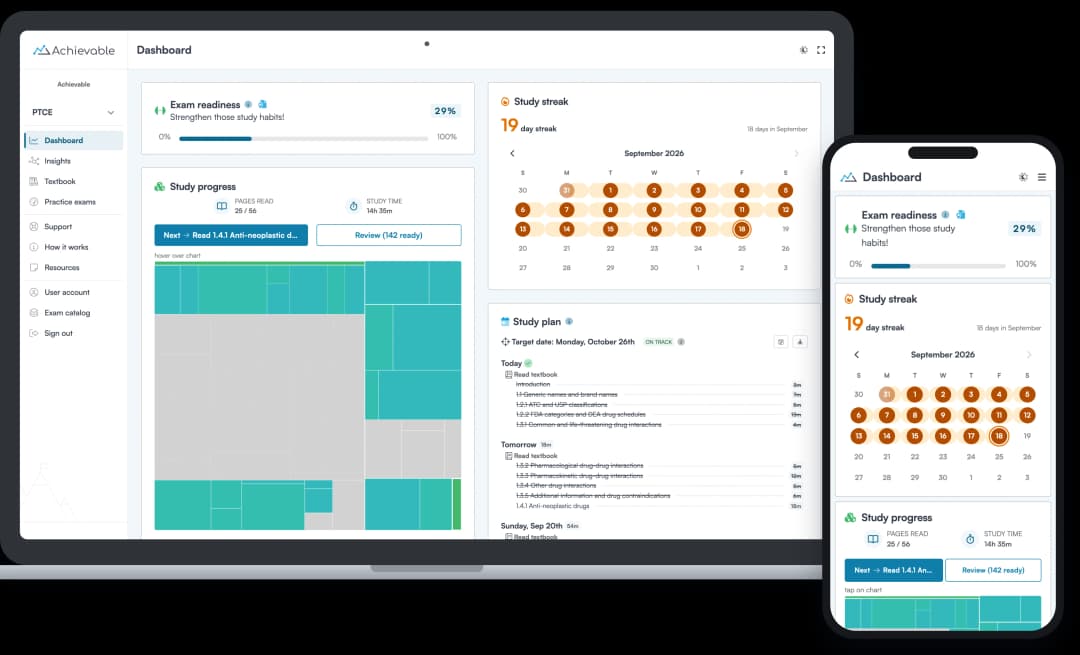
Achievable PTCE supplies the diagnostic, the daily question sets and the exam days in both plans:
- 4 full-length practice exams of 80 questions, the number the real exam scores, with an explanation for every answer. Your scores show which chapters to review before exam day.
- 2,300+ practice questions with explanations, including a quiz bank of 2,000+ review questions you can drill by chapter.
- An adaptive study plan and an AI tutor that keep you on what you haven’t mastered, and a study planner that builds a personalized day-by-day plan.
- $99 for a full year of access, with the first lessons free and no credit card needed.
- A pass guarantee: pass, or get your money back. Pass one of the course’s full-length practice exams within the standard time before your exam. If you then fail the exam, email a picture of your score report with a valid state ID, and once they’re verified, Achievable refunds the course in full. There is no minimum study time and no chapter to finish.
In either plan, the free practice test is your diagnostic, the review-question bank supplies the daily sets, and the course’s full-length exams fill the exam days.
How to use PTCB’s Practice Bank and Pre-PTCE alongside it
PTCB sells two practice tools through your PTCB Account. It recommends studying with the Practice Bank first and taking the Pre-PTCE as a final check of readiness.
- PTCE Practice Bank ($65): over 300 retired PTCE questions and 400 flashcards, with unlimited use for 90 days (access ends early if you become certified). You set the number of questions, the difficulty and the timer, and can drill one knowledge area at a time.
- Pre-PTCE ($29, or $10 less when you buy it with your CPhT application): one 90-question practice exam with 110 minutes, built from retired PTCE questions and made to look like the real exam. You have 90 days to start it once you buy it, you see explanations right after you submit, and a score report by knowledge area within 1 to 3 business days. There’s only one version, so taking it twice shows you the same questions, and once you start it you must finish within 48 hours.
Take the Pre-PTCE once, on day 11 of the 2-week plan or day 24 of the 4-week plan: late enough to test what you’ve learned, and early enough that its score report arrives before your exam. The Practice Bank’s retired questions are a useful extra source for the daily drills if you want more of PTCB’s own question style. Because the Pre-PTCE is a single exam, several full-length exams you haven’t seen before are still what show that you’re consistently ready.
Frequently asked questions
How long do I need to study for the PTCE?
It depends on where you start, and a timed diagnostic tells you. A technician already working in a pharmacy whose first practice score lands near passing can be ready in about 2 weeks at 2 to 3 hours a day. If you’re new to pharmacy or unsure of the math, plan on 4 weeks at 1 to 1.5 hours a day, and longer if your first score is far below passing. You’re ready when your full-length practice scores are comfortably above passing, consistently, not when the calendar runs out.
Can you pass the PTCE in 2 weeks?
It can be done, but only if you already know much of the material from work and you spend the 2 weeks on questions and timed exams rather than rereading. Book the exam only once several full-length practice scores are comfortably above passing.
What score do I need to pass the PTCE?
The PTCE is scored from 1,000 to 1,600, and 1,400 passes. Your unofficial result appears on screen when you finish, and PTCB typically posts the official score report to your PTCB Account within three weeks.
When should I take the Pre-PTCE?
Near the end of your plan, after you’ve studied all four areas. PTCB intends it as a final check of readiness, and it has only one version, so taking it early wastes it.
Do I need a prep course, or are free resources enough?
Start free: Achievable’s free practice test and free chapter notes show where you stand. If the diagnostic shows gaps in more than one area or in calculations, a course with several full-length exams is a good way to close them and prove you’re ready. Achievable PTCE is $99 for a year, with four full-length exams and a pass guarantee.
Key takeaways
- Take a timed, full-length diagnostic first, and sort your misses into the four knowledge areas.
- Study by weight: medications is 35% of the exam, patient safety 23.75%, order entry 22.5% and federal requirements 18.75%.
- Drill questions every day, review every miss, and keep an error log.
- Finish with full-length timed exams, and book the exam when your scores are comfortably above passing across several of them.
- Skip what the 2026 outline dropped, what you already know, and anything new in the last few days.
- Use PTCB’s Pre-PTCE once, as a final check near the end.