

PTCE Exam information
What it is, what's tested, and how it's scored.
PTCE exam details
The Pharmacy Technician Certification Exam (PTCE) assesses your knowledge and skills in various areas crucial for pharmacy technicians. In order to receive a Certified Pharmacy Technician (CPhT) credential, you must first pass the PTCE.
The Pharmacy Technician Certification Board (PTCB) is a non-profit organization that offers the CPhT, the most widely recognized and respected credential for pharmacy technicians in the United States. Its CPhT program is accredited by the National Commission for Certifying Agencies (NCCA).
As a PTCB-certified pharmacy technician, your vital role includes accurately processing prescriptions, preparing and managing medications, maintaining inventory, and handling billing and insurance. Anything that calls for clinical judgment — counseling a patient, for instance — goes to the pharmacist you support. These tasks are integral to ensuring efficient pharmacy operations and promoting patient safety, and your exact scope of practice is set by your state's Board of Pharmacy. Check the pharmacy technician requirements in your state for your board’s registration, training and certification rules.
The PTCE exam is hosted by PTCB and costs $129 to register. Participants have 2 hours to answer 80 scored + 10 unscored multiple-choice questions. The passing score is 1,400 / 1,600.
Time
2 hours
Format
80 scored + 10 unscored multiple-choice questions
Exam fee
$129
Passing score
1,400 / 1,600
Details
The PTCE is a computer-based exam. You'll see 90 multiple-choice questions in 2 hours: 80 scored questions drawn from the four knowledge domains below, plus 10 unscored questions PTCB places at random to trial for future exams. The unscored questions aren't identified, so treat every question as though it counts.
Medications
Federal Requirements
Patient Safety and Quality Assurance
Order Entry and Processing
Your 2 hours break down into a 5-minute tutorial, the 1 hour and 50-minute exam itself, and a 5-minute post-exam survey. PTCB schedules no break in that, and Pearson's rules stop the clock only for a break the test sponsor has scheduled — so if you step out, your exam time keeps running. Plan on the 1 hour 50 minutes being all the time you get for the questions.
The PTCE is scored on a scale of 1,000 to 1,600, and 1,400 is the passing score. An unofficial result appears on screen as soon as you finish the post-exam survey, and you can take a printed copy away from the test center, but it isn't final — PTCB posts the official score report to your PTCB Account within three weeks.
To take the PTCE, create a PTCB Account and apply for certification; the $129 fee covers the application and one exam attempt. Once PTCB approves your application you'll be emailed an authorization to schedule, and you then have 90 days to sit the exam (extendable twice, 90 days at a time, for $20 each). The PTCE is given in person at more than 1,400 Pearson test centers nationwide, including more than 100 on military bases.
The CPhT certification granted to those who pass the PTCE is valid for 2 years. To renew it, you must complete 20 hours of PTCB continuing education in each two-year cycle, including at least one hour of pharmacy law and at least one hour of patient safety.
To be eligible for PTCB's CPhT certification you must live in the United States or its territories, disclose any criminal history and any State Board of Pharmacy action taken on your registration or licensure, comply with PTCB's certification policies, and satisfy one of 2 pathways:
- Education/training: complete a PTCB-Recognized Education/Training Program, or be within 60 days of completing one when you apply. A pharmacy degree is accepted in place of a recognized technician program.
- Work experience: complete at least 500 hours of equivalent work experience as a pharmacy technician. This secondary path serves experienced technicians who weren't in a position to attend a PTCB-recognized program, and the hours must be finished by the time you apply.
PTCE exam summary
Medications
35%
28 questions
The Medications section is the largest part of the PTCE. It covers generic names, brand names, and classifications of medications; therapeutic duplications; common or life-threatening drug interactions and contraindications, including drug-drug, drug-dietary supplement, drug-laboratory, drug-nutrient, and drug-disease interactions; strengths and doses, dosage forms, routes of administration, special handling and administration instructions, and duration of therapy; common or severe side effects, adverse effects, and allergies; indications; drug stability for products such as oral suspensions, insulins, reconstitutables, injectables, and vaccinations; and proper storage, including temperature ranges, light sensitivity, and restricted access.
Federal Requirements
18.75%
15 questions
The Federal Requirements section of the PTCE covers the federal rules governing what a pharmacy may store, order, dispense, return, and destroy. It covers the requirements for storing, handling, and disposing of non-hazardous, hazardous, and pharmacological substances and wastes; controlled substance prescriptions and the DEA schedules; receiving, storing, ordering, labeling, dispensing, returning, take-back programs for, loss or theft of, and destroying controlled substances; restricted drug programs and the processing they demand, such as pseudoephedrine sales and Risk Evaluation and Mitigation Strategies (REMS); FDA medication recall requirements; and the product serialization, tracking, tracing, and quarantining requirements of the Drug Supply Chain Security Act (DSCSA).
Patient Safety and Quality Assurance
23.75%
19 questions
The Patient Safety and Quality Assurance section of the PTCE assesses how you prevent medication errors and what you do when one happens. It covers high-alert and high-risk medications and look-alike/sound-alike (LASA) drugs; error prevention strategies such as Tall Man lettering, separating inventory, leading and trailing zeros, bar code usage, and limiting error-prone abbreviations; recognizing the issues that require pharmacist intervention, including drug utilization review, adverse drug events, OTC recommendations, therapeutic substitution, adherence, and allergies; event reporting through MedWatch and VAERS, near-miss reporting, root-cause analysis, and continuous quality improvement; the types of prescription error; and infection prevention and cleaning standards.
Order Entry and Processing
22.5%
18 questions
The Order Entry and Processing section of the PTCE covers turning a prescription into a dispensed product, and it is where the exam's pharmacy math lives. It covers the formulas, calculations, ratios, proportions, conversions, sig codes, abbreviations, medical terminology, and symbols used to work out days' supply, quantity, dose, concentration, and dilutions; the equipment and supplies required for drug administration, from oral and injectable syringes to inhaler spacers, filters, and nebulizers; lot numbers, expiration dates, and National Drug Code (NDC) numbers; and the procedures for identifying and returning dispensable, non-dispensable, and expired medications and supplies.
Achievable PTCE content outline
1
Medications
Provides foundational knowledge of medications, including generic and brand names, drug classifications, and regulatory categories. Explores drug interactions, contraindications, organ system-based therapies, dosage forms, and administration routes. Also emphasizes medication safety, side effects, storage, and stability.
2
Patient safety and quality assurance
Introduces strategies to prevent medication errors, such as identifying look-alike/sound-alike drugs, following safe dispensing practices, and applying proper labeling techniques. Highlights the importance of error reporting systems, root cause analysis, and hygiene standards. Includes quality assurance processes like drug utilization reviews and outlines the technician's role in promoting safe and effective medication use.
3
Order entry and processing
Details the key responsibilities involved in handling prescriptions, including intake, data entry, and interpretation of sig codes. Covers non-sterile compounding, pharmaceutical calculations, inventory control, and insurance processing. Stresses the importance of accuracy, efficiency, and compliance throughout the prescription workflow.
4
Federal requirements
Explains the laws and regulations that govern pharmacy practice, focusing on drug safety, controlled substances, hazardous waste disposal, and HIPAA privacy protections. Discusses federal programs such as REMS, CMEA, and OBRA, as well as prescription monitoring, FDA recalls, and DEA reporting. Addresses labeling, storage, and documentation standards critical to regulatory compliance.
PTCB exam: quick answers
- What is on the PTCB exam?
- The PTCB exam has 80 scored + 10 unscored multiple-choice questions, and candidates have 2 hours to complete it. The content outline on this page lists every tested topic with the number of questions and the percentage of the exam it accounts for.
- How long is the PTCB exam?
- Candidates have 2 hours for the PTCB exam, covering 80 scored + 10 unscored multiple-choice questions.
- What score do you need to pass the PTCB exam?
- The passing score for the PTCB exam is 1,400 / 1,600.
- How much does the PTCB exam cost?
- Registering for the PTCB exam costs $129, paid to PTCB. Prep materials are a separate cost.
- Who administers the PTCB exam?
- The PTCB exam is administered by PTCB, which sets the official content outline and scoring.
More questions about the exam and how to prepare for it? PTCB FAQ
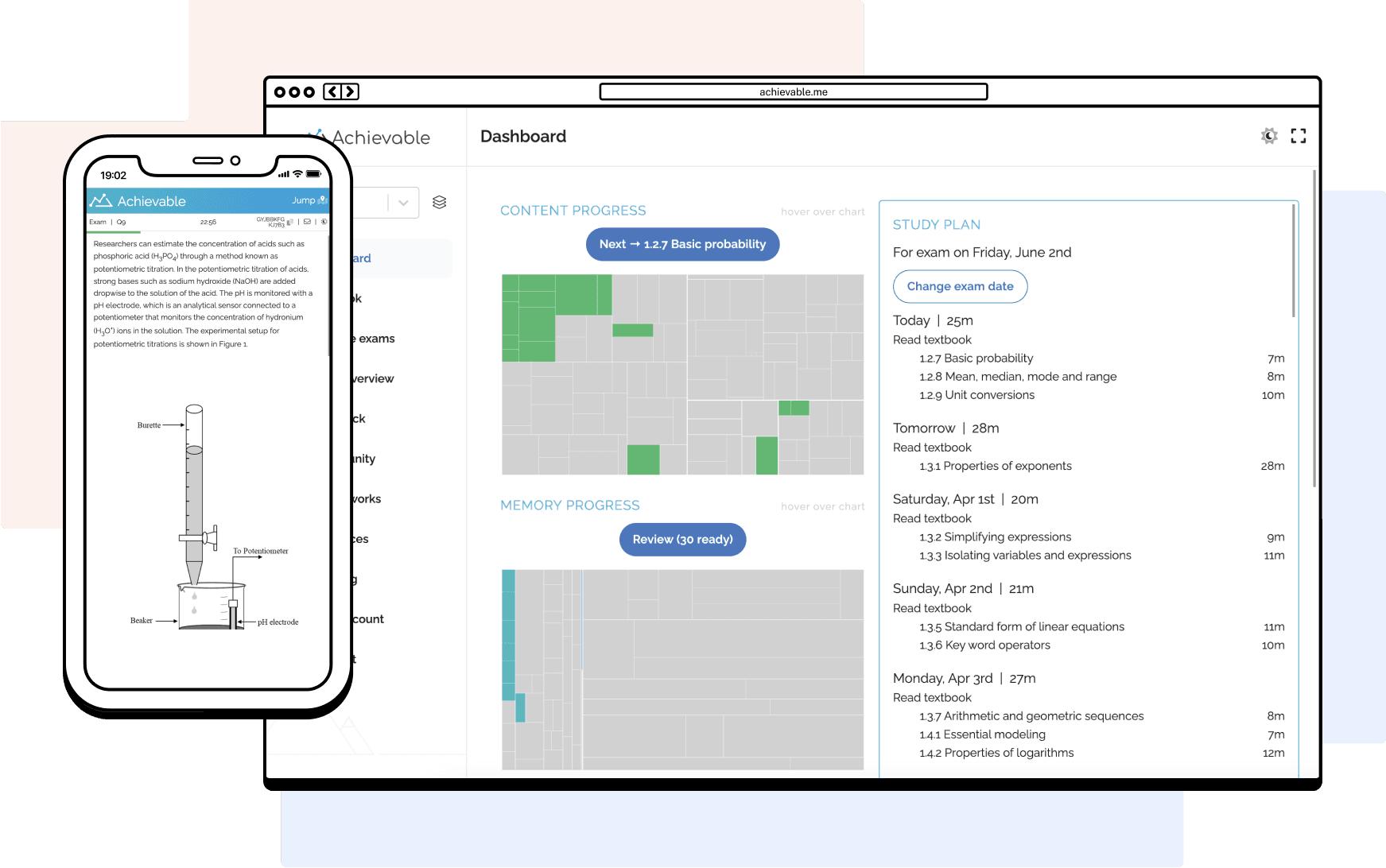
Pass the PTCE. Guaranteed.
Achievable is the best PTCE exam prep course: effective, personalized, and convenient. With Achievable, you'll spend less time studying and pass your exam the first time, or your money back.