Failed the life and health insurance exam? What to change before your retake


Table of contents
- Why the second attempt needs a different approach
- Start with your score report
- Was it the course or the study plan?
- Retake rules by state
- A three-week retake plan
- Week 1: diagnose and set up
- Week 2: rebuild the weakest areas and state law
- Week 3: full-length exams until the scores hold
- What to look for in a course for your retake
- How Achievable handles a life and health retake
- Life and health retake FAQ
- Key takeaways
If you failed the life and health insurance exam once, switch study courses only if the course itself was the problem: its practice scores said you were ready when you weren’t, its explanations gave answers without teaching, it barely covered your state’s law, or your access has run out. Otherwise (too little time, no full-length timed exams, a weak area left alone), keep it and change the plan. Either way, start from your score report, fix your weakest sections, and rebook only when you’re scoring about 10 points above passing, repeatedly, across several full-length practice exams.
For a quick check of where you stand, take Achievable’s free life and health practice exam (95 questions in 2 hours, with every answer explained; your state’s law questions aren’t in it). Questions you haven’t seen are the quickest way to find out whether you know the material or remember the answers. If you do switch, Achievable’s Life and Health Insurance course costs $149 for a full year and gives you 5 full-length practice exams built for your state, 1,500+ practice questions with explanations, and a pass guarantee.
Why the second attempt needs a different approach
One failure is common, and on Texas’s life and health exam, retakes passed less often than first attempts. Pearson VUE’s 2025 pass rates for the Texas Department of Insurance show it for the General Lines Life, Accident and Health exam (in English):
Texas life and health exam, 2025 | Exams graded | Passed | Pass rate |
|---|---|---|---|
First attempt | 26,273 | 14,925 | 57% |
Repeat attempts | 16,293 | 6,453 | 40% |
Repeat attempts made up almost four in ten of the exams graded that year, and only four in ten of them passed. Nationally, 58% of first-time takers of the combined life and health exam passed in 2025, in the states that reported to the NAIC (P&C, life and health pass rates for all 50 states). Change how you prepare, not just how long.
Start with your score report
Your score report is the first clue to what went wrong, and what it shows depends on your state’s testing vendor:
- Pearson VUE (Texas, Florida, Georgia, Illinois, North Carolina): you leave the test center with your score report. In Florida, a failing report includes "a numeric score and diagnostic information relating to the examination, as well as information about reexamination" (Pearson VUE’s Florida candidate handbook), and your score is the percentage you answered correctly, with 70% to pass. In Texas, the score is scaled from 0 to 100 with 70 to pass, and the Texas candidate handbook says a score below 70 shows how close you came, not how many questions you got right.
- PSI (California, New York, Pennsylvania, Ohio, Michigan): your result shows on screen and the report is emailed. In Ohio, New York, Pennsylvania and Michigan, a failing report includes "the diagnostic report indicating your strengths and weaknesses by examination type" (PSI’s Ohio bulletin). California’s tells you "how many questions were answered correctly" (PSI’s California bulletin), and you need 60% to pass there.
- Prometric (Virginia, Utah and other states): Virginia’s and Utah’s reports show your overall percentage and "the correct percentage in each major section of the exam, as defined by the exam content outline" (Virginia’s candidate bulletin).
Read it in three passes:
- How far below the line you were. A few points short usually means a weak area or two and a plan problem. Well short means the foundations need rebuilding, and that is when your course deserves a hard look.
- Which areas dragged you down. Where your report breaks results out by area, rank them from weakest to strongest. The life and health exam has a general part (life policies, annuities, health and disability coverage, Medicare and the like) and a state law part, and the state part is big: 30 of the 130 scored questions on the Texas exam.
- Whether the weakness was narrow or broad. One or two weak areas point to gaps you can close. Weak results everywhere point to how you studied, or what you studied with.
In Florida, you can review the exam you failed. Pearson VUE lets you go through your last exam and the answers you gave, free, once, within 90 days of the exam, using up to half the exam’s time. Call Pearson VUE at (888) 274-2020 to set it up. It shows your answers but not the answer key, so bring your notes on what you weren’t sure of. Only exams taken at a test center can be reviewed, and Florida now books new exams at test centers only, so your retake will be reviewable.
Was it the course or the study plan?
Often the fix is a different plan, not a new course. But some courses leave gaps, and the signs are usually clear once you look for them:
Signs to keep your course | Signs to switch |
|---|---|
You crammed most of it into the last week | Its question bank was small, so you knew the answers by sight |
You took one full-length practice exam, or none, though the course offered more | You scored comfortably on its practice exams and still failed |
You skipped or skimmed your state’s law chapters | Its state law material was thin or written for another state |
You sat the exam with practice scores right at the passing line | Its explanations gave the right answer without teaching why the others were wrong |
You ran short of time on test day | Its format (a long textbook, hours of video) never held your attention |
You liked the course and can keep or extend your access | Your access has run out and you’d rather not pay for the same course again |
If most of your signs are in the left column, keep your course and use the plan below. If they’re in the right one, switch. If it’s split, start with the plan, and switch if your next full-length practice score doesn’t move. If your employer or agency paid for your course or asked you to use a particular one, ask them before you change.
Retake rules by state
Every state sets its own waiting period, attempt limit and fee, and in most of the largest states you can retest within days. Here are the ten most populous states, from each testing vendor’s candidate handbook and the state insurance department, largest first:
State | Wait | Limit | Fee | Prelicensing |
|---|---|---|---|---|
California | None stated | Barred 12 months after 10 failures | $55, plus PSI’s $43 at its centers | Ethics course due before licensing, not the exam |
Texas | None: rebook within a day | None | $49 | None required |
Florida | None stated | 5 attempts in 12 months | $44 | 60-hour course counts for 4 years |
New York | None, but not the same day | None stated | $40 | Certificate never expires |
Pennsylvania | None, but not the same day | None | $55 ($45 for one line) | None required |
Illinois | 24 hours to book, and booked at least 24 hours ahead | None stated; pass General and State within 90 days | $92 per exam ($92 for a line’s General and State on one order) | Certificate valid 1 year |
Ohio | None, but not the same day | None | $49 | Certificate valid 180 days |
Georgia | 14 days after a 1st or 2nd failure, then 60 | None | $67 | Courses valid 1 year |
North Carolina | 24 hours to book, and booked at least 24 hours ahead | None stated | $45 per exam | None required since October 1, 2025 |
Michigan | None, but not the same day | None stated | $41 | Certificate valid 12 months |
Sources: the candidate handbooks from Pearson VUE for Texas, Florida, Illinois, Georgia and North Carolina, and from PSI for California, New York, Pennsylvania, Ohio and Michigan, with North Carolina’s prelicensing change from the NCDOI and California’s from CDI. Fees are per exam for the combined life and health exam, or each line where a state tests them separately, and you pay again for every attempt.
What else to know in the three largest:
- California. Register again with PSI to retest. California dropped its prelicensing hours (20 per line) on January 1, 2026. The 12-hour ethics and Insurance Code course is required before your license is issued, not before the exam (CDI’s prelicensing FAQ). The combined life and health exam is 150 questions in 3 hours 15 minutes, and life and health producer exams are now taken at a test center (CDI notice). Attempts at the Life-only or Accident and Health-only exam in the same 12 months count toward the combined exam’s 10-failure limit, since PSI’s bulletin treats a combination exam as the same exam type as the single-line exams it includes. A pass is valid for one year. Our California life and health guide covers the rest.
- Texas. Texas requires no prelicensing course, so there is nothing to redo. Pay the exam fee again and book online through Pearson VUE’s Texas insurance page or by phone at (888) 754-7667, at least 24 hours ahead. The General Lines Life, Accident and Health exam has 145 questions (130 scored, 30 of them on Texas law) in 2 hours 30 minutes. Once you pass, you have 12 months to apply for your license, or you take the exam again. Our Texas life and health guide covers the rest of the process.
- Florida. Book the retake with Pearson VUE and pay again. Your 60-hour 2-15 course counts as long as you finished it within the four years before you apply (DFS 2-15 requirements). The exam has 165 questions (150 scored) in 2 hours 45 minutes. The DFS says online proctoring "is no longer available for new reservations" (DFS exams page), so book a test center. A pass is valid for one year. Our Florida 2-15 guide covers the rest.
In any other state, look up the retake rules in your testing vendor’s candidate handbook, which your state’s page in our insurance licensing guide links. Our guide to scheduling the life and health exam in every state covers booking, ID and rescheduling rules.
A three-week retake plan
Even where you can rebook right away, the earliest date isn’t the right one. Book the retake for when your practice scores say you’re ready, and use these three weeks to get there. If you were only a few points short, two weeks may do; if you were well short, take four.
Week 1: diagnose and set up
- Take a full-length practice exam for your state under real conditions: its question count and time limit, no notes. If your course doesn’t have one, Achievable’s free life and health practice exam gives you a timed check of the general part, though not your state’s law.
- Put its results beside your score report and list your two or three weakest areas, plus where you stand on state law.
- If you’re switching, start the new course now, and use its study planner to set a date you can reach.
Week 2: rebuild the weakest areas and state law
- Reread the chapters behind your weakest areas, then work their quizzes until you can explain every wrong answer, not just pick the right one. Give extra passes to the topics built on look-alike terms, such as policy provisions and riders, annuity types, and Medicare’s parts against Medicare supplement plans.
- Give your state’s law its own sessions. It is tested apart from the general concepts, and it’s where reading a national textbook leaves gaps.
- End the week with a second full-length timed exam, and review every miss, including the ones you guessed right.
Week 3: full-length exams until the scores hold
- Take a full-length timed exam every other day, and spend the days between on the areas each one shows are still weak.
- Aim for 100% readiness, and for practice exam scores about 10 points above your state’s passing score, repeatedly, across several full-length exams: about 80% in Florida, where the exam passes at 70% correct, and about 70% in California, where it passes at 60%. Texas’s 70 is a scaled score, not a percentage, so there aim for practice scores comfortably above passing, consistently. One good score can be the luck of the draw; several in a row mean you’re ready.
- If you aren’t there yet, push the appointment back rather than sit the exam early. Move it in time to keep your fee: at least 48 hours ahead in Texas (by phone, (888) 754-7667) and Florida (online), and at least two business days ahead in California.
What to look for in a course for your retake
Whether you switch or stay, the course you study with for the retake should have:
- Several full-length, timed practice exams built for your state, with its law questions included, as many as it takes for your scores to hold.
- An explanation for every answer. The wrong choices teach as much as the right one.
- Review that adapts to you. Quizzes that keep returning to the topics you miss, rather than the same fixed set.
- Your state’s law, covered on its own. Not a few pages tacked onto a national textbook.
- Access that lasts past your retake date, so a retake that slips doesn’t cost you another course.
- A guarantee whose terms you can meet, and a free sample of the course before you pay for a second one.
How Achievable handles a life and health retake
Achievable’s Life and Health Insurance course covers the concepts every state tests and your own state’s insurance law:
- 5 full-length practice exams built for your state, each generated from 850+ life and health questions plus your state’s law questions.
- 1,500+ practice questions, each with an explanation, including 680+ review questions across every chapter, with your state’s supplement adding quizzes on its own law.
- State law for all 50 states and Washington, D.C., so the course matches the state you test in.
- Adaptive review. Its learning engine keeps a model of what you remember and continually adjusts your quiz questions toward the topics that matter most for you.
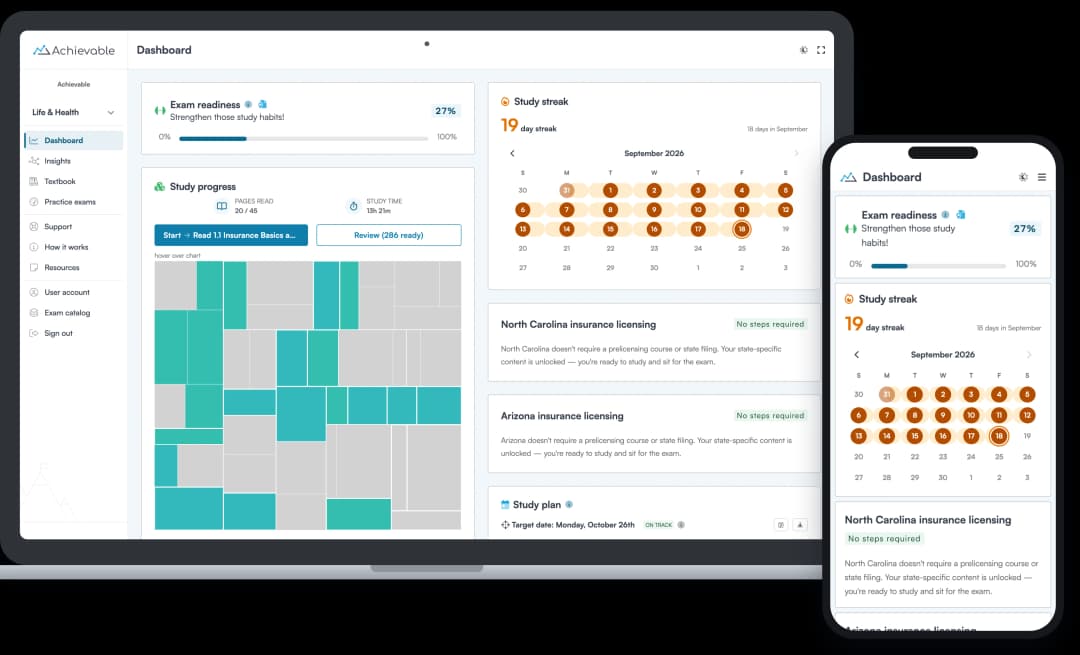
- A study planner that builds a personalized day-by-day plan to get you through all the content by your exam date.
- $149 for a full year of access. The first chapter is free to read, with no credit card needed.
- In Florida, an approved 60-hour 2-15 prelicensing course (DFS course 139268), if you also need the prelicensing hours.
- A pass guarantee. Pass one of the course’s full-length practice exams within the standard time before your exam. If you then fail the exam, email a picture of your score report with a valid state ID, and once they’re verified, Achievable refunds the course in full. There is no minimum study time.
For a section-by-section review before your next attempt, the life and health exam study guide walks through every topic.
Life and health retake FAQ
Should I switch study courses after failing the life and health exam once? Only if the course was the problem: practice scores that didn’t predict your result, explanations that didn’t teach, thin coverage of your state’s law, or access that has run out. Otherwise keep the course and change the plan.
How soon can I retake the life and health exam? In Texas, you can schedule a new exam within a day. New York, Pennsylvania, Ohio and Michigan only rule out a same-day retest, Illinois and North Carolina make you wait 24 hours before you can book, and every booking is at least 24 hours ahead, and Georgia 14 days after a first or second failure and 60 days after any later one. Florida’s and California’s handbooks state no waiting period. Book when your practice scores are about 10 points above passing across several full-length exams, not on the first open date.
How many times can I take the life and health exam? Texas, Pennsylvania, Ohio and Georgia set no limit, and the New York, Illinois, North Carolina and Michigan handbooks state none. Florida allows five attempts at the same exam in 12 months, and California bars you from the same exam for 12 months after 10 failures. Illinois also requires you to pass both its General and State exams within 90 days.
How much does a life and health retake cost? The exam fee again, from $40 in New York to $92 in Illinois: $49 in Texas, $44 in Florida, and $55 in California plus PSI’s $43 fee at its test centers. The table above lists the rest.
Do I have to retake my prelicensing course? Usually not. Texas, Pennsylvania and North Carolina require none, Florida’s 60-hour course counts if you finished it within four years of applying, New York’s certificate never expires, and California’s ethics course is due before your license, not the exam. Watch the date in Ohio (180 days), Michigan (12 months), Illinois and Georgia (one year): if your certificate runs out before you pass, you need a new one.
Can I see the questions I missed? Florida lets you review your last failed exam and your answers, though not the answer key: free, once, within 90 days of a test-center exam, by calling Pearson VUE at (888) 274-2020. Texas’s handbook says exam material isn’t available to candidates for review. In other states, use your score report’s diagnostic, and check your vendor’s handbook.
How does Achievable’s pass guarantee work? Pass one of the course’s full-length practice exams within the standard time before your exam. If you then fail the exam, email a picture of your score report with a valid state ID, and once they’re verified, Achievable refunds the course in full. There is no minimum study time. It’s a full refund, not an extension of your access, and it sets no score target beyond a pass on any one of those practice exams.
Key takeaways
- Switch courses when the course was the problem: practice scores that didn’t predict your result, explanations that didn’t teach, thin state law coverage, or expired access. Otherwise keep it and change the plan.
- On the Texas life and health exam (in English), repeat test takers passed less often in 2025: 40% against 57% for first attempts.
- Retake rules differ by state: Texas lets you rebook within a day with no limit on attempts, Georgia makes you wait 14 days (60 after a third failure), Florida allows five attempts in 12 months, and California bars you for 12 months after 10 failures. Each retake costs the exam fee again.
- Your prelicensing course usually still counts at your retake, and in Florida you can review the exam you failed.
- Don’t sit again until your practice exam scores are about 10 points above passing, repeatedly, across several full-length exams.