Florida 2-15 life and health exam content outline, and how to study it


Table of contents
- Practice the outline with Achievable
- The Florida 2-15 exam at a glance
- Every section and its share of the exam
- Life insurance and annuities: 33%, about 50 questions
- Health insurance: 34%, about 51 questions
- Florida statutes, rules and regulations: 33%, about 50 questions
- The NAIFA-Florida study manual and the exam
- How to study the outline
- A four-week plan
- Exam-day rules
- Key takeaways
The Florida 2-15 exam (Health and Life, including Annuities and Variable Contracts) has 165 multiple-choice questions in 2 hours 45 minutes: 150 scored questions and 15 unscored pretest questions mixed in among them, unmarked. You need 70% to pass, and the pretest questions don’t count toward it. Pearson VUE gives the exam for the Florida Department of Financial Services (DFS), and its content outline splits the scored questions three ways: about a third on life insurance and annuities, a third on health insurance, and a third on Florida statutes, rules and regulations.
That last third is the part to plan for. Florida law is 33% of the exam, about 50 of the 150 scored questions, and the single biggest section on the outline is the Florida law that applies to every line (13%, about 20 questions). Pearson VUE has already published the outline for exams taken on or after January 1, 2027, and the 2-15 sections and weights in it are the same as today’s, so what you study now still applies next year.
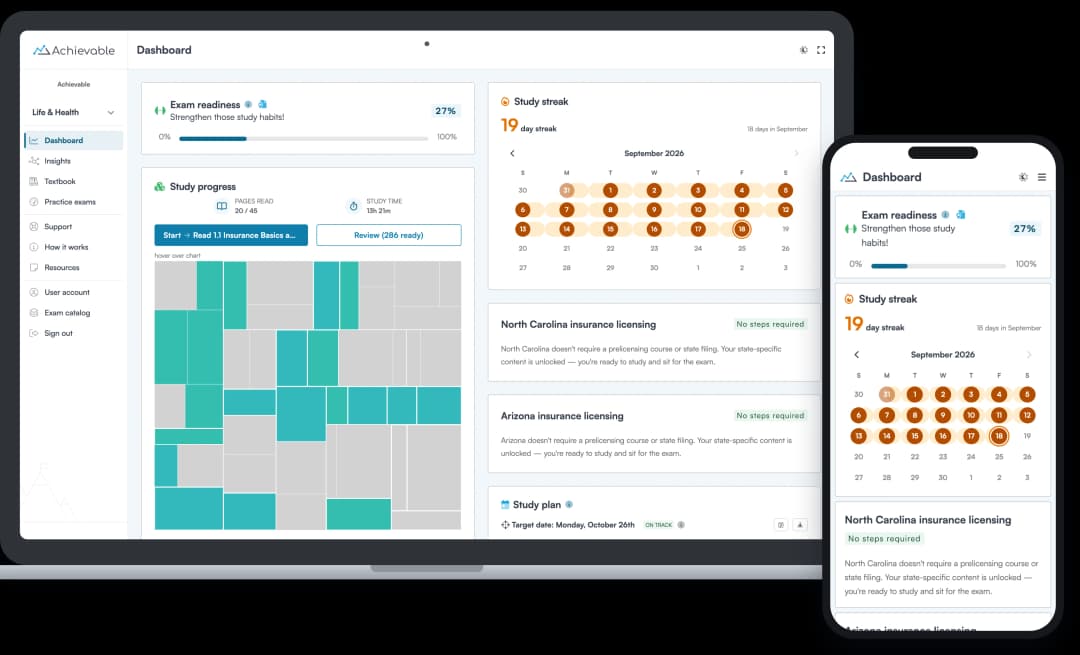
Achievable’s Life and Health Insurance course is approved by DFS for Florida’s 60-hour 2-15 pre-licensing requirement (course 139268), and it covers Florida’s insurance laws alongside the concepts every state tests, with 5 full-length practice exams built for your state. To see where you stand on the general part today, take the free life and health practice exam: 95 questions, every answer explained, with no Florida law questions in it.
Practice the outline with Achievable
Achievable’s Life and Health Insurance course covers every section of the outline below, Florida law included:
- Approved for Florida’s 60-hour requirement. DFS’s course search lists the course (139268, 60 hours, self-study online) as approved for the 2-15 license through July 20, 2027. Approved providers report your completion to DFS, so there’s no certificate to send in.
- 5 full-length practice exams for your state, each built for Florida from 850+ life and health questions (part of the 1,500+ practice questions in the course) plus Florida law questions.
- 1,500+ practice questions with explanations, including 680+ chapter quiz questions.
- A state chapter for Florida law. The last chapter, State regulations & NAIC insurance law, is state-specific, so Florida students study the Florida statutes and rules the exam asks about.
- $149 for a full year of access. The first chapter, General Insurance Concepts, is free to read with a free account, no credit card needed.
- Pass guaranteed, or your money back. Pass one of the course’s full-length practice exams within the standard time before your exam. If you then fail the exam, email a picture of your score report with a valid state ID, and once they’re verified, Achievable refunds the course in full. There is no minimum study time and no chapter to finish. It’s a full refund, not an extension of your access, and it sets no score target beyond a pass on any one of those practice exams.
Our Florida 2-15 license page goes through every step from course to license.
The Florida 2-15 exam at a glance
- Exam: Health and Life and Annuity (including Variable Contracts) Agent, license type 2-15 (Pearson VUE code InsFL-LHA05, or InsFL-LHA05S in Spanish)
- Given by: Pearson VUE, for the Florida Department of Financial Services
- Questions: 165, of which 150 are scored and 15 are unscored pretest questions that aren’t marked
- Time: 2 hours 45 minutes
- Passing score: 70%, the share of the scored questions you answer correctly
- Fee: $44 per attempt, paid to Pearson VUE when you book
- Where: a Pearson VUE test center; Pearson VUE lists this exam only at its test centers
- Before you can be licensed: a DFS-approved 60-hour pre-licensing course for life, health and variable annuities, finished within the four years before you apply
In 2025, 53% of first-time takers of Florida’s combined life and health exam passed (10,807 of 20,390), according to the NAIC figures in our insurance exam pass rates by state.
Every section and its share of the exam
The Florida outline (Pearson VUE publication 121003) has 12 sections: nine of general knowledge, then three of Florida law. It gives each section a percentage, not a question count, so the counts below are that percentage of the 150 scored questions, rounded. The 15 pretest questions are spread across the exam and don’t count toward your score.
Section | Share | About | Course chapters |
|---|---|---|---|
Life: types of policies and features | 10% | 15 | 3, 5–7, 10 |
Life: riders, provisions, options and exclusions | 10% | 15 | 9 |
Life: application, underwriting and delivery | 8% | 12 | 1, 2, 4 |
Life: retirement and other concepts | 5% | 7–8 | 3, 8, 11, 12, 24 |
Health: types of policies | 11% | 16–17 | 16, 17, 19–23, 25 |
Health: provisions, clauses and riders | 10% | 15 | 14, 15 |
Health: social insurance | 4% | 6 | 24, 25 |
Health: other concepts | 4% | 6 | 13, 16, 19, 26 |
Health: field underwriting | 5% | 7–8 | 1, 2, 4, 13 |
Florida law: all lines | 13% | 20 | 27 |
Florida law: life and annuities, variable products included | 10% | 15 | 27 |
Florida law: health | 10% | 15 | 27, with 17, 18, 21, 25 |
Life insurance and annuities: 33%, about 50 questions
Types of life policies and features (10%, about 15 questions). Whole life (ordinary, limited-pay and single-premium); universal, variable whole, variable universal, interest-sensitive and indexed life; term life (level, decreasing, return of premium and annually renewable, and renewable and convertible features); annuities (single and flexible premium, immediate and deferred, fixed, variable and indexed, the accumulation and annuity periods, and payout options); and joint life and survivorship plans. In the course: chapters 3 (Principles of life insurance), 5 (Term life insurance), 6 (Whole life insurance), 7 (Variable insurance products) and 10 (Annuities).
Life policy riders, provisions, options and exclusions (10%, about 15 questions). Riders: waiver of premium and of monthly deduction, guaranteed insurability, payor benefit, accidental death and dismemberment, term riders, other insureds, long-term care, return of premium, disability and cost of living. Provisions and options: entire contract, insuring clause, free look, consideration, owner’s rights, beneficiary designations (primary and contingent, revocable and irrevocable, common disaster, minors, designation by class), premium modes, grace period, automatic premium loan, reinstatement, policy loans and withdrawals, nonforfeiture options, dividend options, incontestability, assignments, suicide, misstatement of age and gender, settlement options and accelerated death benefits. Exclusions: war, aviation and dangerous occupations. In the course: chapter 9 (Life insurance provisions).
Completing the life application, underwriting and delivering the policy (8%, about 12 questions). The application (required signatures, changes, incomplete applications, warranties and representations, the initial premium and receipt, replacement, point-of-sale disclosures such as HIPAA and HIV consent, the USA PATRIOT Act and anti-money laundering, and Gramm-Leach-Bliley privacy); underwriting (insurable interest, medical information and consumer reports, the Fair Credit Reporting Act, risk classification, and stranger- or investor-owned life insurance); delivering the policy (when coverage begins, and explaining the policy to the client); and contract law (the elements of a contract, and why an insurance contract is conditional, unilateral, a contract of adhesion and aleatory). In the course: chapters 1 (General insurance concepts), 2 (Producer roles and receipt types) and 4 (Underwriting).
Retirement and other life insurance concepts (5%, about 7 or 8 questions). Third-party ownership, life settlements, group life (the conversion privilege, contributory and noncontributory plans), qualified and nonqualified retirement plans, needs analysis and suitability (personal needs, key person and buy-sell), Social Security benefits, and the tax treatment of premiums, proceeds and dividends, modified endowment contracts included. In the course: chapters 3, 8 (Group life insurance), 11 (Taxation of life insurance products), 12 (Qualified retirement plans) and 24 (Federal government programs).
Health insurance: 34%, about 51 questions
Types of health policies (11%, about 16 or 17 questions). Disability income (individual, business overhead expense, business disability buyout, group and key employee); accidental death and dismemberment; medical expense insurance (basic hospital, medical and surgical, major medical, HMOs, PPOs, point-of-service plans, flexible spending accounts, high-deductible plans with health savings accounts, and health reimbursement accounts); Medicare supplement policies; group insurance and COBRA; individual and group long-term care (eligibility and levels of care); and dental, vision, cancer, critical illness, worksite, hospital indemnity, short-term medical and accident policies. In the course: chapters 16 (Medical expense insurance), 17 (Group health insurance), 19 to 23 (disability income, AD&D, long-term care, dental, and Section 125 plans and limited policies) and 25 (Medigap and Medicaid).
Health policy provisions, clauses and riders (10%, about 15 questions). The mandatory and optional provisions (entire contract, time limit on certain defenses, grace period, reinstatement, notice of claim, claim forms, proof of loss, time and payment of claims, physical exam and autopsy, legal actions, change of beneficiary, misstatement of age or gender, change of occupation, illegal occupation, and relation of earnings to insurance); other clauses (insuring and consideration clauses, free look, probationary and elimination periods, waiver of premium, exclusions, preexisting conditions, coinsurance, deductibles, eligible expenses, copayments, prior authorization, usual, reasonable and customary charges, and benefit maximums); riders (impairment, guaranteed insurability and future increase options); and renewability (noncancelable, cancelable and guaranteed renewable). In the course: chapters 14 (Required policy provisions) and 15 (Optional policy provisions).
Social insurance (4%, about 6 questions). Medicare Parts A, B, C and D, Medicaid, and Social Security benefits. In the course: chapters 24 (Federal government programs) and 25 (Medigap and Medicaid).
Other health insurance concepts (4%, about 6 questions). Total, partial, recurrent and residual disability; owner’s rights; dependent children’s benefits; primary and contingent beneficiaries; premium modes; nonduplication and coordination of benefits; occupational and non-occupational coverage; the tax treatment of premiums and benefits; managed care; workers’ compensation; and subrogation. In the course: chapters 13 (Health insurance basics), 16, 19 and 26 (Health insurance taxation).
Field underwriting procedures (5%, about 7 or 8 questions). Completing the application, sources of insurability and HIPAA privacy (the MIB report and the Fair Credit Reporting Act), the initial premium and receipt, submitting the application, delivering and explaining the policy, replacement, and contract law (the elements of a contract, insurable interest, warranties and representations). In the course: chapters 1, 2, 4 and 13.
Florida statutes, rules and regulations: 33%, about 50 questions
In Achievable’s course, all three Florida sections are taught in chapter 27, the state chapter, which covers Florida law for Florida students.
Rules common to all lines (13%, about 20 questions). Who regulates what: the Chief Financial Officer, the Financial Services Commission and its Office of Insurance Regulation and Office of Financial Regulation, and the Department of Financial Services (agent licensing and investigations, consumer services, insurance fraud, receivership and unclaimed property). Definitions: insurance contract and transaction, insurer and reinsurance, domestic, foreign and alien companies, fraternals, authorized and unauthorized companies, stock and mutual companies, unlicensed entities and the certificate of authority. Licensing: license types, company and unaffiliated appointments, the education, application, background check and exam requirements, and keeping a license (continuing education, communicating with the Department, record keeping, criminal and administrative actions). Agent responsibilities: acting in a fiduciary capacity (premium accountability and separate accounts), commissions and charges for extra services, replying to DFS and the Office of Insurance Regulation, and ethics. The insurance guaranty fund. Unfair methods of competition: sliding, coercion, misrepresentation, defamation, false advertising, unfair discrimination, unfair claims practices, fraud, controlled business, twisting, churning, rebating and concealment.
Life and annuity insurance, including variable products (10%, about 15 questions). Marketing: agent responsibilities, the buyer’s guide and policy summary, advertising and sales, prohibited practices and penalties, and suitability and best interest. Replacement: the duties of the agent and of the replacing insurer. Individual contracts: protection of beneficiaries from creditors, prohibited provisions, free look, grace period, beneficiary designation and the effect of divorce on death proceeds, the secondary addressee, nonforfeiture options and policy settlement. Group life: required provisions, conversion rights, eligible groups, dependent coverage, employee life and assignment of proceeds.
Health insurance (10%, about 15 questions). Standard provisions for individual and group policies (minimum benefit standards for grandfathered and non-grandfathered plans, required and optional coverages, prohibited provisions); group health (eligible groups, continuation, conversion, coordination of benefits); disclosure (the outline of coverage, renewal and cancellation, advertising, certificates of coverage, group blanket health, unfair trade practices, application responsibilities and marketing); Medicare supplement insurance (minimum standards, open enrollment at 65 and over and under 65, the outline of coverage and buyer’s guide, replacement, duplication of benefits, standardized plans A to N, Medicaid and Medicare Advantage); long-term care policies (disclosure, policy standards, the terms of care from skilled to hospice, replacement, unintentional lapse, the Long-Term Care Partnership and Medicaid); small employer health insurance (rating, renewability and portability, guaranteed issue and employee declination); the Florida Healthy Kids Corporation; rules on HIV and AIDS; plan types (HMO, PPO, EPO, prepaid service organization, indemnity plan and discount medical plan organization); and dread disease policies. Chapter 27 teaches these alongside chapters 17 (Group health insurance), 18 (The Affordable Care Act), 21 (Long term care insurance) and 25 (Medigap and Medicaid).
The NAIFA-Florida study manual and the exam
Florida names one study manual for this exam. DFS has the Florida Health & Life (Including Annuities & Variable Contracts) Study Manual published under contract by NAIFA-Florida, and Florida’s rules make it required material for the 2-15 pre-licensing course: Rule 69B-227.260 says each pre-licensing student must be told who sells the manual and that the state exam is based on its latest edition. NAIFA-Florida sells it online in English and Spanish.
Two lines in Pearson VUE’s candidate handbook explain how the pieces fit. All Florida-specific questions are drawn from the state-approved study materials and from the Florida Statutes. And where a course or study material doesn’t match the content outline, the outline takes precedence. So use the outline as your checklist, the manual as the reference the state questions come from, and the course to learn the material and test yourself on it.
How to study the outline
Split your time three ways. The exam gives about a third each to life, health and Florida law, so give each about a third of your study time. A good order is the one the course follows: the general life and health chapters first, because Florida’s rules (replacement, Medicare supplement standards, long-term care disclosure) only make sense once you know the products they regulate.
Weight within each third by the outline. Policy types and provisions, life and health, are four sections and about 62 of the 150 scored questions. Social insurance and the other health concepts are about 6 questions each: learn them, but don’t spend a week on them.
Drill Florida’s numbers and timeframes separately. The Florida sections ask for specific rules: who does what, by when and how much. Make a list as you read the state chapter and the manual, and quiz yourself on it until it’s automatic. DFS’s own 2-15 license requirements are a good place to start, because licensing and keeping a license are on the outline:
- The pre-licensing course is 60 hours, and it must be finished within the four years before you apply.
- A passing exam score is good for one year: finish the licensing steps within it, or you take the exam again.
- Florida limits you to five attempts at the same exam in 12 months (from Pearson VUE’s Florida handbook).
- Continuing education is 24 hours every two years, due by the end of your birth month.
- A license expires if it stays unappointed for 48 months.
- A new Florida resident licensed in another state for at least a year can transfer the license without the exam by applying within 90 days of moving.
Practice at exam pace. 165 questions in 165 minutes is one minute a question. Take your practice exams full length and timed, with no notes, and review every miss by outline section.
Know when you’re ready. Aim for 100% readiness, and book the exam when you’re scoring about 80% on practice exams, 10 points above the 70% passing score, again and again across several full-length exams, so a pass doesn’t depend on the luck of the draw.
A four-week plan
A review plan for the four weeks after you finish the 60-hour course, at about two hours a day. With more or less time, keep the proportions and stretch or shrink the weeks.
Week | Focus | Outline sections | Share |
|---|---|---|---|
1 | Life insurance and annuities: review chapters 1 to 12 and retake their quizzes | Life sections | 33% |
2 | Health insurance: review chapters 13 to 26 and retake their quizzes | Health sections | 34% |
3 | Florida law: review chapter 27, with the NAIFA-Florida manual for reference; drill your list of Florida numbers every day | Florida sections | 33% |
4 | Full-length timed practice exams; review every miss by section, and repeat until you are ready | All 12 | All |
Exam-day rules
Everything here comes from Pearson VUE’s Florida insurance candidate handbook (publication 121000), its Florida insurance page and the DFS fee schedule. Read the handbook before you book.
- Booking: online at Pearson VUE’s Florida insurance page, at least one business day ahead. You pay the $44 fee when you book.
- Changing or canceling: online, at least 48 hours before the exam, or you lose the fee.
- Arrival: 30 minutes before your appointment. You’ll be photographed for your score report.
- ID: one current, unexpired, government-issued photo ID with your signature, in English, with a name that exactly matches your registration. If the signature is embedded in a chip or hard to read, bring a second ID from the list with a visible signature.
- What you can’t bring: no personal items in the testing room, phones, watches and notes included; they go in the storage the center gives you. The test center gives you materials for notes. You don’t need a calculator, but you can ask the staff for one; personal calculators aren’t allowed.
- Breaks: the handbook’s general policy lets you raise your hand to ask for an unscheduled break where the exam sponsor allows one. The exam clock doesn’t stop, and you must stay on the floor.
- Results: you leave with a score report marked pass or fail, with your numeric score and diagnostic information. If you fail, it includes how to retake.
- If you fail: book and pay again through Pearson VUE, up to five attempts at the same exam in 12 months. You can also ask Pearson VUE, at (888) 274-2020, to review your last failed exam within 90 days, at no charge.
- After you pass: your score is good for one year. To be licensed, you also need the approved course, the DFS application ($50, plus a $5 license ID fee), and fingerprints ($52.50, paid to the fingerprinting vendor).
For the booking steps state by state, see how to schedule your life and health insurance exam. If a first attempt doesn’t go your way, our guide to retaking the life and health exam starts from your score report.
Key takeaways
- The Florida 2-15 exam has 165 questions in 2 hours 45 minutes: 150 scored and 15 unscored pretest questions. You pass with 70%.
- The scored questions split about evenly: 33% life and annuities, 34% health, and 33% Florida law, about 50 questions.
- The biggest single section is Florida law for all lines (13%), and the 2027 outline keeps the 2-15 sections and weights unchanged.
- Florida’s state questions come from the NAIFA-Florida study manual and the Florida Statutes, and the outline wins where any material disagrees.
- Achievable’s Life and Health course is DFS-approved for the 60-hour 2-15 requirement (course 139268), with 5 full-length practice exams for your state, for $149 for a year.