How to pass the Life and Health insurance exam on the first try (even with no insurance background)


To pass the Life and Health insurance exam on the first try, start from your state’s exam content outline, complete any prelicensing education your state requires, and work through a course built for your state chapter by chapter. Then take full-length practice exams until you score about 10 points above the passing mark, again and again, before you book the real one. How long that takes depends mostly on your state: Texas and California require no prelicensing hours before the exam, New York requires 40 and Florida 60, and with no insurance background you should plan on several weeks of steady study either way.
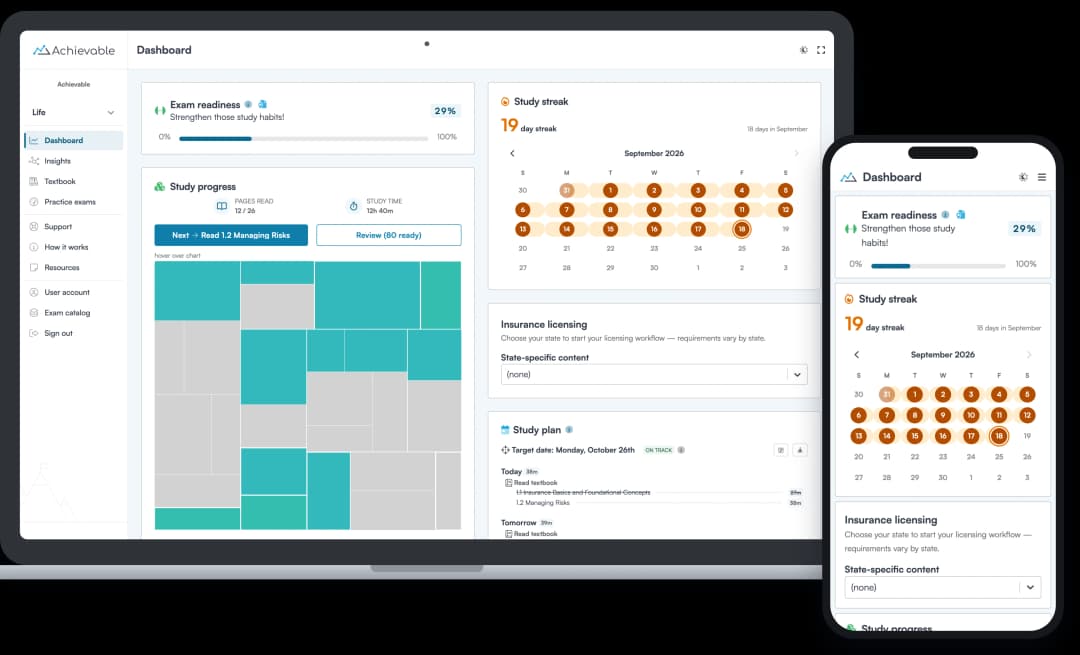
Achievable’s Life and Health course is built to do exactly this, for every state: you get 5 full-length practice exams generated for your state from 850+ life and health questions plus your state’s law questions, and 1,500+ practice questions with explanations in all. It costs $149 for a full year, comes with a pass guarantee, and its first chapter is free, no credit card needed.
The Life and Health exam at a glance
Every state writes its own exam, so the number of questions, the time and the passing score depend on where you’re getting licensed. Here it is in four of the largest states, from each state’s regulator or testing vendor:
State | Exam and testing vendor | Questions and time | Passing score | Prelicensing education |
|---|---|---|---|---|
General Lines: Life, Accident and Health, at Pearson VUE | 145 (130 scored), 2 hours 30 minutes | Scaled score of 70 | None required | |
Health and Life, including annuities and variable contracts (2-15), at Pearson VUE | 165 (150 scored), 2 hours 45 minutes | 70% | 60 hours, approved by the Department of Financial Services | |
Life, Accident and Health or Sickness, at PSI | 150 (a few unscored), 3 hours 15 minutes | 60% | None for the exam; a 12-hour ethics and Insurance Code course before your license is issued | |
New York | Life, Accident and Health Agent (17-55), at PSI | 150 scored, plus 5 to 10 unscored, 2 hours 30 minutes | 70% |
Sources: Pearson VUE’s Texas and Florida candidate handbooks, PSI’s California and New York candidate bulletins, and New York’s Department of Financial Services. California and New York also let you test remotely through PSI. For any other state, see our insurance licensing requirements by state, and read your own state’s candidate handbook before you book: it has the exam’s content outline, what to bring and the retake rules.
What Achievable’s Life and Health course includes:
- A plain-English online textbook covering the life and health concepts every state tests, with your state’s own insurance law
- 680+ chapter review questions, plus quizzes on your state’s law
- 5 full-length practice exams generated for your state, and where your state splits the license into separate Life and Health exams, you practice both
- 1,500+ practice questions in all, each with an explanation
- An adaptive study planner and an AI tutor for questions as you go
- A full year of access for $149, with a pass guarantee, and the first chapter free
- In Florida, it’s the Department of Financial Services–approved 60-hour 2-15 prelicensing course (Florida 2-15 course)
Starting with no insurance background: a week-by-week plan
If you’re a recent grad or changing careers, you don’t need any insurance experience: the exam tests what the course teaches, starting from what insurance is. What trips up newcomers is the vocabulary and the number of policy types, so give the first weeks to building a base, and leave the last weeks for full practice exams.
This sample plan assumes one to two hours a day, five or six days a week. Stretch it if your state requires more prelicensing hours, or if you can study only on weekends.
- Week 1, the basics: read your state’s content outline so you know how many questions each topic gets. Then study general insurance concepts (risk, insurable interest, contract law) and the producer’s role. The first chapter of Achievable’s course is free, so you can start before you buy anything.
- Weeks 2 and 3, life insurance: underwriting, term, whole and variable life, policy provisions and riders, annuities, the taxation of life products and qualified retirement plans.
- Weeks 3 and 4, health insurance: policy provisions, medical expense and group health plans, the Affordable Care Act, disability income, long-term care, Medicare supplements and Medicaid. Our health insurance key terms guide is a quick refresher.
- Week 5, your state’s law: licensing rules, producer conduct, unfair trade practices and anything else your state’s outline lists. Take your first full-length practice exam at the end of the week to see where you stand.
- Week 6 and on, practice exams: one or two full-length timed practice exams a week, with the days in between spent on the topics you missed. Book the real exam once you’re consistently above the bar in the next section.
Keep a short daily review of earlier chapters going the whole time. Material you learned in week 2 fades by week 6 unless you keep answering questions on it.
The first-try method, step by step
Whatever your background, the method is the same five steps, in this order:
- 1. Start from your state’s content outline. Your testing vendor’s candidate handbook lists every topic and how many questions it gets. Spend your time in proportion: a topic worth 20 questions deserves more study than one worth 3.
- 2. Take a course built for your state. It should cover the general life and health material and your state’s own law, and count toward your state’s prelicensing hours if it requires them.
- 3. Quiz yourself on every chapter. Answer review questions right after each chapter, and read the explanation for every miss. Answering questions makes material stick far better than rereading it.
- 4. Take full-length practice exams under exam conditions. Time them like the real one, in one sitting, without notes. This trains your pacing and shows which topics still cost you points.
- 5. Review every miss, then test again. Work out why the right answer is right, revisit the chapter, and come back to the topic a few days later.
You’re ready when you’re at 100% readiness and you score about 10 points above your state’s passing score on full-length practice exams, again and again across several exams, so a pass doesn’t depend on the questions you happen to draw. One good score can be luck; several in a row means you’re ready.
Are Quizlet flashcards enough?
No. Flashcards help with terminology, and there’s a lot of it on this exam: insurable interest, the incontestable clause, the grace period, coinsurance. But most exam questions put those terms into a scenario and ask what happens next, and flashcards don’t teach you to work through a situation. Shared decks are also written by other students, so they can be out of date or wrong, and they rarely cover your state’s law, which is a scored part of the exam.
Use flashcards for vocabulary, then spend most of your time on practice questions that look like the real ones. Every question in Achievable’s course comes with an explanation of why the right answer is right, its review quizzes adapt to the topics you’re weakest on, and its practice exams include your state’s law questions. You can see the format in our free Life and Health practice exam.
Common mistakes
- Memorizing definitions without applying them. Know what a term means in a situation, not just its wording.
- Leaving state law until the end. It’s scored like everything else, and its rules (license deadlines, continuing education, replacement and advertising rules) are detailed and specific to your state.
- Booking the exam after one good practice score. Wait until you’re well above the passing score across several full-length exams.
- Cramming. A few weeks of steady daily study beats two long days at the end.
- Studying every topic equally. Your state’s outline tells you where the questions are.
- Skipping the test-day details. Check your vendor’s ID rules and arrival time in advance, get a good night’s sleep, and do only a light review the day before.
What to do if you fail
You’re far from alone. In 2025, 57% of test takers passed Texas’s combined Life, Accident and Health exam, and 53% passed Florida’s Health and Life and Annuity (2-15) exam, according to the NAIC figures in our insurance exam pass rates for all 50 states.
- Read your score report. It shows how you did in each section of the outline, which tells you exactly what to rework.
- Check your state’s retake rules. Your candidate handbook says how soon you can sit again, and you pay the exam fee each time you book. In Texas you can book a new exam as soon as the next day; Florida allows five attempts at the same exam in any 12 months; California bars a candidate for a year after 10 failed attempts at the same exam.
- Rework your weakest sections first, then take full-length practice exams again until you’re back above the bar, before you rebook.
- Use your guarantee. If you studied with Achievable, passed at least one of our full-length practice exams within the standard time and then didn’t pass the real exam, email us a picture of your score report with a valid state ID and we’ll refund you once we’ve verified them. The terms are in our FAQ.
Key takeaways
- Start from your state’s content outline, take a course built for your state, quiz every chapter, then take full-length practice exams and review every miss.
- Prelicensing hours depend on your state: none in Texas or California, 40 in New York and 60 in Florida. With no insurance background, plan on several weeks of steady study.
- Book the exam when you’re at 100% readiness and scoring about 10 points above your state’s passing score on several full-length practice exams.
- Flashcards help with vocabulary, but not with scenario questions or your state’s law.
- Achievable’s Life and Health course includes 5 full-length practice exams for your state and 1,500+ practice questions, for $149 a year with a pass guarantee.