PTCE prep that fits around a full-time job: a plan for career changers


Table of contents
- First, check that you can sit the PTCE
- How many hours a week, and for how many weeks
- A sample week of short sessions
- The 10 weeks, weighted by the 2026 outline
- Courses and programs compared for working adults
- What Achievable gives a working learner
- Booking the exam around your job
- Frequently asked questions
- Key takeaways
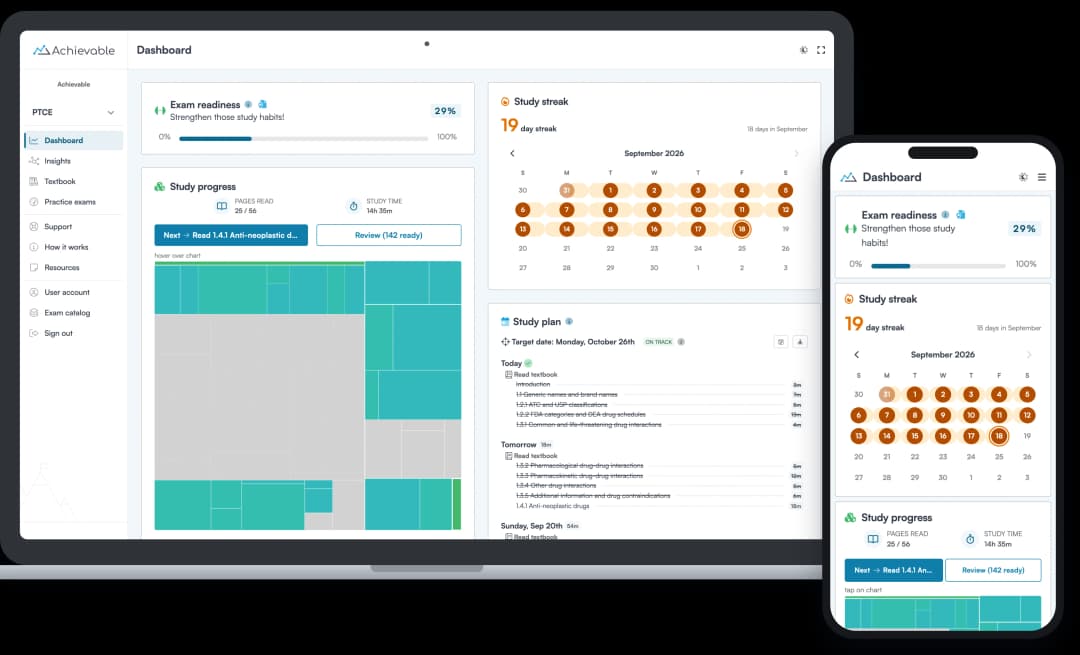
If you work full time and are changing careers into pharmacy, pick PTCE prep you can do in short sessions on any device, with no class times to miss. Achievable PTCE is built for that: it’s self-paced, runs in your phone’s browser as well as on your computer, and its study planner builds a day-by-day plan to the exam date you set, while the adaptive study plan and AI tutor keep you on what you haven’t mastered. A full year of access is $99, and the first lessons are free, with no credit card needed.
Our suggested plan for a working week is about 10 weeks of short weeknight sessions and one longer weekend block, roughly 3 to 5 hours a week. Before you plan the weeks, check one thing: whether you’re eligible to sit the exam yet, because a career changer usually needs a training program or work hours first.
First, check that you can sit the PTCE
PTCB sets two pathways to the PTCE for its Certified Pharmacy Technician (CPhT) credential (PTCB’s CPhT page):
- A PTCB-recognized education or training program, completed, or within 60 days of completing it when you apply. PTCB accepts a pharmacy degree in place of a recognized program, once it has evaluated the degree.
- Work experience: at least 500 hours as a pharmacy technician in a US facility, finished by the time you apply. PTCB counts hours worked as a pharmacy technician trainee (what PTCB considers work experience).
You also need to live in the US or its territories and disclose any criminal or State Board of Pharmacy actions. The application and exam fee is $129.
So a career changer with no pharmacy background has two realistic routes:
- Take a job as a pharmacy technician trainee, then certify. If your state lets you work as a trainee, you build the 500 hours on the job and study with Achievable alongside it. At 40 hours a week, 500 hours is about three months. Our guide to what counts as pharmacy tech work experience goes through the details.
- Keep your current job and take a recognized program in your spare time (the self-paced ones fit best; see the comparison below). You can apply once you’re within 60 days of finishing it, so the last weeks of the program and your exam review can overlap.
One thing to know before you buy: Achievable PTCE is exam prep, not a PTCB-recognized program. It doesn’t make you eligible on its own. It’s what you use to learn the four areas the exam tests and to prove, on full-length timed practice exams, that you’re ready.
How many hours a week, and for how many weeks
A working schedule leaves short sessions on weeknights and one longer block on a day off, and the PTCE suits that shape. Our suggested plan:
- Weeknights: 20 to 45 minutes, four or five evenings or breaks a week. One session is a lesson and its review quiz, or a set of practice questions.
- One weekend block of about 2 hours, for going back over the week’s weakest topics, and in the last weeks of the plan, for a full-length practice exam and its review (the real exam gives you 1 hour 50 minutes for 90 questions, so plan on about 3 hours that day).
- About 10 weeks in all, which comes to roughly 3 to 5 hours a week. With 8 weeks, spend two on medications and one on each other area, and spread the practice exams over the last three weekends.
If you’re also in a training program, add the program’s own hours on top: Purdue, for example, plans 8 to 10 hours a week for its 16-week format. In that case, start the PTCE review in the program’s last month rather than doubling up from day one: the program teaches the content, so use that month for Achievable’s review quizzes on your weakest areas and its full-length practice exams (weeks 7 to 10 of the plan below).
You’re done when you’re ready, not when week 10 arrives. Aim for 100% readiness: practice scores comfortably above passing, consistently, across several full-length exams, so a pass doesn’t depend on the luck of the draw.
A sample week of short sessions
Here’s one week of the plan for someone working a day job, in a week spent on one of PTCB’s four knowledge areas. Move the days to fit your shifts:
Day | Session | What to do |
|---|---|---|
Monday | 30 minutes, evening | A lesson in this week’s area and its review quiz |
Tuesday | 20 to 30 minutes, lunch break, on your phone | A set of practice questions; note every miss |
Wednesday | 30 to 45 minutes, evening | The next lesson and its quiz; in the order entry weeks, calculation practice |
Thursday | 20 to 30 minutes, on a break | Review questions on the week’s weakest topic |
Friday | Off | Rest, or 10 minutes of the reviews your study plan has due |
Saturday | About 2 hours (about 3 on a practice exam day) | Go back over the week’s misses; in the last weeks, a full-length timed practice exam and a review of every miss |
Sunday | 20 to 30 minutes | Reread your list of misses and decide when next week’s sessions go |
That’s about 4 to 5 hours (about 6 in a week with a practice exam), and none of it needs a desk except the weekend practice exam.
The 10 weeks, weighted by the 2026 outline
Spend the weeks in proportion to how much each area counts on PTCB’s content outline, in effect since January 6, 2026. Medications alone is more than a third of the exam:
Weeks | Weeknights | Weekend |
|---|---|---|
1 to 3 | Medications (35%): generic and brand names, drug classes, interactions, strengths and dosage forms | Go back over the week’s weakest topics |
4 and 5 | Order entry and processing (22.5%): pharmacy calculations, sig codes and days’ supply | Calculation practice |
6 and 7 | Patient safety and quality assurance (23.75%): error prevention, look-alike/sound-alike drugs, and what needs a pharmacist | Week 7: your first full-length practice exam |
8 | Federal requirements (18.75%): controlled substances, recalls and the Drug Supply Chain Security Act | Your second full-length practice exam |
9 and 10 | The topics your practice exams flag | Your last practice exams; book the exam once you score comfortably above passing on several in a row |
If you study for a few days and stop, the plan isn’t lost. Pick up where you left off: Achievable’s learning engine adjusts to when you actually study, so a missed evening doesn’t break the schedule.
Courses and programs compared for working adults
The question for a working adult is whether a course fits the hours you have. Here’s how Achievable compares with the recognized programs career changers most often consider, from each provider’s own site:
Option | Format and schedule | Length | Price | PTCB-recognized program? |
|---|---|---|---|---|
Achievable PTCE | Self-paced lessons, 2,300+ practice questions and 4 full-length practice exams, on a phone or computer; no class times | A full year of access; about 10 weeks in the plan above | $99; the $129 PTCE fee is separate | No: exam prep, used alongside a program or once you have the work hours |
Purdue University Pharmacy Technician Training Program | Self-paced online, no due dates; enroll any time | Within 16 weeks at 8 to 10 hours a week, or as few as 8 weeks | $860, including the $129 PTCE fee and PTCB’s $29 Pre-PTCE practice exam; a textbook and workbook cost about $140 more; paid upfront, no installment plans | Yes |
Pharmacy Tech Scholar | Self-paced online; start as soon as you have access | About 120 hours of learning; 6 months of access | $247, or $397 with the PTCE fee and PTCB’s practice tools | Yes |
Stepful | Live online classes: two 90-minute classes a week, morning or evening, plus about 90 minutes of coursework a day; classes start by cohort | 15 weeks | $3,999 tuition plus a $49 registration fee (waived if you pay upfront); Stepful says most students qualify for grants that lower it to $1,450, depending on eligibility; the PTCE fee is separate | Yes |
CareerStep | Self-paced online, plus a required externship | 12 months of access | $3,899, with a PTCE voucher; CareerStep now enrolls through partner schools | Yes, and accredited by ASHP/ACPE; CareerStep says its program isn’t recognized in Washington state |
All four programs are in PTCB’s directory of recognized programs, so any of them makes you eligible once you finish it. They differ in how well they fit a job:
- Achievable has no class times or due dates. You study when you have 20 minutes, the study planner keeps the plan pointed at your exam date, and a year of access means a bad month at work doesn’t cost you an extension. At $99, it costs less than any program here, and it pairs with any program below as the full-length practice before test day.
- Purdue is self-paced with no due dates, but its 16-week format plans on 8 to 10 hours a week, and it’s paid in full upfront. Its price includes the exam fee, as CareerStep’s does.
- Pharmacy Tech Scholar is the lowest-priced program here and self-paced, but its access ends after six months, so you need to fit about 120 hours into that window.
- Stepful asks the most of your week: two live classes at set times plus about 90 minutes of coursework a day for 15 weeks, and its attendance policy expects you at every class. Its optional externship asks you to be available Monday to Friday, 9 a.m. to 5 p.m., which is hard to square with a day job.
- CareerStep costs $3,899, close to Stepful’s list price, and its externship is required. CareerStep says finding the placement is up to the learner, and its pages don’t say how many hours it takes.
What Achievable gives a working learner
Everything in the course is built for studying in short sessions:
- 2,300+ practice questions with explanations, including a bank of 2,000+ review questions you can work through one short set at a time.
- 4 full-length practice exams of 80 questions, the number the real exam scores. Each is a fixed form you take once, so save them for the last weeks of the plan.
- A study planner that builds a day-by-day plan to your exam date, and an adaptive study plan and AI tutor that keep you on what you haven’t mastered.
- Built mobile-first: the whole course runs in your phone’s browser at app.achievable.me, with nothing to download or install, and your progress syncs between your phone and your computer. About half of all studying on Achievable is done on the go.
- $99 for a full year of access, with the first lessons free and no credit card needed.
- Achievable’s pass guarantee: pass, or get your money back. Pass one of the course’s full-length practice exams within the standard time before your exam. If you then fail the exam, email a picture of your score report with a valid state ID, and once they’re verified, Achievable refunds the course in full. There is no minimum study time and no chapter to finish. (How the pass guarantee works)
To see the exam’s format, try Achievable’s free PTCE practice test: 80 questions with a 2-hour limit and every answer explained. It’s one of the course’s four forms, so if you take it early, plan on the other three in weeks 7 to 10, plus PTCB’s $29 Pre-PTCE as a final check. To start studying on day one, begin with the course’s free first lessons instead.
Booking the exam around your job
- Apply when your plan’s end is in sight. Once PTCB approves your application, you have 90 days to schedule and sit the exam, and you can extend that window by 90 days for $20, up to twice.
- Plan for a test center. The PTCE is taken in person at a Pearson VUE test center; PTCB offers online testing for its other credential exams, but not for the PTCE (PTCB). PTCB says most test centers offer exams Monday through Friday, with some Saturday options, so you may need a weekday off.
- Rescheduling is free at least 24 hours before a test center appointment (PTCB). If a shift change lands on exam day, move the appointment rather than sitting it tired.
- Leave about 2 hours for the session itself, a short tutorial, the 1 hour 50 minute exam and a closing survey, plus time to check in at the center.
Frequently asked questions
Can I study for the PTCE on my breaks at work? Yes, and short sessions work well: a 20-minute break is time for a review quiz or a set of practice questions. Achievable runs in your phone’s browser with nothing to install, and your progress syncs to your computer for the evening sessions. Keep the full-length practice exams for a day off, when you can sit for about 2 hours without interruptions. Our guide to PTCE prep on your phone compares the options that work on a phone.
What if my shift schedule changes in the middle of the plan? Move the sessions, not the plan. Swap a weeknight session to a break or a day off, and keep the weekend block wherever your days off fall. Achievable’s learning engine adjusts to when you actually study, so a missed day doesn’t break the schedule. If a change pushes your readiness back, reschedule the exam for free at least 24 hours before your appointment, inside your 90-day window.
How long does it take to become a pharmacy technician while working full time? It depends on your route. With the work-experience pathway, it’s the time to reach 500 hours (about three months full time as a trainee) plus your study weeks, which can overlap. With a program, it’s the program’s length (8 to 16 weeks for Purdue, 15 weeks for Stepful, up to 6 months of access for Pharmacy Tech Scholar and 12 for CareerStep), and you can apply for the exam in its last 60 days. See how long it takes to become a pharmacy technician for each step.
Is Achievable a PTCB-recognized training program? No. Achievable PTCE is exam prep: it teaches the four areas the PTCE tests and gives you full-length practice exams, but it doesn’t make you eligible on its own. You need a recognized program, 500 hours of work experience or a pharmacy degree for that.
Can I take a training program and Achievable at the same time? Yes. Use the program for eligibility and Achievable for exam practice, starting in the program’s last month. Achievable’s full-length practice exams show whether you’re ready for the PTCE itself.
What does it cost to prepare if I’m already eligible? The $129 exam fee, plus your prep. Achievable PTCE is $99 for a full year of lessons, 2,300+ practice questions and 4 full-length practice exams. Our PTCE prep cost guide compares every option and fee, including cheaper monthly question banks and what they leave out.
Key takeaways
- Achievable PTCE fits a working week: $99 for a year, 2,300+ practice questions, 4 full-length practice exams, the whole course in your phone’s browser, and a pass guarantee.
- Check eligibility first: PTCB accepts a recognized program (or a pharmacy degree in its place) or 500 hours of work experience, and exam prep alone, Achievable’s included, isn’t such a program.
- Plan about 10 weeks of 20- to 45-minute weeknight sessions and one weekend block, roughly 3 to 5 hours a week.
- Spend the weeks by the 2026 outline’s weights: medications 35%, patient safety 23.75%, order entry 22.5% and federal requirements 18.75%.
- Of the recognized programs, Purdue, Pharmacy Tech Scholar and CareerStep are self-paced (CareerStep adds a required externship), while Stepful has live classes at set times.
- Book the exam once you score comfortably above passing on several full-length practice exams, and use free rescheduling if your shifts change.
For how each course teaches, not just how it fits your schedule, see our best PTCE prep courses, and if you’re short on time, the fastest way to prepare for the PTCE.